
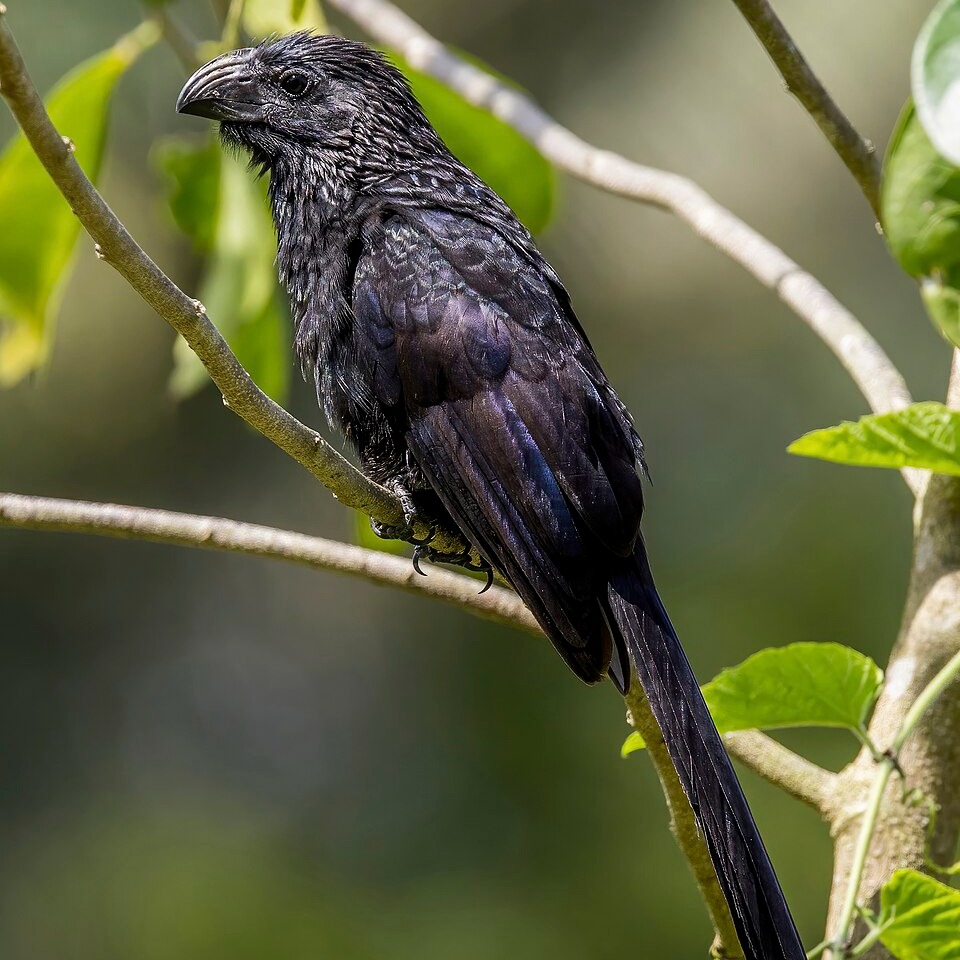
Crotophaga sulcirostris
Groove-billed Ani
Swainson, 1827
Added by
Anonymous Curator
Reviewed by
Under Review
Last modified by
Julia Trouin
TaxonomyBiological classification ranks placing this species within the tree of life, from Kingdom down to Genus.
Ecology & StatusHow this species lives: habitat preferences, diet, behavior, population status, and role in its ecosystem.
OriginWhether the species is native (evolved here), endemic (found only here), or introduced by human activity.
Native
Population TrendDirection of change in population size over time: increasing, stable, decreasing, or unknown.
Stable
Breeding SeasonTime of year when this species typically reproduces or flowers.
Wet Season
Trophic RolePosition in the food chain: producer, herbivore, carnivore, omnivore, decomposer, or parasite.
Insectivore
Recent SightingsWhether this species has been observed in the wild in Costa Rica within recent years.
Yes
Habitat SummaryOverview of the specific ecosystems and environments where this species is found in Costa Rica. Multi-lang
It is a bird of open spaces that has benefited greatly from deforestation and agriculture. It avoids dense forests and prefers savannas, cattle pastures, agricultural fields, thorny scrublands, roadsides, and suburban areas. It requires some isolated shrubs or trees for nesting and roosting. In Costa Rica, it is a highly common and noisy bird in the dry lowlands of Guanacaste and the Central Valley, tolerating very warm climates.BehaviourDaily activity patterns, movement, territory use, foraging style, and seasonal behavioral changes. Multi-lang
Highly gregarious, diurnal birds, living in cohesive flocks of 5 to 15 individuals. Their flight appears inefficient, alternating rapid wingbeats with unsteady glides where their long tail seems to unbalance them. They spend the day walking on the ground in search of insects and communicate constantly with harsh, whining whistles that sound like a drawn-out 'teee-hooo!'. At dusk, the entire flock huddles tightly together in dense branches to sleep.Social ActivitySocial structure: whether the species is solitary, paired, or colonial; hierarchy and communication. Multi-lang
Extremely social year-round. They maintain close-knit family groups that forage, roost, allopreen, and nest together. The group cooperatively defends its territory against other flocks of anis.Feeding GuildWhat the species eats, how it forages or hunts, and its role as a consumer in the food web. Multi-lang
Insectivore / Ground and commensal forager.Trophic Chain DetailsSpecific interactions in local food webs: prey species, predators, competitors, and scavengers. Multi-lang
Opportunistic omnivore with a strong insectivorous preference. Its diet is based on grasshoppers, beetles, bugs, and spiders, but they also catch small lizards and eat berries or seeds if insects are scarce. Adults can be prey for falcons and savanna hawks. Their communal nests are frequently attacked by snakes, white-faced capuchins, and opossums.Reproductive BehaviourMating strategies, courtship displays, nesting or spawning behavior, and parental care. Multi-lang
They have a cooperative breeding reproductive system. A flock (1 to 4 monogamous pairs) builds a single, bulky open-cup nest of thorny sticks and twigs, lined with green leaves, in the fork of a tree. Multiple females lay their white eggs in this same nest, resulting in clutches that can exceed 15 eggs. All group members (males, females, and young from previous broods) take turns incubating the eggs for 13-15 days and cooperate intensely to feed and defend the altricial chicks. The chicks leave the nest very quickly, in just 10 days, climbing through the surrounding branches.Physical Measures
Length (cm)
30.0 - 34.0 cm
Weight (Grams)
70 g - 90 g
Lifespan
Sexual MaturityAge at which the individual becomes capable of reproducing for the first time.
12 - 24 Months
Gestation / IncubationDuration from fertilization to birth (mammals) or to hatching (egg-laying species).
13 - 15