
Costa Rica Species
Mustela frenata
AnimaliaHighest rank in taxonomy. Groups all life into domains: Animalia, Plantae, Fungi, etc.IUCN LCInternational Union for Conservation of Nature — the world authority on species extinction risk, using standardized criteria. — Least Concern — widespread and abundant; not at immediate risk of extinction.In ProgressCurrent stage of this record in the editorial review workflow. Recent Sighting

Mustela frenata

Long-tailed Weasel

Lichtenstein, 1831

Detailed Texts Multi-lang
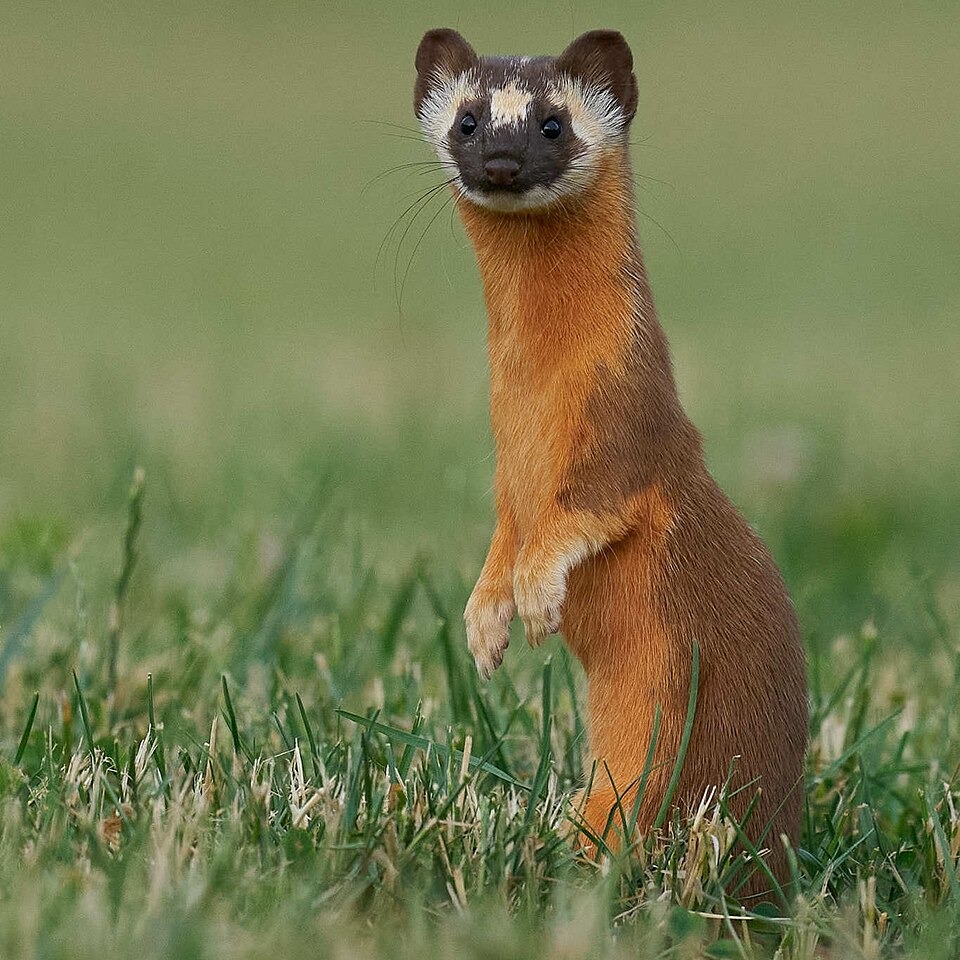
The long-tailed weasel (Mustela frenata) is the smallest carnivore in Costa Rica, but also one of the fiercest and most relentless. It has an unusually long, slender, tubular body supported by very short legs, a long neck, and a small, flattened head. Its dorsal fur is cinnamon brown to reddish-brown, while its belly, throat, and lower neck are bright yellow or cream. Central American populations are distinguished by a striking white or yellowish facial 'mask' crossing the forehead, flanked by dark patches. Its long tail, which nearly equals its body length, ends in an unmistakable black tip. It is a hyperactive predator with extremely acute senses, capable of hunting prey several times its own size.

Added by

Anonymous Curator

Reviewed by

Under Review

Last modified by

Julia Trouin

TaxonomyBiological classification ranks placing this species within the tree of life, from Kingdom down to Genus.

PhylumRank below Kingdom. Groups organisms sharing a fundamental body plan (e.g., Chordata = vertebrates and some invertebrates).Chordata
ClassRank below Phylum. Subdivides by structural traits (e.g., Mammalia, Aves, Reptilia, Insecta).Mammalia
OrderRank below Class. Groups related families sharing common ancestry (e.g., Carnivora, Primates).Carnivora
FamilyRank below Order. Groups closely related genera (e.g., Felidae = cats, Canidae = dogs).Mustelidae
GenusRank just above Species. The first word in the two-part binomial scientific name.Mustela
Taxonomic AuthorityThe scientist who first formally described and published this species, followed by the year of publication.Lichtenstein, 1831
Record Completeness
85%
Coming soon

Ecology & StatusHow this species lives: habitat preferences, diet, behavior, population status, and role in its ecosystem.

OriginWhether the species is native (evolved here), endemic (found only here), or introduced by human activity.

Native

Population TrendDirection of change in population size over time: increasing, stable, decreasing, or unknown.

Stable

Breeding SeasonTime of year when this species typically reproduces or flowers.

Year Round

Trophic RolePosition in the food chain: producer, herbivore, carnivore, omnivore, decomposer, or parasite.

Carnivore

Recent SightingsWhether this species has been observed in the wild in Costa Rica within recent years.

Yes

Habitat SummaryOverview of the specific ecosystems and environments where this species is found in Costa Rica. Multi-lang

It is a tremendously adaptable animal that inhabits an enormous variety of ecosystems, including wet rainforests, dry forests, scrublands, pastures, and agricultural areas. It tolerates human presence very well and is frequently found near farms, stone walls, and barns where rodents abound. In Costa Rica, it can be found from sea level up to the cold paramos and oak forests of Cerro de la Muerte (over 3,000 meters above sea level).

BehaviourDaily activity patterns, movement, territory use, foraging style, and seasonal behavioral changes. Multi-lang

It is an astonishingly fast, curious, and bold animal, active both day and night. It moves via quick bounds, stopping frequently to stand upright on its hind legs and scan the horizon. It hunts primarily by smell and hearing. Its killing method is precise: it delivers a lightning-fast bite to the base of the skull or the back of the prey's neck, severing the spinal cord. Despite its size, it does not hesitate to confront venomous snakes, rabbits, or iguanas that vastly exceed it in size.

Social ActivitySocial structure: whether the species is solitary, paired, or colonial; hierarchy and communication. Multi-lang

It is a strictly solitary and strongly territorial animal. Males and females only tolerate each other during the brief mating season. They demarcate their vast territories using scent marks from their anal glands.

Feeding GuildWhat the species eats, how it forages or hunts, and its role as a consumer in the food web. Multi-lang

Carnivore.

Trophic Chain DetailsSpecific interactions in local food webs: prey species, predators, competitors, and scavengers. Multi-lang

Strict carnivore mesopredator. Plays a vital role in controlling populations of mice, field rats, and pocket gophers. It is preyed upon by birds of prey (hawks, owls), foxes, coyotes, domestic cats, and large snakes.

Reproductive BehaviourMating strategies, courtship displays, nesting or spawning behavior, and parental care. Multi-lang

In many parts of its range, it exhibits 'delayed implantation': the fertilized egg partially develops and then halts for months before attaching to the uterus. Although active gestation lasts only 27 days, the total pregnancy can last up to 280 days (this phenomenon is less pronounced in the humid tropics). The female prepares an underground nest, lined with fur and feathers from her prey, where she gives birth to 3 to 8 blind, deaf pups. The male does not participate in rearing.

Physical Measures

Length (cm)

30.0 - 55.0 cm

Weight (Grams)

100 g - 500 g

Offspring per cycleTypical number of young (live births, eggs, or seeds) produced by one adult in a single reproductive event or breeding season.3 - 8
Sexual DimorphismObservable physical differences between males and females of the same species (e.g., size, coloration, features).Yes

Lifespan

Sexual MaturityAge at which the individual becomes capable of reproducing for the first time.

3 - 12 Months

Gestation / IncubationDuration from fertilization to birth (mammals) or to hatching (egg-laying species).

27 - 280

Lifespan EstimatedExpected duration of life from birth to natural death under wild conditions.
Males3 - 5 Years
Females3 - 5 Years

Sexual DimorphismPhysical differences in size, coloration, or morphology between males and females of this species.

Males Multi-lang

Males are significantly larger and more robust, potentially weighing twice as much as a small female.

Females Multi-lang

Much smaller and lighter, allowing them to access even narrower rodent burrows.

Evolutionary AdaptationsInherited traits and behaviors that improve the species' survival and reproduction in its specific environment. Multi-lang

Cylindrical Morphology (Underground Hunter): Its long, thin, flexible body, combined with short legs, has evolved specifically to allow it to chase mice and pocket gophers directly into their own underground burrows, leaving them no escape.
Hyperactive Metabolism: Because of its large body surface area relative to its mass, it loses heat very quickly. To compensate, it possesses one of the highest metabolisms among mammals, forcing it to hunt and consume up to 40% of its body weight every day.

Main ThreatsDocumented pressures reducing the population: habitat loss, hunting, disease, climate change, and invasive species. Multi-lang

Secondary Poisoning: The intensive use of rodenticides (rat poisons) in agricultural and peri-urban areas is lethal to the weasel, as it dies after consuming rodents that have ingested the poison.
Human Conflict (Poultry Predation): They are frequently hunted with machetes, trapped, or shot by farmers due to their reputation (often justified) of entering chicken coops and killing poultry.

Interesting FactsSurprising or notable facts that highlight what makes this species unique or ecologically important. Multi-lang

Weasel War Dance: When confronting difficult prey (like rabbits or large birds), the weasel often performs a strange and frantic 'war dance', executing acrobatic leaps, arching its back, and moving side to side. This confuses, distracts, or hypnotizes the prey long enough for the weasel to deliver its lethal bite to the back of the neck.
Cold-blooded Killer: Its hunting instinct is so powerful that, if it enters an area with many cornered prey (like a chicken coop), it will kill as many as it can, even if it can only eat one. It does not do this out of 'malice', but out of a strong evolutionary instinct to kill any available prey for caching food.