
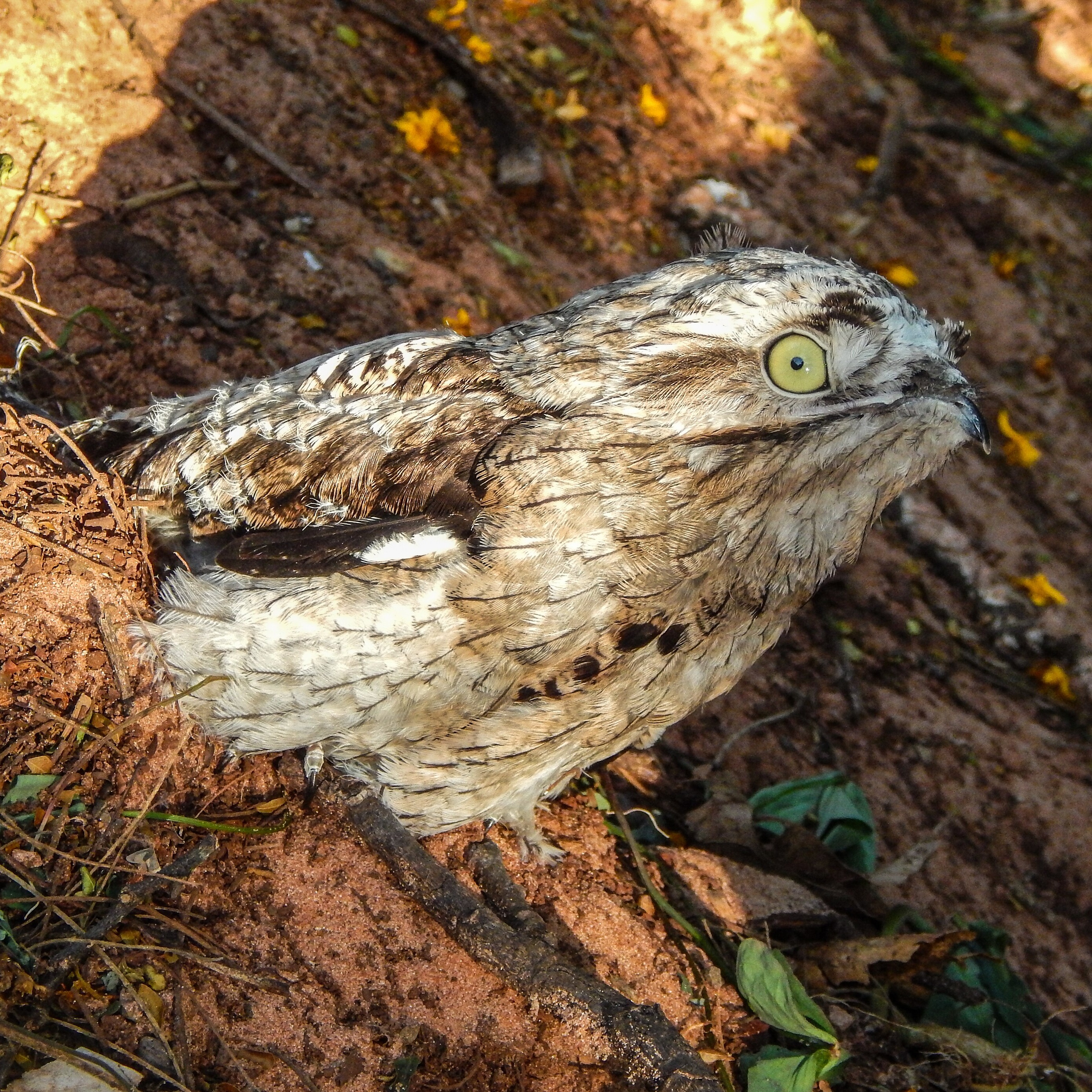
Nyctibius griseus
Common Potoo
(Gmelin, 1789)
Added by
Anonymous Curator
Reviewed by
Under Review
Last modified by
Julia Trouin
TaxonomyBiological classification ranks placing this species within the tree of life, from Kingdom down to Genus.
Ecology & StatusHow this species lives: habitat preferences, diet, behavior, population status, and role in its ecosystem.
OriginWhether the species is native (evolved here), endemic (found only here), or introduced by human activity.
Native
Population TrendDirection of change in population size over time: increasing, stable, decreasing, or unknown.
Stable
Breeding SeasonTime of year when this species typically reproduces or flowers.
Dry Season
Trophic RolePosition in the food chain: producer, herbivore, carnivore, omnivore, decomposer, or parasite.
Insectivore
Recent SightingsWhether this species has been observed in the wild in Costa Rica within recent years.
Yes
Habitat SummaryOverview of the specific ecosystems and environments where this species is found in Costa Rica. Multi-lang
It avoids dense, dark continuous forests, preferring semi-open environments. It inhabits forest edges, gallery forests, wooded savannas, clearings, plantations, and agricultural areas with remnant trees. It requires dead branches and bare stumps (snags) to roost and hunt. In Costa Rica, it is a widely distributed but hard-to-see bird, present on both the Pacific and Caribbean slopes, from sea level up to about 1,200 meters in elevation.BehaviourDaily activity patterns, movement, territory use, foraging style, and seasonal behavioral changes. Multi-lang
It is a strictly nocturnal and crepuscular bird. It spends the entire day completely motionless, paralyzed in its cryptic posture on a branch, trusting blindly in its camouflage (even if approached within inches). At dusk, it wakes up and adopts a more horizontal, owl-like posture. It uses a sallying hunting technique: it detects a flying insect, makes a short, silent, acrobatic flight from its perch to catch it, and returns to the exact same stump to wait again.Social ActivitySocial structure: whether the species is solitary, paired, or colonial; hierarchy and communication. Multi-lang
It is a strictly solitary bird, very rarely seen in pairs, except during the mating season or when there is a chick in the nest. They disperse over large territories to avoid competition.Feeding GuildWhat the species eats, how it forages or hunts, and its role as a consumer in the food web. Multi-lang
Nocturnal aerial insectivore (Sally hunter).Trophic Chain DetailsSpecific interactions in local food webs: prey species, predators, competitors, and scavengers. Multi-lang
Carnivore (Nocturnal aerial insectivore). Its diet consists almost exclusively of large flying insects: rhinoceros beetles, giant moths, true bugs, cicadas, and dung beetles. Adults have few predators due to their perfect camouflage, but white-faced capuchin monkeys, toucans, and forest hawks may devour the single egg or the chick if they manage to detect it.Reproductive BehaviourMating strategies, courtship displays, nesting or spawning behavior, and parental care. Multi-lang
They are seasonally monogamous, but they build no nest whatsoever. The female lays a single whitish egg with lilac spots directly on a small natural depression, crevice, or the broken end of a bare stump, balancing it precariously. Both the male (during the day) and the female (during the night) take turns incubating it by sitting on it in their stump posture for about 33 days. The chick is altricial but hatches covered in white down and quickly learns to adopt the broken branch posture of its parents to camouflage itself.Physical Measures
Length (cm)
33.0 - 38.0 cm
Weight (Grams)
145 g - 190 g
Lifespan
Sexual MaturityAge at which the individual becomes capable of reproducing for the first time.
12 - 24 Months
Gestation / IncubationDuration from fertilization to birth (mammals) or to hatching (egg-laying species).
33