
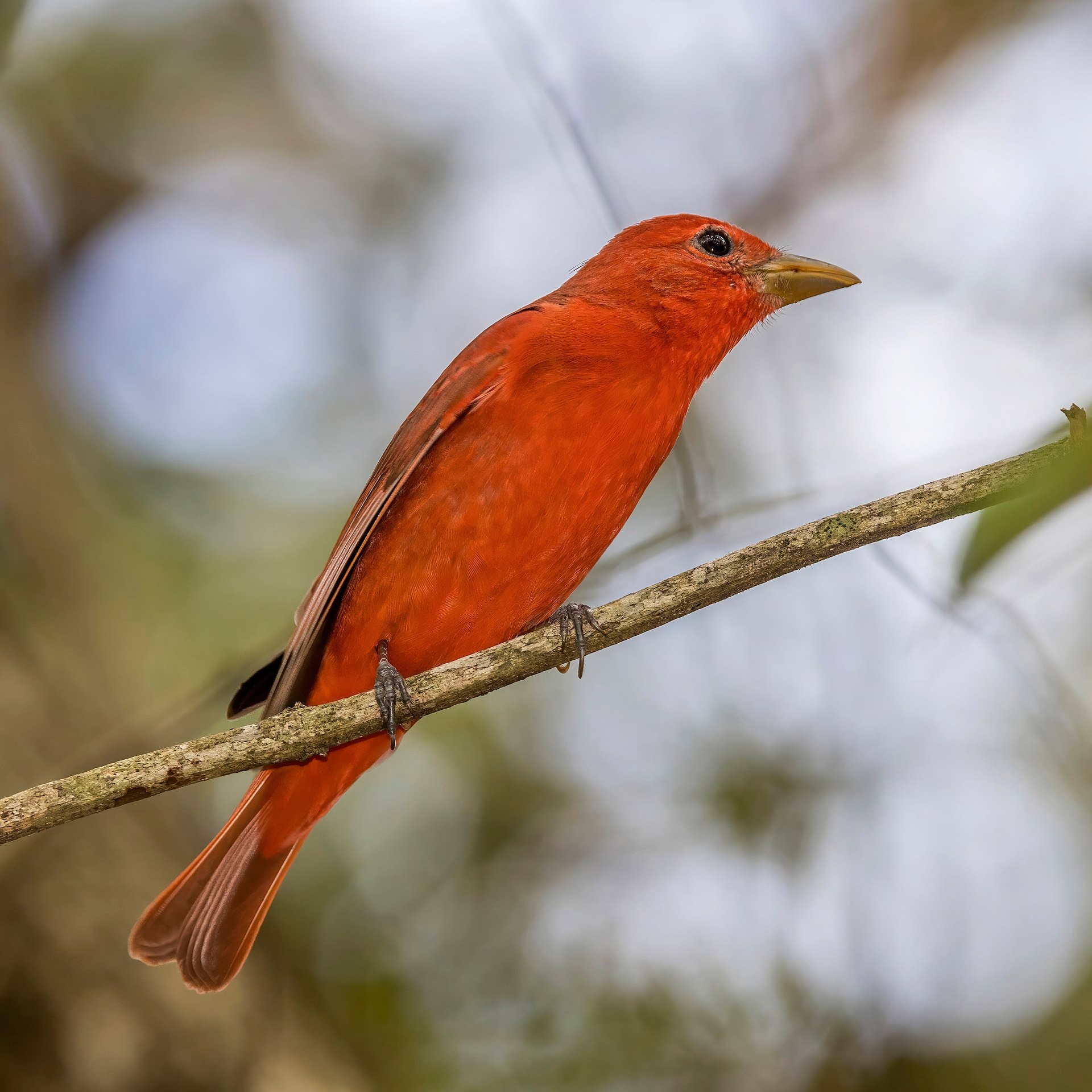
Piranga rubra
Summer Tanager
Linnaeus, 1758
Added by
Anonymous Curator
Reviewed by
Under Review
Last modified by
Julia Trouin
TaxonomyBiological classification ranks placing this species within the tree of life, from Kingdom down to Genus.
Ecology & StatusHow this species lives: habitat preferences, diet, behavior, population status, and role in its ecosystem.
OriginWhether the species is native (evolved here), endemic (found only here), or introduced by human activity.
--
Population TrendDirection of change in population size over time: increasing, stable, decreasing, or unknown.
Stable
Breeding SeasonTime of year when this species typically reproduces or flowers.
--
Trophic RolePosition in the food chain: producer, herbivore, carnivore, omnivore, decomposer, or parasite.
Insectivore
Recent SightingsWhether this species has been observed in the wild in Costa Rica within recent years.
Yes
Habitat SummaryOverview of the specific ecosystems and environments where this species is found in Costa Rica. Multi-lang
During the non-breeding season (autumn to northern spring), it inhabits a wide variety of Neotropical habitats including secondary forests, humid forest edges, dry forests, shaded coffee and cacao plantations, suburban gardens with scattered trees, and gallery forests, from sea level up to approximately 2,300 meters in altitude. In its North American breeding grounds, it prefers open deciduous forests, pine-oak woodlands, and riparian woodlands. It is a highly adaptable species that prefers the mid-to-upper strata of the forest canopy.BehaviourDaily activity patterns, movement, territory use, foraging style, and seasonal behavioral changes. Multi-lang
It is a diurnal and solitary bird outside the breeding season. In its wintering territories in the Neotropics, it maintains a markedly territorial and independent existence, actively defending specific trees rich in fruits or insects from other conspecifics. It moves in a leisurely and deliberate manner through thick foliage, scanning the surroundings from clear branches before launching into acrobatic aerial pursuits or briefly descending to pluck ripe berries.Social ActivitySocial structure: whether the species is solitary, paired, or colonial; hierarchy and communication. Multi-lang
It is a strictly solitary bird outside the breeding season and does not form conspecific flocks. However, during its winter stay in the Neotropics, it frequently associates peripherally with mixed-species canopy flocks led by local tanagers and wood-warblers, taking advantage of the collective alarm against terrestrial or aerial predators, though it maintains a prudent distance from other individuals.Feeding GuildWhat the species eats, how it forages or hunts, and its role as a consumer in the food web. Multi-lang
Highly specialized insectivore and frugivore. Its diet primarily consists of bees, wasps, hornets, beetles, flying ants, cicadas, and dragonflies captured through hovering or direct pursuits. It extensively supplements its diet in the Neotropics by consuming wild berries and fruits from trees of the Ficus, Cecropia, and Miconia genera.Trophic Chain DetailsSpecific interactions in local food webs: prey species, predators, competitors, and scavengers. Multi-lang
It functions primarily as a highly efficient secondary consumer in the forest canopy. It is a key predator of large flying insects, effectively controlling populations of wasps, bees, beetles, and caterpillars. By consuming a large volume of fleshy fruits and berries, it also acts as a primary consumer and seed dispersal agent for epiphytic plants and tropical shrubs. It falls prey to medium-sized raptors (such as hawks of the genus Accipiter), and its eggs are preyed upon by tree squirrels and toucans.Reproductive BehaviourMating strategies, courtship displays, nesting or spawning behavior, and parental care. Multi-lang
Breeding occurs strictly in North America during the northern summer. The nest is built almost entirely by the female and consists of a shallow, thin, and fragile-looking open cup made of dry grass stems, fine twigs, and tree bark, located between 3 and 10 meters high on an outer horizontal branch of a deciduous tree. She generally lays 3 to 4 eggs (rarely 5) of a pale greenish-blue color with abundant brown and gray spots concentrated at the wide end. Incubation lasts 11 to 12 days and is performed exclusively by the female, while the male occasionally feeds her at the nest. Both parents intensely feed the nestlings with crushed insects until they fledge at 13-15 days old.Physical Measures
Length (cm)
17.0 - 19.0 cm
Weight (Grams)
24 g - 32 g
Lifespan
Sexual MaturityAge at which the individual becomes capable of reproducing for the first time.
1 Years
Gestation / IncubationDuration from fertilization to birth (mammals) or to hatching (egg-laying species).
11 - 12