
PlantaeIUCN LCIn Progress Recent Sighting
Erythrina poeppigiana
Mountain Immortelle
(Walp.) O.F.Cook, 1901
Detailed Texts Multi-lang
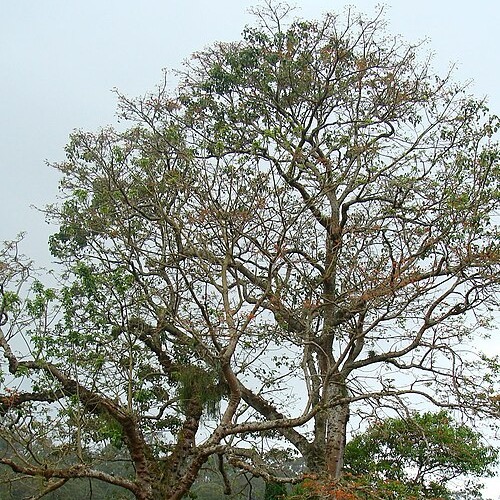
The Mountain Immortelle (Erythrina poeppigiana), locally known in Costa Rica as 'Poró gigante' or 'Poró extranjero', is a majestic, fast-growing deciduous tree belonging to the legume family (Fabaceae). Originally native to the Andean and Amazonian regions of South America, it was introduced to Central America in the 19th century and has since become an indelible part of Costa Rica's scenic and agricultural identity. It reaches up to 30 meters (100 feet) in height, with a thick, smooth-barked trunk that bears strong conical spines in its youth. Its most spectacular feature is its massive flowering. During the dry season, the tree completely sheds its leaves and its immense canopy is covered in a fiery mantle of bright orange flowers, creating a dazzling visual contrast across the hillsides. It is globally recognized for its foundational role in agroforestry, specifically used as a 'shade tree' in traditional coffee and cacao plantations. Although its wood is extremely soft and light, lacking commercial timber value, its true worth lies in its invaluable ecological services, beautifying the valleys while enriching the earth.
Added by
Anonymous Curator
Reviewed by
Under Review
Last modified by
Gerardo Venegas
Taxonomy
PhylumTracheophyta
ClassMagnoliopsida
OrderFabales
FamilyFabaceae
GenusErythrina
Taxonomic Authority(Walp.) O.F.Cook, 1901
Ecology & Status
Origin
Introduced
Population Trend
Stable
Growth Habit
--
Leaf Type
--
Flowering Season
--
Recent Sightings
Yes
Habitat Summary Multi-lang
It displays remarkable adaptability to diverse altitudinal and soil conditions, developing vigorously in humid tropical and premontane zones, preferably between 500 and 1,500 meters (1,600 to 5,000 feet) above sea level. It requires high levels of annual precipitation, although it demands a distinct dry season to synchronize its spectacular flowering. In Costa Rica, it forms the dominant canopy of the iconic coffee-growing valleys of the Central Valley, Naranjo, Turrialba, and Coto Brus. It is rarely found in undisturbed primary forests in Central America, being primarily an inhabitant of agricultural landscapes, roadsides, and shade-grown coffee farms (agroecosystems).Light & Water Needs Multi-lang
Information not available in English. Help us expand this record!Behaviour Multi-lang
The Mountain Immortelle is a true ecological synchronizer. The biology of this tree rules the calendar of the country's valleys. During the hottest, driest months of the year, the landscape suffers a shortage of flowers; it is at that exact moment that Erythrina poeppigiana enters an explosive, synchronous reproductive mode, dropping all its leaves and bursting into fire-colored flowers. This blooming not only creates an aesthetic impact in the canopy but acts as an immense nutritional rescue source for birds and animals during the harsh dry season. With the arrival of the first rains, the flowers fall like a red carpet on the agricultural soil, and the tree violently resprouts with a fresh green canopy, providing shade back to the coffee crop right when needed.Toxicity / Uses Multi-lang
Information not available in English. Help us expand this record!Physical Measures
Length (cm)
1500.0 - 3000.0 cm
Reproductive Structures
Flower Photos (Max 2)
No imageFruit Photos (Max 2)
No imageEvolutionary Adaptations Multi-lang
Biological nitrogen fixation: As a prominent member of the legumes, it possesses nodules on its roots that house symbiotic bacteria of the genus Rhizobium. These bacteria capture atmospheric nitrogen and convert it into usable forms for the plant. When the tree sheds its leaves or is pruned, this nitrogen is reincorporated into the soil, acting as a massive, free green fertilizer that revitalizes volcanic soils depleted by agriculture.
Strategic deciduousness (Shedding): To ensure its flowers are as visible as possible to pollinators and to conserve water during the driest months, the tree drops 100% of its foliage before flowering. This adaptation allows the immense canopy to become an orange visual beacon, free of foliar obstacles, facilitating rapid access for birds to the nectaries.
Ornithophilous floral morphology: Unlike bee-pollinated flowers, the flowers of the Mountain Immortelle are scimitar or sword-shaped, robust, orange/red in color, and scentless. Their corolla embraces a massive reservoir of sweet liquid nectar, evolutionarily tailored to the beaks of adapted passerine birds, forcing them to rub their heads or chests against the prominent stamens while drinking.
Main Threats Multi-lang
Replacement by sun-grown coffee: The primary threat to populations of this species is not timber logging (its wood is commercially useless), but rather the shifting agricultural paradigm. The replacement of traditional shade-grown coffee plantations with high-density coffee varieties tolerant of direct sun is eradicating vast hectares of Poró in Costa Rica.
Severe pollarding practices (Excessive pruning): In agriculture, Porós are subjected to drastic annual pollarding (chapeas) to prevent overshading and to use their branches as mulch. If this pruning is done abusively, it depletes the tree's energy reserves, encouraging infections by stem borer beetles and drastically reducing its capacity to flower.
Interesting Facts Multi-lang
It is the emblematic tree of Costa Rican coffee plantations and has its own verb. Its influence is so vast that in Costa Rica, the term 'chapear el poró' (pollarding the poró) or the concept of 'porotales' is used to refer to the cultural and agricultural activity of pruning these giant trees with a live machete. The orange mountainsides during March are a seasonal tourist attraction.
Its 'foreign' name distinguishes it from its cousins. Although it is the most imposing Erythrina species in Costa Rica, E. poeppigiana was imported from South America for agriculture. To differentiate it from the much smaller native species traditionally used for living fence posts (Erythrina berteroana), local farmers nicknamed it 'Poró extranjero' (foreign Poró).
It is capable of multiplying via immense clonal stakes. Because of the vitality of its tissues and adventitious roots, farmers propagate the Poró by planting branches as thick as a human arm directly into the bare soil. They take root with astonishing ease and in a short time grow to form a new, genetically identical tree.