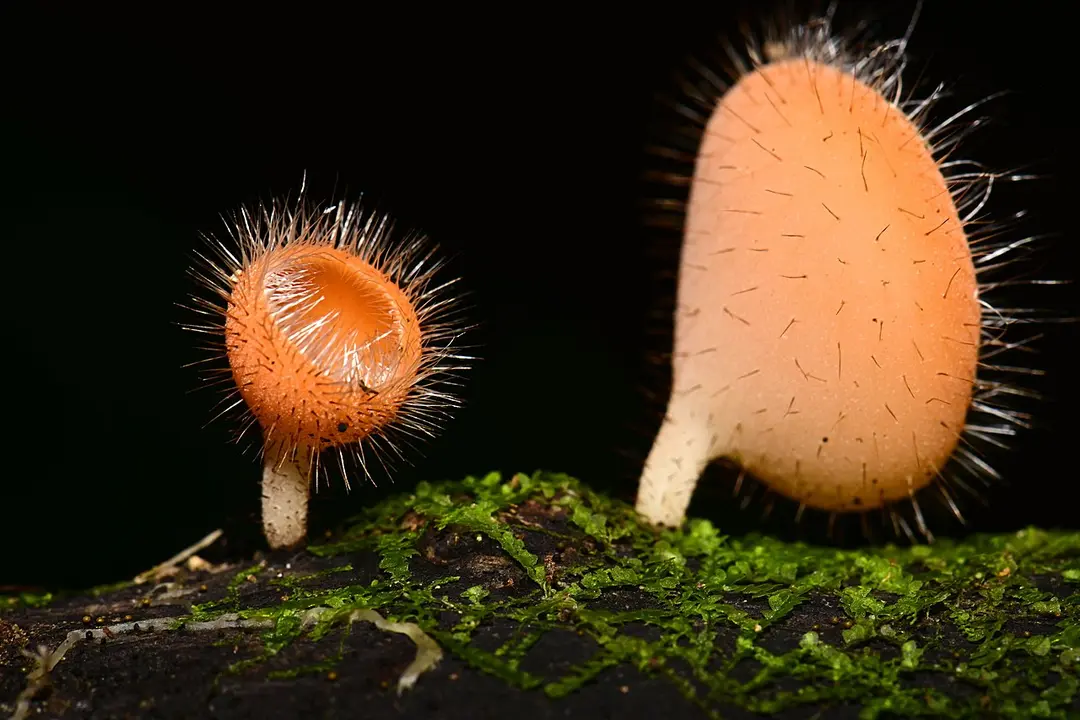
Cookeina tricholoma
Bristly Tropical Cup
(Alb. & Schwein.) Kuntze, 1891
Added by
Gerardo Venegas
Reviewed by
Under Review
Last modified by
Gerardo Venegas
Other Names (Global)Regional and multilingual names used for this species across different countries and languages.
 Pink Fringe Cup
 Copita peludaCopita peluda
TaxonomyBiological classification ranks placing this species within the tree of life, from Kingdom down to Genus.
Ecology & StatusHow this species lives: habitat preferences, diet, behavior, population status, and role in its ecosystem.
OriginWhether the species is native (evolved here), endemic (found only here), or introduced by human activity.
Native
Population TrendDirection of change in population size over time: increasing, stable, decreasing, or unknown.
Stable
Trophic RolePosition in the food chain: producer, herbivore, carnivore, omnivore, decomposer, or parasite.
Omnivore
EdibilityWhether this mushroom is edible, toxic, hallucinogenic, or of unknown safety. Never eat based solely on this data.
Inedible
Cap ShapeShape of the mushroom cap (pileus): convex, flat, umbonate, funnel-shaped, bell-shaped, etc.
Depressed
Hymenium TypeThe spore-bearing surface of a fungus: gills, pores, teeth, ridges, smooth, or wrinkled.
Smooth
Fruiting SeasonTime of year when this species typically reproduces or flowers.
Wet Season
Recent SightingsWhether this species has been observed in the wild in Costa Rica within recent years.
Yes
Habitat SummaryOverview of the specific ecosystems and environments where this species is found in Costa Rica. Multi-lang
Thrives in the dense, humid understory of lowland and premontane tropical rainforests across Costa Rica, where ambient moisture levels remain consistently high.SubstrateThe organic material or host organism this fungus colonizes and decomposes. Multi-lang
Grows exclusively on dead, decaying hardwood logs, fallen branches, and moist woody debris in deeply shaded areas.BehaviourDaily activity patterns, movement, territory use, foraging style, and seasonal behavioral changes. Multi-lang
It plays a crucial ecological role as a saprobic (wood-decaying) fungus. It actively decomposes fallen timber, breaking down complex lignins and recycling essential nutrients back into the rainforest ecosystem.Physical Measures
Length (cm)
1.0 - 3.0 cm
Hymenium StructuresMacro photographs of the spore-bearing surfaces used for mushroom identification.
Smooth