
Costa Rica Species
Epidendrum radicans
PlantaeHighest rank in taxonomy. Groups all life into domains: Animalia, Plantae, Fungi, etc.IUCN LCInternational Union for Conservation of Nature — the world authority on species extinction risk, using standardized criteria. — Least Concern — widespread and abundant; not at immediate risk of extinction.In ProgressCurrent stage of this record in the editorial review workflow. Recent Sighting

Epidendrum radicans

Fire-star Orchid / Reed-stem Epidendrum

Pav. ex Lindl., 1831

Detailed Texts Multi-lang
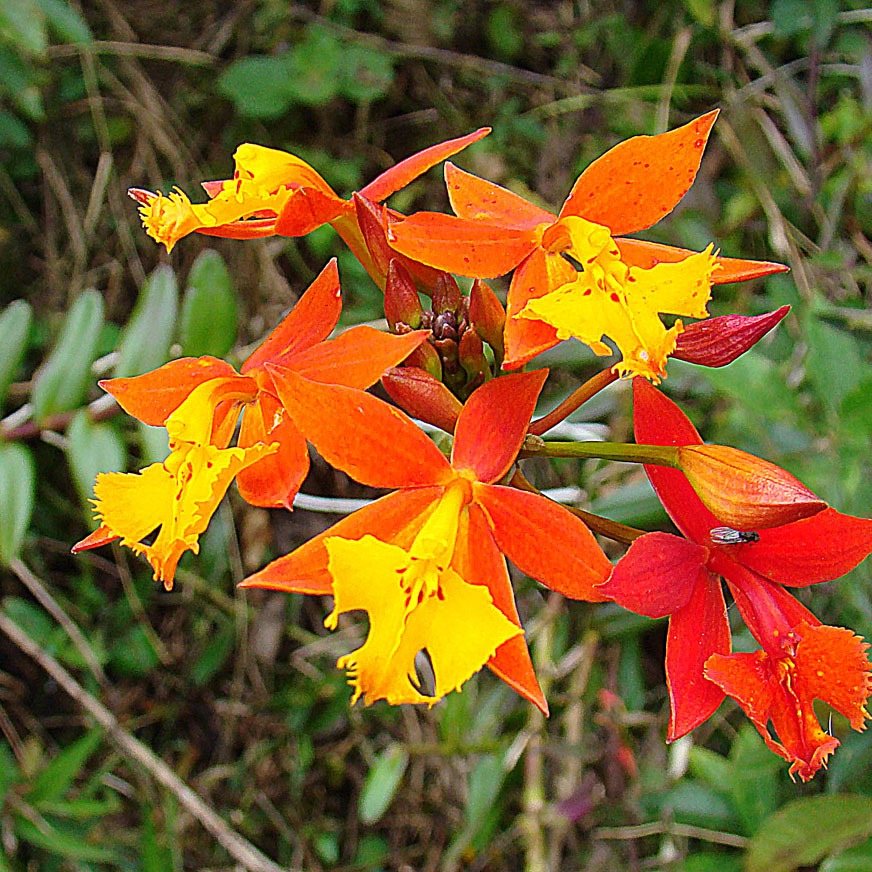
Epidendrum radicans is a vigorously growing terrestrial or lithophytic orchid with a creeping or semi-erect habit, known for its amazing ability to colonize embankments and roadsides. Unlike many epiphytic orchids, this species develops long, slender reed-like stems (lacking pseudobulbs) that can reach over a meter in length, covered by distichous, elliptical, and leathery leaves. Its most distinctive feature is the production of numerous white adventitious roots that sprout along the entire stem, allowing it to anchor to the soil or rocks. The inflorescence is a dense terminal cluster producing vibrant flowers, usually intense orange or fire-red with a trilobed, fringed lip featuring a bright yellow center. It is an architectural species that transforms open, sunny landscapes into patches of intense color.

Added by

Anonymous Curator

Reviewed by

Under Review

Last modified by

Julia Trouin

TaxonomyBiological classification ranks placing this species within the tree of life, from Kingdom down to Genus.

PhylumRank below Kingdom. Groups organisms sharing a fundamental body plan (e.g., Chordata = vertebrates and some invertebrates).Tracheophyta
ClassRank below Phylum. Subdivides by structural traits (e.g., Mammalia, Aves, Reptilia, Insecta).Liliopsida
OrderRank below Class. Groups related families sharing common ancestry (e.g., Carnivora, Primates).Asparagales
FamilyRank below Order. Groups closely related genera (e.g., Felidae = cats, Canidae = dogs).Orchidaceae
GenusRank just above Species. The first word in the two-part binomial scientific name.Epidendrum
Taxonomic AuthorityThe scientist who first formally described and published this species, followed by the year of publication.Pav. ex Lindl., 1831
Record Completeness
84%
Coming soon

Ecology & StatusHow this species lives: habitat preferences, diet, behavior, population status, and role in its ecosystem.

OriginWhether the species is native (evolved here), endemic (found only here), or introduced by human activity.

Native

Population TrendDirection of change in population size over time: increasing, stable, decreasing, or unknown.

Stable

Trophic RolePosition in the food chain: producer, herbivore, carnivore, omnivore, decomposer, or parasite.

--

Growth HabitPhysical form and structure of the plant: tree, shrub, herb, vine, epiphyte, aquatic, etc.

--

Leaf TypeLeaf characteristics: deciduous (seasonal shed), evergreen, simple, compound, needle-like, etc.

--

Flowering SeasonTime of year when this species typically reproduces or flowers.

Year Round

Recent SightingsWhether this species has been observed in the wild in Costa Rica within recent years.

Yes

Habitat SummaryOverview of the specific ecosystems and environments where this species is found in Costa Rica. Multi-lang

It thrives in open and disturbed areas with high sunlight incidence, from 500 up to 2,500 meters (1,600-8,200 feet) in altitude. It is a heliophytic species that successfully colonizes roadside embankments, pastures, cloud forest edges, and rocky outcrops. It requires high ambient humidity and well-drained soils, often nutrient-poor. In Costa Rica, it is extremely common in the mountainous areas of the Central Valley, the Talamanca Range, and disturbed areas on both slopes.

Light & Water NeedsSunlight intensity and moisture levels this plant needs to grow and reproduce successfully. Multi-lang

Information not available in English. Help us expand this record!

BehaviourDaily activity patterns, movement, territory use, foraging style, and seasonal behavioral changes. Multi-lang

It is a pioneer species that stabilizes embankments thanks to its adventitious root network. Its flowers are mainly pollinated by butterflies from the Papilionidae and Pieridae families, attracted by red and yellow colors. By not producing nectar, the plant depends on the presence of other colorful flowers in the area to attract insects through mimicry. It is a perennial plant that maintains stable colonies for decades if undisturbed.

Toxicity / UsesToxic compounds present and their documented effects on humans or other organisms. Multi-lang

Information not available in English. Help us expand this record!

Physical Measures

Length (cm)

50.0 - 150.0 cm

Reproductive StructuresFlowers, fruits, and seeds — the reproductive organs and their seasonal appearance.

Flower Photos (Max 2)

No image

Fruit Photos (Max 2)

No image

Evolutionary AdaptationsInherited traits and behaviors that improve the species' survival and reproduction in its specific environment. Multi-lang

Generalized Adventitious Roots: Unlike most orchids, E. radicans produces white roots along its entire creeping stem. This adaptation allows it to obtain moisture and nutrients from multiple points in the substrate and recover quickly if part of the plant is damaged, facilitating aggressive colonization of unstable soils.
Non-rewarding Floral Mimicry: Its flowers visually mimic other nectar-rich species (such as Asclepias curassavica) to attract butterflies. This adaptation allows it to ensure pollination through deception, saving the metabolic energy that true nectar production would require.

Main ThreatsDocumented pressures reducing the population: habitat loss, hunting, disease, climate change, and invasive species. Multi-lang

Road maintenance: Because its preferred habitat is roadside embankments, intensive clearing and herbicide use on road edges eliminate large local populations.

Interesting FactsSurprising or notable facts that highlight what makes this species unique or ecologically important. Multi-lang

The Wandering Orchid: Its specific name 'radicans' refers to its ability to take root anywhere the stem touches the ground, making it one of the easiest orchids to propagate and most resistant to direct sun.