
PlantaeIUCN LCIn Progress Recent Sighting
Terminalia amazonia
Coral Oak / Nargusta
(J.F.Gmel.) Exell, 1935
Detailed Texts Multi-lang
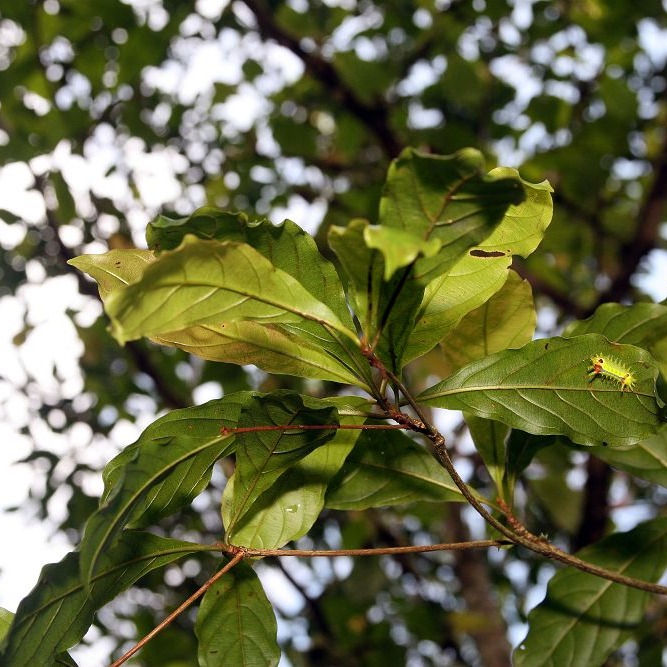
The coral oak or nargusta (Terminalia amazonia) is a majestic emergent forest tree of the Combretaceae family, revered in the Neotropics for its imposing stature and the exceptional quality of its wood. It is a colossus that can reach up to 50 meters (165 feet) in height, breaking the rainforest canopy with a straight, cylindrical trunk free of branches in its first 20 to 30 meters. Its trunk is characterized by prominent buttresses and a fluted bole, covered by grayish to yellowish-brown bark that exfoliates in irregular plates. Visually, the tree is unmistakable due to its 'sympodial' branching architecture (typical of the genus Terminalia), where branches extend horizontally in superimposed tiers like a Chinese pagoda, and its leaves are clustered in tight rosettes at the tips of the twigs. It blooms in spikes of small, apetalous, pale yellow flowers. Its wood, ranging from yellowish to reddish-brown tones (hence its common names), is highly resistant and coveted. Distributed from southern Mexico to Brazil and Peru, it is one of the most valuable and iconic native timber species in Costa Rica.
Added by
Anonymous Curator
Reviewed by
Under Review
Last modified by
Julia Trouin
Taxonomy
PhylumTracheophyta
ClassMagnoliopsida
OrderMyrtales
FamilyCombretaceae
GenusTerminalia
Taxonomic Authority(J.F.Gmel.) Exell, 1935
Ecology & Status
Origin
Native
Population Trend
Decreasing
Growth Habit
--
Leaf Type
--
Flowering Season
--
Recent Sightings
Yes
Habitat Summary Multi-lang
It is a highly versatile tree that thrives in both undisturbed primary forests and advanced secondary forest areas. It reaches its maximum development in humid and very humid tropical lowland forests, typically from sea level up to 1,200 meters (4,000 feet) in elevation. It possesses a remarkable tolerance to different soil types, growing vigorously on both well-drained, steep slopes and in valleys with heavy, occasionally waterlogged clay soils. In Costa Rica, it forms part of the dominant upper canopy in vast areas of the Southern Pacific, the Northern Zone, and the Caribbean.Light & Water Needs Multi-lang
Information not available in English. Help us expand this record!Behaviour Multi-lang
The phenology of the Amarillón is an ecosystem reset event. During the harsh dry season (February to May), this emergent tree drops its old reddish leaves for a short period (becoming semi-deciduous) as a water-saving strategy. At that exact moment of bareness, the tree bursts into yellow inflorescences that completely cover the crown, producing a sudden feast of nectar during the most famine-stricken time of the forest for flying insects. As soon as flowering ends, its five-winged samaras are released exactly during the most intensely windy months of the year (the 'trade winds'), guaranteeing that they fall on distant deforested lands ready to germinate with the burst of the May rains.Toxicity / Uses Multi-lang
Information not available in English. Help us expand this record!Physical Measures
Length (cm)
2000.0 - 5000.0 cm
Reproductive Structures
Flower Photos (Max 2)
No imageFruit Photos (Max 2)
No imageEvolutionary Adaptations Multi-lang
Sympodial branching architecture (Pagoda effect): The tree exhibits a growth strategy known as 'Aubréville's model'. Its branches grow horizontally in well-defined overlapping layers, leaving empty spaces between them, similar to the roofs of an oriental pagoda. By grouping all the leaves at the very end of each branch, the tree drastically maximizes sunlight interception in the canopy while minimizing self-shading, a master adaptation to dominate forest light competition.
Specialized aerodynamic anemochory: Instead of relying on animals for seed dispersal, the Amarillón produces dry fruits surrounded by five membranous wings (pentapterous samaras). This tiny helicopter-like structure takes advantage of the strong wind currents of the dry season (March-April), ensuring that, when falling from the 40 or 50 meters of the emergent canopy, the seeds glide in a spiral for miles to colonize distant forest clearings.
Massive buttresses and fluted bole: In Neotropical ecosystems with extremely high precipitation, soils are often shallow and prone to waterlogging. To stabilize a colossal trunk and a broad crown that withstands intense wind gusts and downpours, it develops enormous buttress roots that extend meters across the ground, merging with the trunk to form thick vertical channels that offer unbreakable physical support.
Main Threats Multi-lang
Excessive selective logging: The wood of the Amarillón is legendary for its hardness, interlocked grain, termite resistance, and beauty (featuring streaks ranging from golden yellow to coral red). Because of its immense value in structural building, luxury flooring, pillars, and shipbuilding, mature wild populations have been heavily decimated by legal and illegal logging throughout Central America, drastically reducing its original density.
Primary canopy fragmentation: As an emergent tree that requires enormous amounts of space and uninterrupted wind in the canopy to efficiently disseminate its samara seeds, clear-cutting and the transformation of the jungle into isolated agricultural plots prevent the natural travel of seeds, isolating the species' genetic turnover.
Interesting Facts Multi-lang
Wood to last a thousand years: The reputation of Amarillón or Coral Oak wood is so legendary in Costa Rica that the structures, beams, and columns of many historical haciendas, docks, and churches built over 100 years ago with this tree remain intact today, unyielding to the boiling humidity and constant termite attacks of the jungle.
The Neotropical 'Pagoda': When observing a Terminalia amazonia from a distance, its profile astonishingly resembles a stylized pine or an oriental building. This geometric pyramidal or tiered shape is the result of a strict botanical genetic code: the stem grows vertically, pauses, emits a whorl of perfectly horizontal branches, and repeats the process, creating immense floating green discs.
It is a prodigy of modern reforestation. Although its wood is valuable and hard, the coral oak contradicts the myth that hardwoods grow slowly. It is one of the fastest-growing precious timber species on the planet. Therefore, it has become a keystone species in reforestation projects in Costa Rica, allowing farmers to recover wastelands and obtain a sustainable timber economic profit in biologically viable times.