
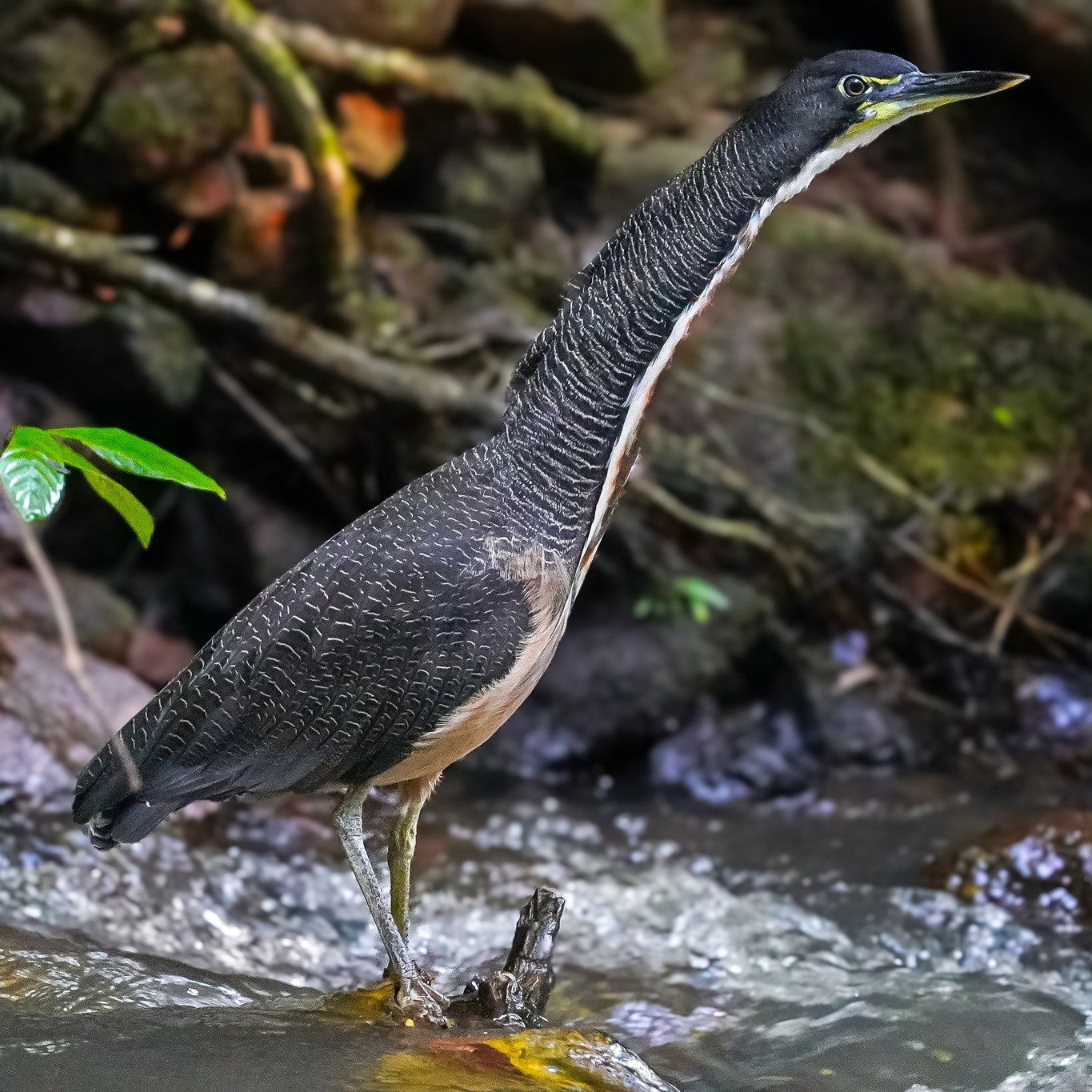
Tigrisoma fasciatum
Fasciated Tiger-Heron
(Such, 1825)
Added by
Anonymous Curator
Reviewed by
Under Review
Last modified by
Julia Trouin
TaxonomyBiological classification ranks placing this species within the tree of life, from Kingdom down to Genus.
Ecology & StatusHow this species lives: habitat preferences, diet, behavior, population status, and role in its ecosystem.
OriginWhether the species is native (evolved here), endemic (found only here), or introduced by human activity.
Native
Population TrendDirection of change in population size over time: increasing, stable, decreasing, or unknown.
Decreasing
Breeding SeasonTime of year when this species typically reproduces or flowers.
Dry Season
Trophic RolePosition in the food chain: producer, herbivore, carnivore, omnivore, decomposer, or parasite.
Carnivore
Recent SightingsWhether this species has been observed in the wild in Costa Rica within recent years.
Yes
Habitat SummaryOverview of the specific ecosystems and environments where this species is found in Costa Rica. Multi-lang
Unlike other herons that seek stagnant waters, this species is an extreme specialist of torrential rivers and mountain streams. It inhabits exclusively freshwater courses with fast currents, foaming rapids, and rocky beds flanked by dense gallery forests. In Costa Rica, it is distributed primarily in the foothills and middle elevations of the Tilarán, Central, and Talamanca mountain ranges, generally between 300 and 1,500 meters above sea level.BehaviourDaily activity patterns, movement, territory use, foraging style, and seasonal behavioral changes. Multi-lang
It is a solitary and fiercely territorial bird. It utilizes a passive ambush hunting strategy: it stands on rocks protruding from the river or walks very slowly along the stony edges, staring intently into the turbulent water. With a swift movement of its neck and thick bill, it spears or grabs prey attempting to swim against the current. Unlike its lowland relative, it does not vocalize as frequently, relying more on stealth in its noisy environment.Social ActivitySocial structure: whether the species is solitary, paired, or colonial; hierarchy and communication. Multi-lang
Strictly solitary. They defend a particular stretch of mountain river, not tolerating other individuals of their species, except during the breeding season.Feeding GuildWhat the species eats, how it forages or hunts, and its role as a consumer in the food web. Multi-lang
Carnivore / Fast-current Piscivore.Trophic Chain DetailsSpecific interactions in local food webs: prey species, predators, competitors, and scavengers. Multi-lang
Specialized predator. Its diet consists mainly of fish adapted to fast currents, mountain tadpoles, frogs, and large aquatic macroinvertebrates (like dragonfly nymphs and crayfish). Eggs and chicks are prey for arboreal snakes and climbing mammals like monkeys or coatis. Adults are rarely preyed upon due to their wariness.Reproductive BehaviourMating strategies, courtship displays, nesting or spawning behavior, and parental care. Multi-lang
It breeds in isolation, never in colonies. Nest building is a joint effort: they form a robust platform of sticks on a horizontal branch of a tree, usually hanging over the river current or on steep riparian cliffs. The female lays 1 to 2 mottled white eggs. Incubation takes about 30 to 34 days and is shared. The chicks sport the dense cryptic (tiger-striped) plumage from a very young age to hide in the nest while their parents hunt.Physical Measures
Length (cm)
60.0 - 70.0 cm
Weight (Grams)
800 g - 1.20 kg
Lifespan
Sexual MaturityAge at which the individual becomes capable of reproducing for the first time.
24 - 30 Months
Gestation / IncubationDuration from fertilization to birth (mammals) or to hatching (egg-laying species).
30 - 34