
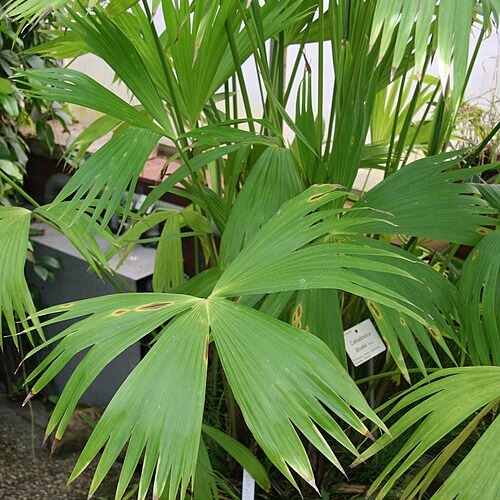
Carludovica drudei
Drude's Carludovica
Mast., 1877
Added by
Anonymous Curator
Reviewed by
Under Review
Last modified by
Julia Trouin
TaxonomyBiological classification ranks placing this species within the tree of life, from Kingdom down to Genus.
Ecology & StatusHow this species lives: habitat preferences, diet, behavior, population status, and role in its ecosystem.
OriginWhether the species is native (evolved here), endemic (found only here), or introduced by human activity.
Native
Population TrendDirection of change in population size over time: increasing, stable, decreasing, or unknown.
Stable
Trophic RolePosition in the food chain: producer, herbivore, carnivore, omnivore, decomposer, or parasite.
--
Growth HabitPhysical form and structure of the plant: tree, shrub, herb, vine, epiphyte, aquatic, etc.
--
Leaf TypeLeaf characteristics: deciduous (seasonal shed), evergreen, simple, compound, needle-like, etc.
--
Flowering SeasonTime of year when this species typically reproduces or flowers.
Year Round
Recent SightingsWhether this species has been observed in the wild in Costa Rica within recent years.
Yes
Habitat SummaryOverview of the specific ecosystems and environments where this species is found in Costa Rica. Multi-lang
It inhabits exclusively the understory and margins of very wet tropical rainforests, from sea level up to 1,200 meters (4,000 feet) in altitude. It prefers sites with partial shade, high atmospheric humidity, and soils rich in organic matter. It is commonly found near watercourses and in areas with rugged topography where the canopy allows filtered light. In Costa Rica, it is a very frequent species on the Caribbean Slope, the Northern Zone, and the South Pacific.Light & Water NeedsSunlight intensity and moisture levels this plant needs to grow and reproduce successfully. Multi-lang
Information not available in English. Help us expand this record!BehaviourDaily activity patterns, movement, territory use, foraging style, and seasonal behavioral changes. Multi-lang
It plays a crucial role in the reproductive ecology of curculionid beetles. The spadix produces heat (thermogenesis) to volatilize scents that attract insects, which feed on the staminodes and pollinate the plant. Its fleshy fruits are a food source for birds and small ground mammals. Its dense growth helps stabilize soil on humid slopes.Toxicity / UsesToxic compounds present and their documented effects on humans or other organisms. Multi-lang
Information not available in English. Help us expand this record!Physical Measures
Length (cm)
200.0 - 400.0 cm