
PlantaeIUCN LCIn Progress Recent Sighting
Carludovica drudei
Drude's Carludovica
Mast., 1877
Detailed Texts Multi-lang
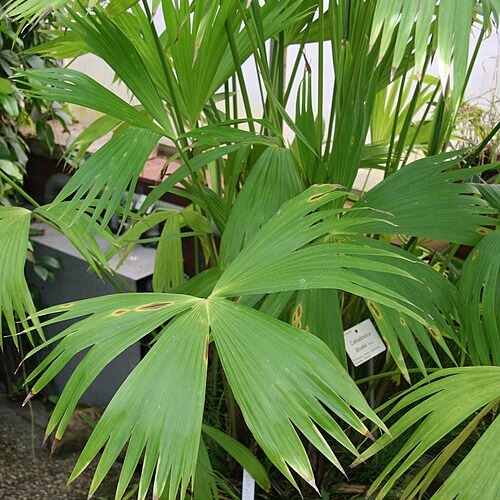
Carludovica drudei is a robust, perennial herbaceous plant without a visible aerial stem, belonging to the Cyclanthaceae family. Often confused with a palm due to its flabellate (fan-shaped) leaves, it is distinguished by having leaves deeply divided into three or four main segments. Its petioles are long, cylindrical, and flexible, emerging directly from an underground rhizome to reach heights of up to 3 or 4 meters. The inflorescence is a dense, cylindrical spadix, initially protected by several spathes. During anthesis, the spadix unfurls numerous long, sterile cream-colored filaments (staminodes) that attract specific pollinators. The fruit is a fleshy syncarp that, upon ripening, opens to reveal a bright orange pulp with numerous tiny seeds. It is an architectural species that dominates the lower and middle strata of very wet forests.
Added by
Anonymous Curator
Reviewed by
Under Review
Last modified by
Julia Trouin
Taxonomy
PhylumTracheophyta
ClassLiliopsida
OrderPandanales
FamilyCyclanthaceae
GenusCarludovica
Taxonomic AuthorityMast., 1877
Ecology & Status
Origin
Native
Population Trend
Stable
Growth Habit
--
Leaf Type
--
Flowering Season
Year Round
Recent Sightings
Yes
Habitat Summary Multi-lang
It inhabits exclusively the understory and margins of very wet tropical rainforests, from sea level up to 1,200 meters (4,000 feet) in altitude. It prefers sites with partial shade, high atmospheric humidity, and soils rich in organic matter. It is commonly found near watercourses and in areas with rugged topography where the canopy allows filtered light. In Costa Rica, it is a very frequent species on the Caribbean Slope, the Northern Zone, and the South Pacific.Light & Water Needs Multi-lang
Information not available in English. Help us expand this record!Behaviour Multi-lang
It plays a crucial role in the reproductive ecology of curculionid beetles. The spadix produces heat (thermogenesis) to volatilize scents that attract insects, which feed on the staminodes and pollinate the plant. Its fleshy fruits are a food source for birds and small ground mammals. Its dense growth helps stabilize soil on humid slopes.Toxicity / Uses Multi-lang
Information not available in English. Help us expand this record!Physical Measures
Length (cm)
200.0 - 400.0 cm
Reproductive Structures
Flower Photos (Max 2)
No imageFruit Photos (Max 2)
No imageEvolutionary Adaptations Multi-lang
Attractive Staminodes: During flowering, the spadix releases long sterile filaments that serve as an intense visual lure in the understory dimness and emit potent chemical fragrances to attract specific pollinating beetles, ensuring reproduction in an environment with low insect density.
Water Collection Architecture: Its trilobed leaves and channeled petioles function as a funnel system directing rainwater and dew directly toward the central rhizome, ensuring constant hydration even during periods of lower rainfall.
Main Threats Multi-lang
Habitat loss: Deforestation for agriculture and livestock eliminates the humid microclimates necessary for its survival. As an understory plant, canopy opening exposes it to excessive solar radiation that desiccates its tissues.
Interesting Facts Multi-lang
It is not a palm: Although visually appearing as a small fan palm, Carludovica drudei is more closely related to members of the Pandanales order than to true palms. It is a classic example of convergent evolution.