Costa Rica Species
Vochysia ferruginea
PlantaeHighest rank in taxonomy. Groups all life into domains: Animalia, Plantae, Fungi, etc.IUCN LCInternational Union for Conservation of Nature — the world authority on species extinction risk, using standardized criteria. — Least Concern — widespread and abundant; not at immediate risk of extinction.In ProgressCurrent stage of this record in the editorial review workflow. Recent Sighting

Vochysia ferruginea

Botarrama

Mart., 1824

Detailed Texts Multi-lang
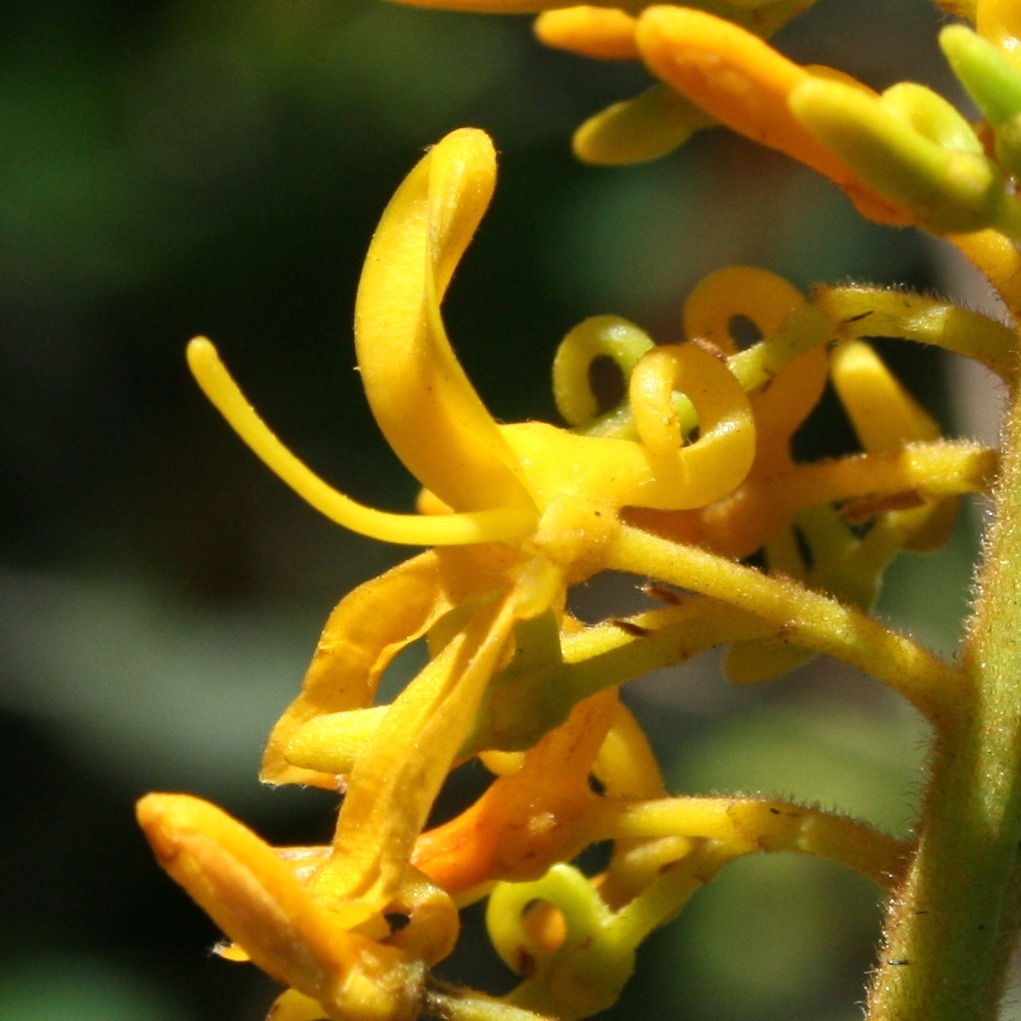
The botarrama (Vochysia ferruginea) is a majestic medium to large-sized tree of the Vochysiaceae family, widely known in Costa Rica for transforming entire hillsides into canvases of brilliant, golden yellow during its flowering season. Its specific epithet 'ferruginea' alludes to the distinctive reddish or rust-red color of the pubescence that covers the underside of its mature leaves and young twigs. With a cylindrical trunk of smooth, grayish bark that can reach up to 30 meters (100 feet) in height, this species is a vigorous colonizer of disturbed areas. It is distributed from Honduras to the Amazon basin in South America. Even though its wood is considered soft and of low durability against rot, ecologically it is a fundamental secondary succession species that stabilizes and regenerates severely degraded ecosystems, additionally serving as an immense nectar oasis for pollinators.

Added by

Anonymous Curator

Reviewed by

Under Review

Last modified by

Julia Trouin

TaxonomyBiological classification ranks placing this species within the tree of life, from Kingdom down to Genus.

PhylumRank below Kingdom. Groups organisms sharing a fundamental body plan (e.g., Chordata = vertebrates and some invertebrates).Tracheophyta
ClassRank below Phylum. Subdivides by structural traits (e.g., Mammalia, Aves, Reptilia, Insecta).Magnoliopsida
OrderRank below Class. Groups related families sharing common ancestry (e.g., Carnivora, Primates).Myrtales
FamilyRank below Order. Groups closely related genera (e.g., Felidae = cats, Canidae = dogs).Vochysiaceae
GenusRank just above Species. The first word in the two-part binomial scientific name.Vochysia
Taxonomic AuthorityThe scientist who first formally described and published this species, followed by the year of publication.Mart., 1824
Record Completeness
91%
Coming soon

Ecology & StatusHow this species lives: habitat preferences, diet, behavior, population status, and role in its ecosystem.

OriginWhether the species is native (evolved here), endemic (found only here), or introduced by human activity.

Native

Population TrendDirection of change in population size over time: increasing, stable, decreasing, or unknown.

Stable

Trophic RolePosition in the food chain: producer, herbivore, carnivore, omnivore, decomposer, or parasite.

--

Growth HabitPhysical form and structure of the plant: tree, shrub, herb, vine, epiphyte, aquatic, etc.

--

Leaf TypeLeaf characteristics: deciduous (seasonal shed), evergreen, simple, compound, needle-like, etc.

--

Flowering SeasonTime of year when this species typically reproduces or flowers.

--

Recent SightingsWhether this species has been observed in the wild in Costa Rica within recent years.

Yes

Habitat SummaryOverview of the specific ecosystems and environments where this species is found in Costa Rica. Multi-lang

It is a highly aggressive and adaptable pioneer species that predominates in humid tropical and premontane forests, from sea level up to 1,200 meters (4,000 feet) in elevation. It thrives exceptionally well in ultisols and oxisols: highly acidic, clayey, severely degraded soils with high concentrations of aluminum and iron, where other timber species fail. In Costa Rica, it is very common along the Caribbean lowlands, the Osa Peninsula, and the Central Valley, often forming almost pure stands along roadsides, abandoned pastures, and exposed slopes subject to heavy rainfall.

Light & Water NeedsSunlight intensity and moisture levels this plant needs to grow and reproduce successfully. Multi-lang

Information not available in English. Help us expand this record!

BehaviourDaily activity patterns, movement, territory use, foraging style, and seasonal behavioral changes. Multi-lang

It is a pioneer species with a medium to long life cycle that acts as a 'forest band-aid'. It performs a vital healing function in the ecosystem, being among the first large structural trees to dominate the vertical stratum when an arid pasture is abandoned. Its phenological cycle is explosive: after surviving the drought, when the rains begin to settle in heavily, its dense canopy of rough leaves abruptly transforms into an immense, highly visible yellow cloud. This synchronous and massive flowering works as an indispensable magnet that completely defines the diurnal and territorial foraging of countless forest pollinators. Its rapidly decomposing wood also ensures that, if the tree falls in a storm, the nutrient cycle returns to the soil at a dizzying pace.

Toxicity / UsesToxic compounds present and their documented effects on humans or other organisms. Multi-lang

Information not available in English. Help us expand this record!

Physical Measures

Length (cm)

1000.0 - 3000.0 cm

Reproductive StructuresFlowers, fruits, and seeds — the reproductive organs and their seasonal appearance.

Flower Photos (Max 2)

No image

Fruit Photos (Max 2)

No image

Evolutionary AdaptationsInherited traits and behaviors that improve the species' survival and reproduction in its specific environment. Multi-lang

Aluminum hyperaccumulation: Unlike the vast majority of plants for which aluminum in acidic soils is toxic and inhibits root growth, the botarrama actively absorbs and sequesters large amounts of aluminum in its own cellular tissues without suffering damage. This gives it a massive competitive advantage in leached tropical soils and possibly renders its leaves indigestible to many herbivores.
Thermal ferruginous pubescence: The thick layer of velvety, rust-colored hairs on the underside of leaves and young stems acts as a multifunctional insulator. It reflects excessive sunlight during extreme heat, retains a thin boundary layer of moisture to prevent desiccation (reducing transpiration), and forms a harsh physical barrier that makes it difficult for defoliating insects to chew.
Aerodynamic anemochory: To effectively colonize distant deforested areas, the tree produces fruits in the form of three-lobed woody capsules. When they split open and dry in the hot winds, they release hundreds of small seeds equipped with a single asymmetrical lateral wing (samara). This wing allows them to spin like microscopic aerodynamic propellers, staying suspended to be carried in a spiral over great distances away from the mother tree.

Main ThreatsDocumented pressures reducing the population: habitat loss, hunting, disease, climate change, and invasive species. Multi-lang

Forestry devaluation: Because it is a tree with very soft, lightweight wood that is highly susceptible to rapid fungal rot or termite attack, it is often erroneously considered a 'weed' by the timber industry. In active cattle pastures, it is systematically felled and burned without commercial use, ignoring its key role for soil recovery.
Urbanization and loss of regeneration areas: Rapid urban expansion and paving in premontane zones eliminate patches of secondary forest, ditches, and abandoned lands that this pioneer species utilizes to thrive and prevent landslides on unstable slopes.

Interesting FactsSurprising or notable facts that highlight what makes this species unique or ecologically important. Multi-lang

Costa Rican phenological clock: In many regions of Costa Rica, this species is locally known as 'Mayo', 'San Juan', or 'Flor de Mayo'. These popular nicknames exist because its massive and unmistakable bright yellow flowering is perfectly synchronized with the seasonal transition: it blooms intensely right at the end of April and throughout May, culturally and biologically announcing the firm arrival of the rainy season.
Bauxite mine tracker: Since science discovered that it is a proven aluminum hyperaccumulator, the analysis of the dried foliar tissues of Vochysia ferruginea has occasionally been used in specialized biogeochemical studies to locate, profile, and map hidden underground deposits of bauxite (the primary aluminum ore) in dense tropical forest areas.
The King of Restoration: Due to its astonishing rate of fast growth in full sun and its heroic resistance to lethally acidic soils that would kill an oak tree, the botarrama is currently classified as one of the golden species in government reforestation and ecological restoration programs to rescue farms degraded by decades of agrochemicals and extreme intensive cattle ranching.