
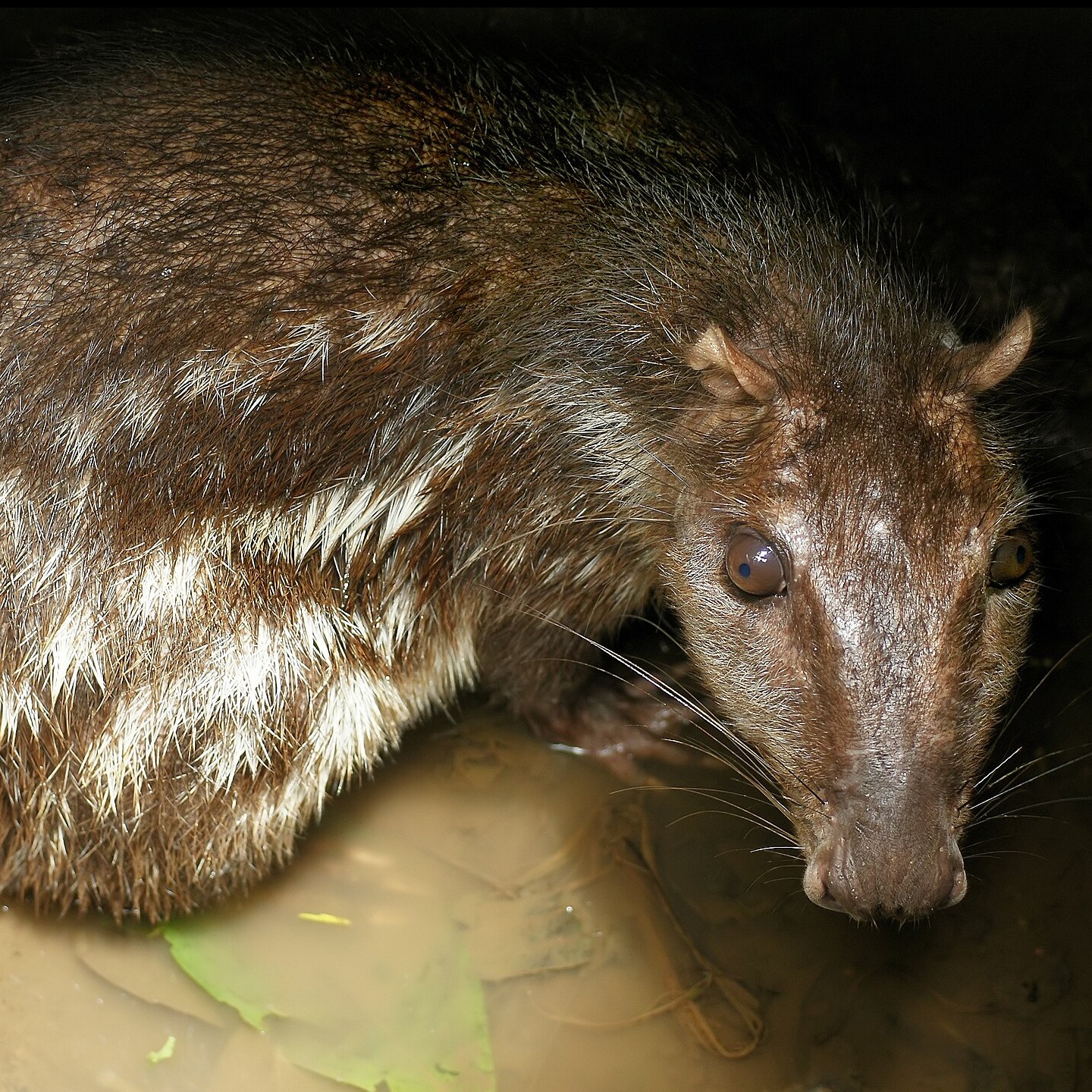
Cuniculus paca
Spotted Paca
Linnaeus, 1766
Added by
Anonymous Curator
Reviewed by
Under Review
Last modified by
Julia Trouin
TaxonomyBiological classification ranks placing this species within the tree of life, from Kingdom down to Genus.
Ecology & StatusHow this species lives: habitat preferences, diet, behavior, population status, and role in its ecosystem.
OriginWhether the species is native (evolved here), endemic (found only here), or introduced by human activity.
Native
Population TrendDirection of change in population size over time: increasing, stable, decreasing, or unknown.
Decreasing
Breeding SeasonTime of year when this species typically reproduces or flowers.
Year Round
Trophic RolePosition in the food chain: producer, herbivore, carnivore, omnivore, decomposer, or parasite.
Herbivore
Recent SightingsWhether this species has been observed in the wild in Costa Rica within recent years.
Yes
Habitat SummaryOverview of the specific ecosystems and environments where this species is found in Costa Rica. Multi-lang
It preferentially inhabits lowland and premontane tropical moist and very moist forests, always in close association with water bodies such as rivers, streams, creeks, and lagoons. It also occupies gallery forests, mature secondary forests, and occasionally cacao or banana plantations adjacent to native vegetation. It requires soft or sandy soils to excavate its burrows, which are generally located among the roots of large trees, on riverbanks or escarpments. It rarely ventures more than 300 meters from a permanent water source.BehaviourDaily activity patterns, movement, territory use, foraging style, and seasonal behavioral changes. Multi-lang
The spotted paca is strictly nocturnal, beginning activity between 18:00 and 20:00 hours and returning to its burrow before dawn. It is primarily solitary, although breeding pairs share a territory stably. It excavates and maintains complex burrow systems with chambers lined with dry leaves where it rests and raises young. At the slightest sign of danger, it prefers to take refuge in water rather than flee over land. It marks its territory with glandular secretions and urine at fixed points. Its activity is highly sensitive to human presence and artificial light, so it is rarely observed in areas with nocturnal disturbance.Social ActivitySocial structure: whether the species is solitary, paired, or colonial; hierarchy and communication. Multi-lang
Primarily solitary outside the breeding period. Adults establish individual territories that they actively defend through vocalization (guttural grunts), dorsal hair erection, and direct chases. Pairs are de facto monogamous during the breeding season and may temporarily share a burrow. Chemical communication through perianal glands and urinary marks at strategic points in the territory is fundamental to avoiding direct encounters between individuals. Juveniles remain with the mother until approximately 3–4 months of age.Feeding GuildWhat the species eats, how it forages or hunts, and its role as a consumer in the food web. Multi-lang
Opportunistic frugivore-granivore. Its diet consists primarily of fallen ripe fruits, hard seeds, fleshy roots, and bark. It occasionally supplements with tender leaves, shoots, and small invertebrates. During the dry season it relies more heavily on underground roots and tubers. Unlike the agouti, it does not cache seeds but consumes food directly at the point of discovery or transports it to the burrow.Trophic Chain DetailsSpecific interactions in local food webs: prey species, predators, competitors, and scavengers. Multi-lang
Primary consumer that feeds on fruits, seeds, roots, and bark. It acts as a secondary seed disperser by transporting fruits considerable distances before consuming them. Its main predators are the jaguar (Panthera onca), puma (Puma concolor), ocelot (Leopardus pardalis), boa constrictor (Boa constrictor), spectacled caiman (Caiman crocodilus), and harpy eagle (Harpia harpyja). In fragmented areas, domestic dogs represent a significant additional threat. Its elimination from an ecosystem can generate changes in forest floristic composition by interrupting dispersal processes of certain plant species.Reproductive BehaviourMating strategies, courtship displays, nesting or spawning behavior, and parental care. Multi-lang
Reproduction occurs year-round with peaks associated with the onset of the dry season. Courtship involves prolonged chases and the male spraying urine on the female. After a gestation of 114–119 days, usually a single precocial young is born (rarely two), with open eyes, complete fur, and lateral spots already visible. The young can walk hours after birth. The mother nurses for approximately 90 days. Young reach sexual maturity between 7 and 9 months. An adult female can give birth up to twice per year if feeding conditions are favorable.Physical Measures
Length (cm)
60.0 - 82.0 cm
Weight (Grams)
6.00 kg - 12.00 kg
Lifespan
Sexual MaturityAge at which the individual becomes capable of reproducing for the first time.
7 - 9 Months
Gestation / IncubationDuration from fertilization to birth (mammals) or to hatching (egg-laying species).
114 - 119