
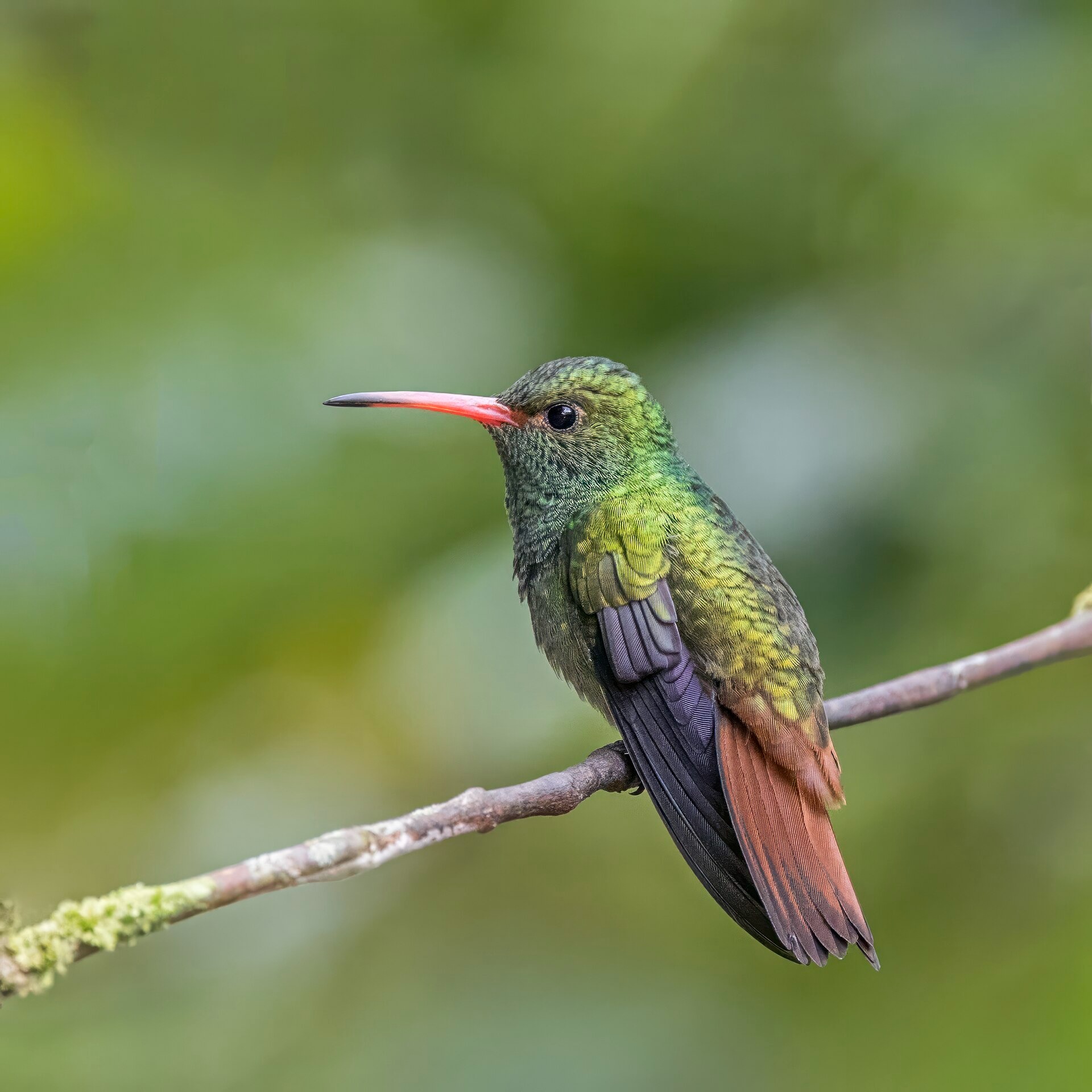
Amazilia tzacatl
Rufous-tailed Hummingbird
(De la Llave, 1833)
Added by
Anonymous Curator
Reviewed by
Under Review
Last modified by
Julia Trouin
TaxonomyBiological classification ranks placing this species within the tree of life, from Kingdom down to Genus.
Ecology & StatusHow this species lives: habitat preferences, diet, behavior, population status, and role in its ecosystem.
OriginWhether the species is native (evolved here), endemic (found only here), or introduced by human activity.
Native
Population TrendDirection of change in population size over time: increasing, stable, decreasing, or unknown.
Increasing
Breeding SeasonTime of year when this species typically reproduces or flowers.
Year Round
Trophic RolePosition in the food chain: producer, herbivore, carnivore, omnivore, decomposer, or parasite.
Herbivore
Recent SightingsWhether this species has been observed in the wild in Costa Rica within recent years.
Yes
Habitat SummaryOverview of the specific ecosystems and environments where this species is found in Costa Rica. Multi-lang
It is a master of adaptability. It avoids closed, dark rainforests, thriving in open, sunlit areas altered by humans. It is exceedingly common at forest edges, clearings, scrublands, coffee plantations, pastures with scattered trees, and, most especially, in urban gardens, parks, and town squares. In Costa Rica, it is probably the most abundant hummingbird in the lowlands and mid-elevations of both slopes (Caribbean and Pacific), reaching up to 1,800 meters in the Central Valley.BehaviourDaily activity patterns, movement, territory use, foraging style, and seasonal behavioral changes. Multi-lang
They are diurnal birds with very conspicuous habits. They are constantly heard in gardens emitting a sharp, angry chirp, similar to two stones rubbing together quickly ('tzi-tzi-tzi!'), especially when chasing an intruder mid-flight. They sedentarily defend a nectar-rich flower patch, perching on the highest exposed branch of their territory like sentinels. In hovering flight, their agility is unparalleled; they can fly backward or remain suspended in the air thanks to their wings rotating in a figure '8'.Social ActivitySocial structure: whether the species is solitary, paired, or colonial; hierarchy and communication. Multi-lang
Highly antisocial and aggressively territorial, except in the brief moment of mating. They never travel in flocks. Males do not interact with females beyond copulation and will violently chase their own kind out of the garden.Feeding GuildWhat the species eats, how it forages or hunts, and its role as a consumer in the food web. Multi-lang
Nectarivore / Stationary territorial forager.Trophic Chain DetailsSpecific interactions in local food webs: prey species, predators, competitors, and scavengers. Multi-lang
Omnivore (Primarily Nectarivore and Insectivore). It depends heavily on the nectar of red and tubular flowers (such as Stachytarpheta, Heliconias, and Hamelia) for quick energy. However, to obtain necessary proteins to survive, it hunts small gnats in mid-air and steals small spiders from their webs. Despite their aggressiveness, they can be preyed upon by small arboreal snakes (vine snakes), cats, and occasionally, large spiders or praying mantises that ambush them on flowers.Reproductive BehaviourMating strategies, courtship displays, nesting or spawning behavior, and parental care. Multi-lang
The female assumes full responsibility for raising the young. She builds a tiny, very compact cup-shaped nest using soft plant fibers (like balsa or dandelion), tightly bound and shingled on the outside with lichens and dry leaves glued with spider webs (for camouflage). The nest is placed on low horizontal branches (1 to 4 m high). She invariably lays 2 tiny white eggs. Incubation lasts about 15-16 days. The chicks are completely altricial, and the mother feeds them by inserting her bill into their throats to regurgitate nectar and insect mash. The young fledge at 18-22 days.Physical Measures
Length (cm)
9.0 - 11.0 cm
Weight (Grams)
4.5 g - 5.5 g
Lifespan
Sexual MaturityAge at which the individual becomes capable of reproducing for the first time.
10 - 12 Months
Gestation / IncubationDuration from fertilization to birth (mammals) or to hatching (egg-laying species).
15 - 16