
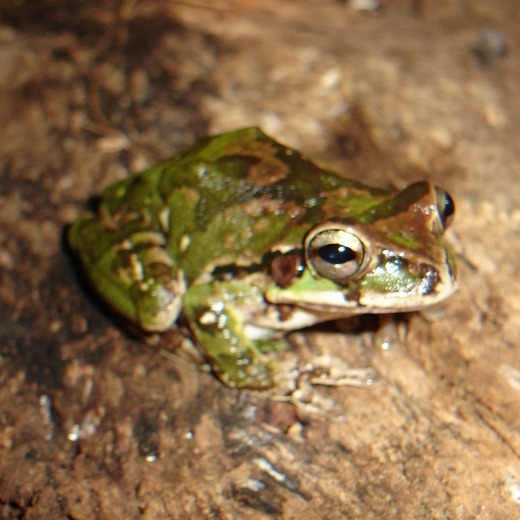
AnimaliaIUCN LCIn Progress Recent Sighting
Smilisca baudinii
Mexican Tree Frog
Duméril and Bibron, 1841
Detailed Texts Multi-lang
A medium to large-sized frog with a robust build. Its dorsal coloration is highly variable, capable of changing rapidly between brown, gray, or green tones, often with irregular dark spots. It possesses large adhesive disks on its fingers that facilitate its arboreal life.
Added by
Anonymous Curator
Reviewed by
Under Review
Last modified by
Julia Trouin
Taxonomy
PhylumChordata
ClassAmphibia
OrderAnura
FamilyHylidae
GenusSmilisca
Taxonomic AuthorityDuméril and Bibron, 1841
Ecology & Status
Origin
Native
Population Trend
Stable
Breeding Season
Wet Season
Trophic Role
Insectivore
Recent Sightings
Yes
Habitat Summary Multi-lang
Inhabits a wide variety of ecosystems, from humid tropical forests to dry jungles, agricultural areas, and urban gardens. It is an extremely adaptable species and common in disturbed areas.Behaviour Multi-lang
Mostly nocturnal species. During the day, it is found sheltering in tree hollows, bromeliads, or even under bark to avoid desiccation.Social Activity Multi-lang
Generally solitary outside the breeding season. During rains, males form choruses in temporary ponds, actively competing to attract females.Feeding Guild Multi-lang
Active ambush hunter. Uses its sticky tongue to catch prey that approach its position on leaves or branches.Trophic Chain Details Multi-lang
Opportunistic insectivore. Its diet consists of a wide range of arthropods, including beetles, moths, crickets, and other small insects captured in the vegetation.Reproductive Behaviour Multi-lang
Oviparous species. The female deposits large groups of eggs in temporary ponds or permanent water bodies. The larvae develop rapidly in the water.Physical Measures
Length (cm)
5.0 - 9.0 cm
Weight (Grams)
15 g - 45 g
Offspring per cycle100 - 1000
Sexual DimorphismYes
Lifespan
Sexual Maturity
1 - 2 Years
Gestation / Incubation
1 - 2
Lifespan Estimated
Males3 - 6 Years
Females3 - 6 Years
Sexual Dimorphism
Males Multi-lang
Males are smaller and possess a very developed and evident subgular vocal sac, used during their mating songs.
Females Multi-lang
Females are larger and more robust than males, with a coloration that may appear more uniform in certain resting phases.
Evolutionary Adaptations Multi-lang
Color Change Capability: It can drastically alter its skin tonality in response to temperature, humidity, and the environment, allowing it to effectively hide from predators.
Main Threats Multi-lang
Although resilient, contamination of stagnant water sources and excessive urbanization can drastically reduce available breeding sites.
Interesting Facts Multi-lang
It is known for its incredibly loud and deep mating calls, which can be heard over long distances, marking its presence on rainy nights.