
Costa Rica Species
Taeniotes scalatus
AnimaliaHighest rank in taxonomy. Groups all life into domains: Animalia, Plantae, Fungi, etc.IUCN NEInternational Union for Conservation of Nature — the world authority on species extinction risk, using standardized criteria. — Not Evaluated — not yet assessed against the IUCN Red List criteria.In ProgressCurrent stage of this record in the editorial review workflow. Recent Sighting

Taeniotes scalatus

Longhorn Beetle

(Fabricius, 1787)

Detailed Texts Multi-lang
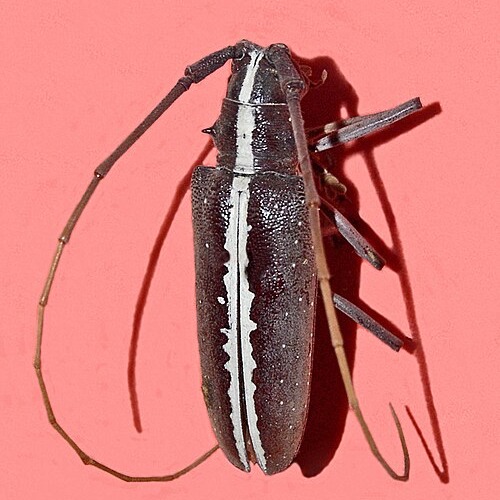
A striking and large longhorn beetle recognized by its elongated, robust body and exceptionally long antennae. The dorsal coloration consists of a black or dark velvet background adorned with a distinctive, neat sequence of pale yellow, cream, or greenish-white spots running down the center of the elytra, closely resembling the rungs of a ladder.

Added by

Anonymous Curator

Reviewed by

Under Review

Last modified by

Julia Trouin

TaxonomyBiological classification ranks placing this species within the tree of life, from Kingdom down to Genus.

PhylumRank below Kingdom. Groups organisms sharing a fundamental body plan (e.g., Chordata = vertebrates and some invertebrates).Arthropoda
ClassRank below Phylum. Subdivides by structural traits (e.g., Mammalia, Aves, Reptilia, Insecta).Insecta
OrderRank below Class. Groups related families sharing common ancestry (e.g., Carnivora, Primates).Coleoptera
FamilyRank below Order. Groups closely related genera (e.g., Felidae = cats, Canidae = dogs).Cerambycidae
GenusRank just above Species. The first word in the two-part binomial scientific name.Taeniotes
Taxonomic AuthorityThe scientist who first formally described and published this species, followed by the year of publication.(Fabricius, 1787)
Record Completeness
96%
Coming soon

Ecology & StatusHow this species lives: habitat preferences, diet, behavior, population status, and role in its ecosystem.

OriginWhether the species is native (evolved here), endemic (found only here), or introduced by human activity.

Native

Population TrendDirection of change in population size over time: increasing, stable, decreasing, or unknown.

Unknown

Breeding SeasonTime of year when this species typically reproduces or flowers.

Year Round

Trophic RolePosition in the food chain: producer, herbivore, carnivore, omnivore, decomposer, or parasite.

Herbivore

Recent SightingsWhether this species has been observed in the wild in Costa Rica within recent years.

Yes

Habitat SummaryOverview of the specific ecosystems and environments where this species is found in Costa Rica. Multi-lang

Distributed across Central America, Mexico, and northern South America. It thrives in dense humid tropical rainforests, premontane moist forests, and wood plantations, heavily associating with various woody plant species belonging to families like Moraceae and Ficus.

BehaviourDaily activity patterns, movement, territory use, foraging style, and seasonal behavioral changes. Multi-lang

Diurnal and active throughout the warmer months. Adults spend their time crawling along branches, feeding on soft outer bark and plant sap. They are strong fliers but typically prefer walking along the trunks of target host trees, relying on their striped appearance to break up their silhouette in dappled jungle light.

Social ActivitySocial structure: whether the species is solitary, paired, or colonial; hierarchy and communication. Multi-lang

Solitary. Individuals live independently, with no cooperative behaviors or social grouping. They encounter each other solely on target host trees during mating efforts, where males may display mild competitive posturing using their antennae.

Feeding GuildWhat the species eats, how it forages or hunts, and its role as a consumer in the food web. Multi-lang

Herbivore / Xylophage (Wood-borer as larvae).

Trophic Chain DetailsSpecific interactions in local food webs: prey species, predators, competitors, and scavengers. Multi-lang

Larvae are internal woodborers, consuming rotting or dying inner structural wood tissues and boring tunnels packed with frass. Adults feed on tender bark, foliage, and sap flows. Natural predators include woodpeckers, large insectivorous birds, monkeys, small arboreal lizards, and large parasitic wasps that target larvae.

Reproductive BehaviourMating strategies, courtship displays, nesting or spawning behavior, and parental care. Multi-lang

Females utilize their sharp mouthparts to slice distinct slits into the outer bark of stressed or dying host trees. They deposit single oval white eggs into these micro-cavities. Upon hatching, the young larvae tunnel directly into the sapwood to begin their prolonged developmental feeding phase.

Physical Measures

Length (cm)

3.0 - 4.5 cm

Weight (Grams)

3.5 g - 7 g

Offspring per cycleTypical number of young (live births, eggs, or seeds) produced by one adult in a single reproductive event or breeding season.30 - 75
Sexual DimorphismObservable physical differences between males and females of the same species (e.g., size, coloration, features).Yes

Lifespan

Sexual MaturityAge at which the individual becomes capable of reproducing for the first time.

10 - 14 Months

Gestation / IncubationDuration from fertilization to birth (mammals) or to hatching (egg-laying species).

14 - 21

Lifespan EstimatedExpected duration of life from birth to natural death under wild conditions.
Males8 - 12 Months
Females8 - 12 Months

Sexual DimorphismPhysical differences in size, coloration, or morphology between males and females of this species.

Males Multi-lang

Males possess dramatically elongated antennae that can reach up to twice or three times their total body length. Their front legs are also marginally longer and slenderer.

Females Multi-lang

Females display shorter antennae, usually only slightly longer than their body length, and feature a wider, heavier abdominal region tailored for carrying and depositing eggs.

Evolutionary AdaptationsInherited traits and behaviors that improve the species' survival and reproduction in its specific environment. Multi-lang

Equipped with incredibly powerful, sharp mandibles designed to easily chew through thick bark and tough plant tissue, allowing the female to score slits for egg-laying and the adults to feed on tree bark.
Features ultra-sensory long antennae containing complex chemoreceptors that help locate distressed or damaged host trees over great distances in dense jungle environments.

Main ThreatsDocumented pressures reducing the population: habitat loss, hunting, disease, climate change, and invasive species. Multi-lang

Loss of mature, diverse forest habitats due to intensive clearing for agriculture, alongside heavy insecticide exposure in commercial timber reserves where they are classified as wood pests.

Interesting FactsSurprising or notable facts that highlight what makes this species unique or ecologically important. Multi-lang

When handled or stressed, adults produce a clearly audible stridulation sound by rubbing the rear edge of their prothorax against a specialized ridged plate on the mesothorax, meant to startle potential predators.