
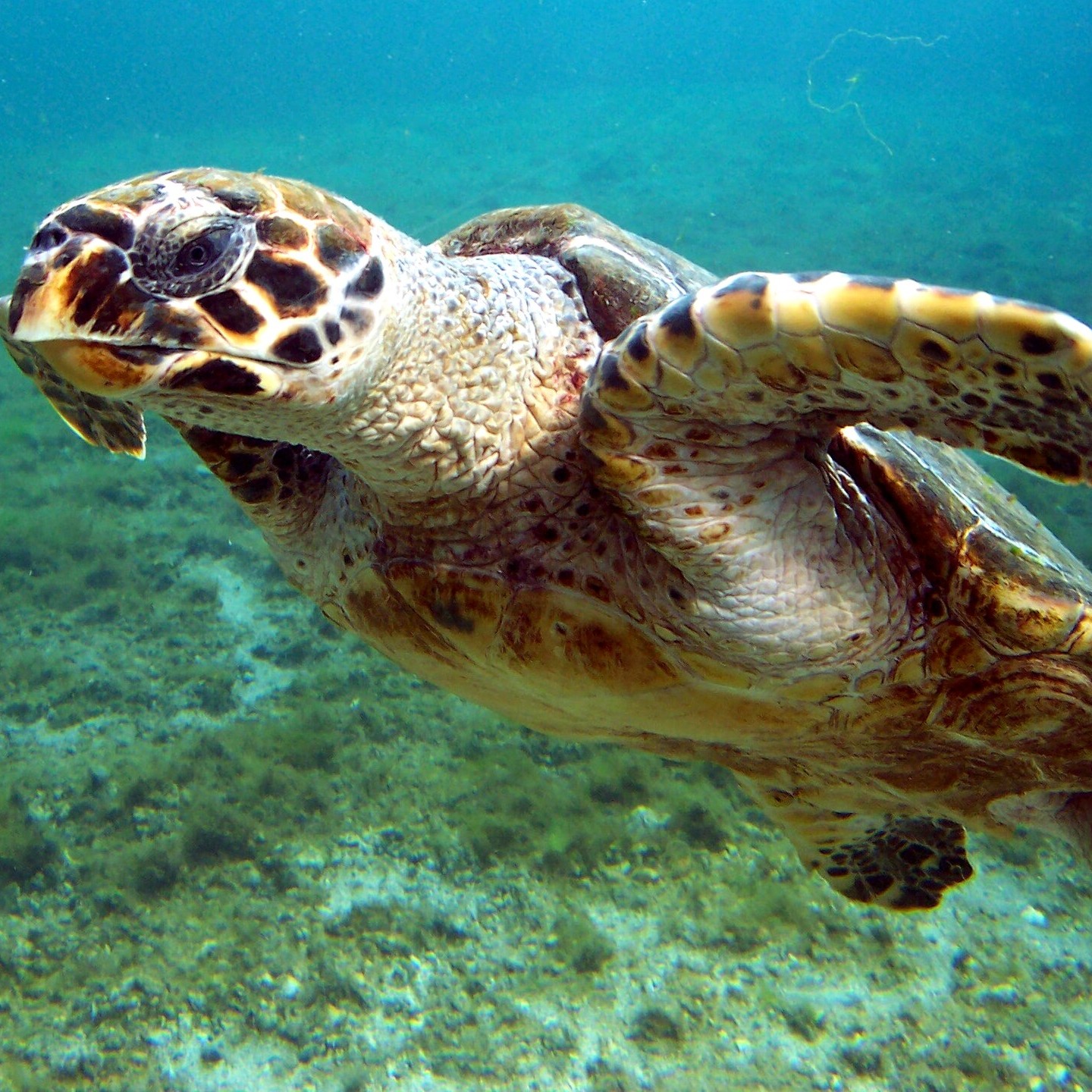
Eretmochelys imbricata
Hawksbill Turtle
(Linnaeus, 1766)
Added by
Anonymous Curator
Reviewed by
Under Review
Last modified by
Julia Trouin
TaxonomyBiological classification ranks placing this species within the tree of life, from Kingdom down to Genus.
Ecology & StatusHow this species lives: habitat preferences, diet, behavior, population status, and role in its ecosystem.
OriginWhether the species is native (evolved here), endemic (found only here), or introduced by human activity.
Native
Population TrendDirection of change in population size over time: increasing, stable, decreasing, or unknown.
Decreasing
Breeding SeasonTime of year when this species typically reproduces or flowers.
--
Trophic RolePosition in the food chain: producer, herbivore, carnivore, omnivore, decomposer, or parasite.
--
Recent SightingsWhether this species has been observed in the wild in Costa Rica within recent years.
Yes
Habitat SummaryOverview of the specific ecosystems and environments where this species is found in Costa Rica. Multi-lang
The hawksbill turtle occupies a series of specific marine habitats throughout its life cycle, with a critical dependence on coral reefs and seagrass beds. Adults and subadults forage exclusively or almost exclusively on coral reefs, sponge beds, and shallow rocky bottoms (2 to 30 meters depth), where sponges — their main food — grow in reef crevices and walls. Pelagic juveniles spend their first years in oceanic currents of open waters among floating sargassum masses. Reproductive adults nest on tropical and subtropical beaches of fine or coarse sand with direct access to the reef. In Costa Rica, the species is most frequent in the Caribbean, especially in Cahuita National Park, Isla del Caño Biological Reserve, Gandoca-Manzanillo National Wildlife Refuge, and the reef waters of the Mesoamerican Reef Corridor. In the Pacific it is less frequent but recorded in the Golfo Dulce, Isla del Coco, and reef zones of the Central and South Pacific. It needs relatively intact nesting beaches — with moderate slope, compact sand, and without severe nocturnal light pollution — within walking distance of reef foraging zones.BehaviourDaily activity patterns, movement, territory use, foraging style, and seasonal behavioral changes. Multi-lang
The hawksbill turtle is primarily solitary and spends most of its adult life foraging on coral reefs in its distribution area. Adults are benthic animals that move relatively slowly through the reef, exploring crevices and walls with their bill in search of sponges. They can dive to 30 meters depth although most foraging occurs between 2 and 15 meters. They are partly nocturnal in areas of high predation pressure — resting during the day in reef crevices — although in protected zones they are active both day and night. Breathing is obligatorily aerial: they must surface every 45-90 minutes when active, though they can remain submerged for up to 3-4 hours at rest with reduced metabolism. They are not territorial and the home ranges of different individuals overlap broadly. They are relatively calm in temperament when encountered by divers — unlike the more flighty character of other sea turtles — making them a star attraction of Costa Rican diving but also making them more vulnerable to direct human disturbance.Social ActivitySocial structure: whether the species is solitary, paired, or colonial; hierarchy and communication. Multi-lang
The hawksbill turtle is essentially solitary throughout its adult aquatic life phase. Individuals forage alone, sleep alone on the reef, and only congregate transiently during the mating season in the vicinity of nesting beaches. Mating occurs in the water, often in shallow waters near the nesting beach, and may involve multiple males competing for a single female. Females store sperm and can fertilize multiple clutches with the sperm from a single mating or from multiple males during the same season. During nesting, females come ashore solitarily, generally at night, and do not socially interact with other females nesting simultaneously on the same beach. There is no parental care of any kind after laying: the female abandons the clutch immediately after covering it.Feeding GuildWhat the species eats, how it forages or hunts, and its role as a consumer in the food web. Multi-lang
Specialized spongivore with opportunistic supplement of soft benthic invertebrates. 70-95% of the diet consists of benthic marine sponges, with preference for high-toxin and spicule-content sponges that most other marine predators cannot consume — Geodia, Chondrilla, Aplysina, Ircinia, and other Demospongiae. The remaining 5-30% includes jellyfish, sessile tunicates (ascidians), crinoids, sea anemones, calcareous algae, soft mollusks (nudibranchs, small gastropods), soft echinoderms, and occasionally small, slow fish. It forages exclusively on the coral and rocky benthos, using the narrow bill to extract prey from crevices and walls inaccessible to other species. It does not exhibit active hunting behavior for fast mobile prey.Trophic Chain DetailsSpecific interactions in local food webs: prey species, predators, competitors, and scavengers. Multi-lang
Specialized secondary consumer of benthic sponges (spongivore), with a unique trophic position in the coral reef that no other vertebrate species can equivalently occupy. Its diet consists primarily (70-95%) of sponges of the classes Demospongiae and Calcarea, especially genera such as Geodia, Chondrilla, Aplysina, Ircinia, Neopetrosia, and Anthosigmella — all highly toxic to most predators. The remaining 5-30% includes jellyfish, tunicates, crinoids, anemones, algae, soft mollusks, and occasionally fish. By controlling sponge populations on the reef, the hawksbill acts as an ecological regulator that prevents the overabundance of sponges competing for coral space, being a first-order structuring component of the reef ecosystem. Its main predators at sea are the tiger shark (Galeocerdo cuvier) and lemon shark (Negaprion brevirostris) for adult individuals, the blacktip shark (Carcharhinus limbatus) and bottlenose dolphin (Tursiops truncatus) for juveniles, and the orca (Orcinus orca) occasionally. On land, nesting females are vulnerable to the jaguar (Panthera onca) in the Costa Rican Caribbean and eggs are preyed upon by the coati (Nasua narica), raccoon (Procyon lotor), gray fox (Urocyon cinereoargenteus), and feral dogs.Reproductive BehaviourMating strategies, courtship displays, nesting or spawning behavior, and parental care. Multi-lang
The hawksbill turtle reaches sexual maturity between 20 and 35 years, the latest maturity of all species in the set. Females return to nest on the same beach where they were born, at a frequency of every 2 to 5 years between reproductive seasons. During an active reproductive season, a female can make 3 to 6 nests separated by periods of 13 to 18 days between successive layings. Mating occurs at sea, in the weeks before the first nesting of the season. Females come ashore exclusively at night, generally 2 to 3 hours after sunset, search for a site on the beach above the tide line, excavate with their rear flippers a nest 45 to 60 cm deep, deposit the eggs, carefully cover the nest, and return to the sea, all in 45 to 90 minutes. The clutch consists of 80 to 160 soft, flexible-shelled spherical eggs about 4 cm in diameter, whose incubation lasts 60 to 70 days depending on sand temperature. The sex of the hatchlings is determined by incubation temperature (environmental sex determination): temperatures above 29.5°C produce predominantly females and below 28.5°C predominantly males. Hatchlings — about 4 cm long and 15-20 g in weight — emerge from the nest collectively at night and run toward the sea guided by the luminous brightness of the marine horizon. Most perish before reaching the sea or in the first pelagic days.Physical Measures
Length (cm)
62.0 - 95.0 cm
Weight (Grams)
45.00 kg - 90.00 kg
Lifespan
Sexual MaturityAge at which the individual becomes capable of reproducing for the first time.
20 - 35 Years
Gestation / IncubationDuration from fertilization to birth (mammals) or to hatching (egg-laying species).
60 - 70