
AnimaliaIUCN CRIn Progress Recent Sighting
Eretmochelys imbricata
Hawksbill Turtle
(Linnaeus, 1766)
Detailed Texts Multi-lang
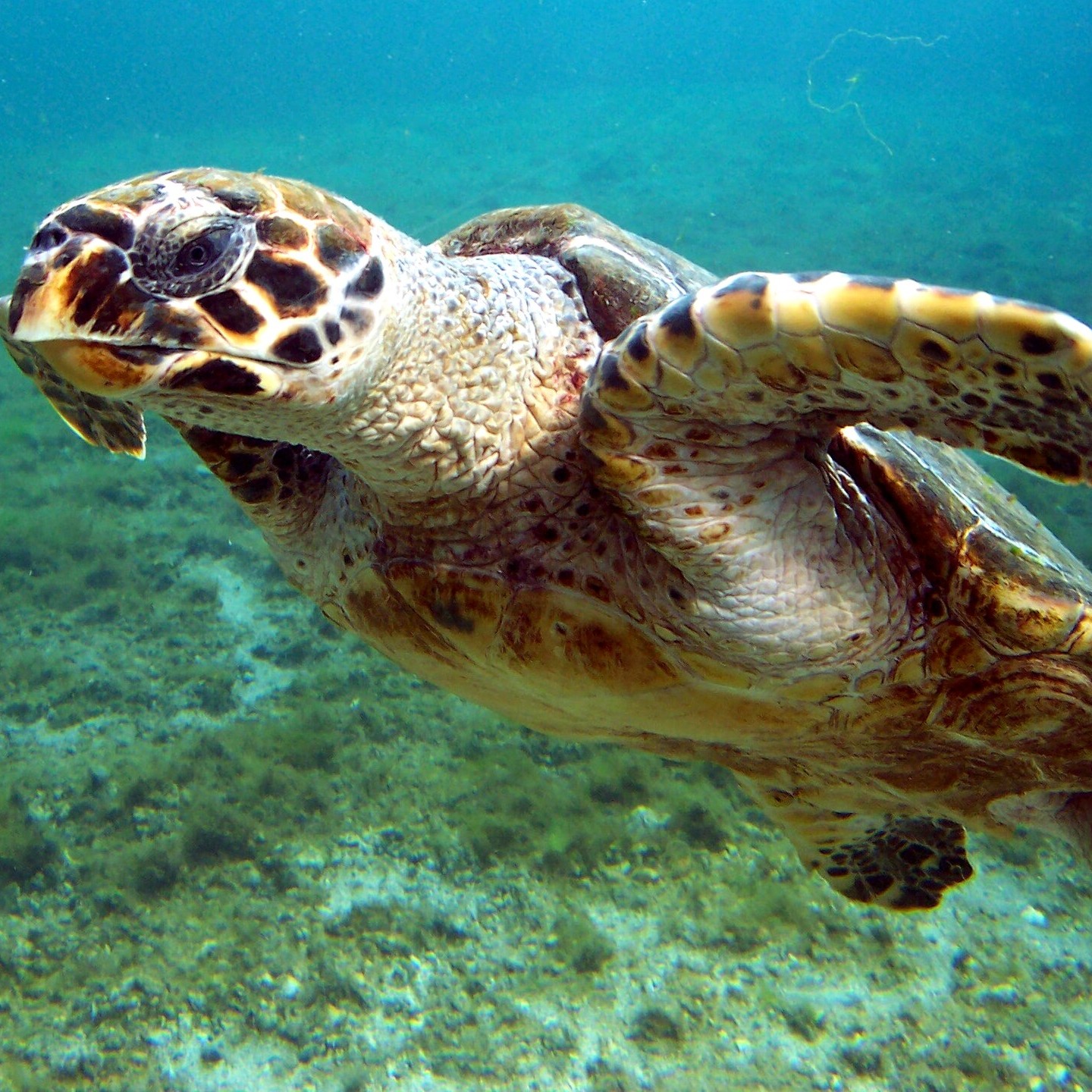
The hawksbill turtle (Eretmochelys imbricata) is the only living species of the genus Eretmochelys and one of the seven sea turtle species in the world, belonging to the family Cheloniidae. It is medium-sized within the group — the smallest of the sea turtles that nest in Costa Rica — with a slightly laterally compressed elliptical carapace of amber-brown color with radiating streaks of dark yellow, orange, and black that create a marbled pattern unique to each individual. The scutes of the carapace — the keratinous scales — overlap each other in young adults like roof tiles, a diagnostic feature that gives the species its name (imbricata = arranged in imbricated, overlapping fashion) and that is partially lost in older adults where the scales flatten. The head is narrow and elongated with a pointed, downward-curving beak similar to a hawk's bill — hence the English name 'hawksbill' — perfectly adapted to extract sponges from coral reef crevices. The eyes are large and dark. The anterior flippers are long and powerful, with two visible claws on the leading edge. The skin color is yellowish-brown with dark spots. Adult males have a longer, thicker tail with greater basal musculature than females, and the front flippers end in a more prominent curved claw. The species has a circum-tropical distribution, present in all tropical oceans of the world between latitudes 30°N and 30°S.
Added by
Anonymous Curator
Reviewed by
Under Review
Last modified by
Julia Trouin
Taxonomy
PhylumChordata
ClassReptilia
OrderTestudines
FamilyCheloniidae
GenusEretmochelys
Taxonomic Authority(Linnaeus, 1766)
Ecology & Status
Origin
Native
Population Trend
Decreasing
Breeding Season
--
Trophic Role
--
Recent Sightings
Yes
Habitat Summary Multi-lang
The hawksbill turtle occupies a series of specific marine habitats throughout its life cycle, with a critical dependence on coral reefs and seagrass beds. Adults and subadults forage exclusively or almost exclusively on coral reefs, sponge beds, and shallow rocky bottoms (2 to 30 meters depth), where sponges — their main food — grow in reef crevices and walls. Pelagic juveniles spend their first years in oceanic currents of open waters among floating sargassum masses. Reproductive adults nest on tropical and subtropical beaches of fine or coarse sand with direct access to the reef. In Costa Rica, the species is most frequent in the Caribbean, especially in Cahuita National Park, Isla del Caño Biological Reserve, Gandoca-Manzanillo National Wildlife Refuge, and the reef waters of the Mesoamerican Reef Corridor. In the Pacific it is less frequent but recorded in the Golfo Dulce, Isla del Coco, and reef zones of the Central and South Pacific. It needs relatively intact nesting beaches — with moderate slope, compact sand, and without severe nocturnal light pollution — within walking distance of reef foraging zones.Behaviour Multi-lang
The hawksbill turtle is primarily solitary and spends most of its adult life foraging on coral reefs in its distribution area. Adults are benthic animals that move relatively slowly through the reef, exploring crevices and walls with their bill in search of sponges. They can dive to 30 meters depth although most foraging occurs between 2 and 15 meters. They are partly nocturnal in areas of high predation pressure — resting during the day in reef crevices — although in protected zones they are active both day and night. Breathing is obligatorily aerial: they must surface every 45-90 minutes when active, though they can remain submerged for up to 3-4 hours at rest with reduced metabolism. They are not territorial and the home ranges of different individuals overlap broadly. They are relatively calm in temperament when encountered by divers — unlike the more flighty character of other sea turtles — making them a star attraction of Costa Rican diving but also making them more vulnerable to direct human disturbance.Social Activity Multi-lang
The hawksbill turtle is essentially solitary throughout its adult aquatic life phase. Individuals forage alone, sleep alone on the reef, and only congregate transiently during the mating season in the vicinity of nesting beaches. Mating occurs in the water, often in shallow waters near the nesting beach, and may involve multiple males competing for a single female. Females store sperm and can fertilize multiple clutches with the sperm from a single mating or from multiple males during the same season. During nesting, females come ashore solitarily, generally at night, and do not socially interact with other females nesting simultaneously on the same beach. There is no parental care of any kind after laying: the female abandons the clutch immediately after covering it.Feeding Guild Multi-lang
Specialized spongivore with opportunistic supplement of soft benthic invertebrates. 70-95% of the diet consists of benthic marine sponges, with preference for high-toxin and spicule-content sponges that most other marine predators cannot consume — Geodia, Chondrilla, Aplysina, Ircinia, and other Demospongiae. The remaining 5-30% includes jellyfish, sessile tunicates (ascidians), crinoids, sea anemones, calcareous algae, soft mollusks (nudibranchs, small gastropods), soft echinoderms, and occasionally small, slow fish. It forages exclusively on the coral and rocky benthos, using the narrow bill to extract prey from crevices and walls inaccessible to other species. It does not exhibit active hunting behavior for fast mobile prey.Trophic Chain Details Multi-lang
Specialized secondary consumer of benthic sponges (spongivore), with a unique trophic position in the coral reef that no other vertebrate species can equivalently occupy. Its diet consists primarily (70-95%) of sponges of the classes Demospongiae and Calcarea, especially genera such as Geodia, Chondrilla, Aplysina, Ircinia, Neopetrosia, and Anthosigmella — all highly toxic to most predators. The remaining 5-30% includes jellyfish, tunicates, crinoids, anemones, algae, soft mollusks, and occasionally fish. By controlling sponge populations on the reef, the hawksbill acts as an ecological regulator that prevents the overabundance of sponges competing for coral space, being a first-order structuring component of the reef ecosystem. Its main predators at sea are the tiger shark (Galeocerdo cuvier) and lemon shark (Negaprion brevirostris) for adult individuals, the blacktip shark (Carcharhinus limbatus) and bottlenose dolphin (Tursiops truncatus) for juveniles, and the orca (Orcinus orca) occasionally. On land, nesting females are vulnerable to the jaguar (Panthera onca) in the Costa Rican Caribbean and eggs are preyed upon by the coati (Nasua narica), raccoon (Procyon lotor), gray fox (Urocyon cinereoargenteus), and feral dogs.Reproductive Behaviour Multi-lang
The hawksbill turtle reaches sexual maturity between 20 and 35 years, the latest maturity of all species in the set. Females return to nest on the same beach where they were born, at a frequency of every 2 to 5 years between reproductive seasons. During an active reproductive season, a female can make 3 to 6 nests separated by periods of 13 to 18 days between successive layings. Mating occurs at sea, in the weeks before the first nesting of the season. Females come ashore exclusively at night, generally 2 to 3 hours after sunset, search for a site on the beach above the tide line, excavate with their rear flippers a nest 45 to 60 cm deep, deposit the eggs, carefully cover the nest, and return to the sea, all in 45 to 90 minutes. The clutch consists of 80 to 160 soft, flexible-shelled spherical eggs about 4 cm in diameter, whose incubation lasts 60 to 70 days depending on sand temperature. The sex of the hatchlings is determined by incubation temperature (environmental sex determination): temperatures above 29.5°C produce predominantly females and below 28.5°C predominantly males. Hatchlings — about 4 cm long and 15-20 g in weight — emerge from the nest collectively at night and run toward the sea guided by the luminous brightness of the marine horizon. Most perish before reaching the sea or in the first pelagic days.Physical Measures
Length (cm)
62.0 - 95.0 cm
Weight (Grams)
45.00 kg - 90.00 kg
Offspring per cycle80 - 160
Sexual DimorphismYes
Lifespan
Sexual Maturity
20 - 35 Years
Gestation / Incubation
60 - 70
Lifespan Estimated
Males30 - 50 Years
Females30 - 50 Years
Sexual Dimorphism
Males Multi-lang
The adult male is distinguishable from the female by three characteristics: (1) the tail, which is considerably longer, thicker, and more muscular at its base than the female's — the male's tail extends notably beyond the posterior margin of the carapace, up to 20-25 cm in large adult individuals, while the female's barely protrudes —; (2) the front flippers, which end in a more prominent and pronounced curved claw in the male, used to grip the female during mating; and (3) the inguinal region, where males display a more anterior and pronounced cloacal notch. Juveniles and subadults are sexually indistinguishable externally.
Females Multi-lang
The adult female has a short tail barely visible beyond the posterior margin of the carapace — generally less than 5 cm of visible length —, the flipper claw is smaller and less curved than the male's, and the cloacal region is more posterior. Female carapaces tend to be slightly proportionally wider than males' due to the need to accommodate the ovaries and body space required for egg production. Adult females and adult males are of the same general size. Juveniles of both sexes are completely indistinguishable externally before sexual maturity.
Evolutionary Adaptations Multi-lang
Narrow, downward-curved bill — analogous to a hawk's — that constitutes the species' most critical morphological adaptation and the most immediate anatomical difference from other sea turtles. This bill allows the hawksbill to insert itself into narrow coral reef crevices to extract sponges that other turtles cannot reach. The specialization on sponges — organisms that most vertebrates cannot consume due to their silica content, toxins, and antipalatable secondary compounds — is the result of a coevolution between the hawksbill's bill and its prey morphology spanning more than 60 million years.
Exceptional biochemical tolerance to sponge toxins: the sponges that constitute the hawksbill's primary diet contain some of the most potent marine toxins known — including spongiose toxins, tetrodotoxin derivatives, and cytotoxic compounds — which are lethal to most marine predators. The hawksbill can accumulate these toxins in its body without suffering adverse effects thanks to a specialized hepatic detoxification system, and its flesh becomes so toxic — especially in the Pacific where it consumes sponges with higher toxin loads — that it can cause the death of humans who consume it.
Long-range magnetic navigation: like all sea turtles, the hawksbill possesses magnetoreceptors in the head that allow it to detect the intensity and inclination of the Earth's magnetic field and use them as a high-precision navigation system at oceanic scale. Females use this system to return decades later to the exact beach where they were born — with position errors of less than one kilometer — to nest. This 'natal homing' is one of the most extraordinary animal navigation feats documented, comparable in precision to that of long-range migratory birds.
Imbricated scute carapace with simultaneous thermoregulatory and camouflage properties: the amber-black-orange marbled pattern of the carapace, produced by the arrangement of pigments in the keratin layers of the scutes, matches the colors and textures of the coral reef when sunlight penetrates the water at oblique angles. This cryptic coloration reduces the detectability of the turtle by large predators — sharks, orcas — when it rests motionless on the reef at night. Additionally, the multilayer structure of the imbricated scales provides exceptional mechanical rigidity that protects the carapace from impacts against corals and rocks during foraging.
Main Threats Multi-lang
Illegal carapace trade — 'carey' or Japanese 'bekko': the largest historical driver of the global collapse of hawksbill turtle populations has been systematic hunting to extract the carapace scutes, whose keratin presents a unique coloration and malleability making it the most coveted material from any sea turtle. Known as 'bekko' in Japan — where it was the preferred material for making eyeglass frames, combs, clasps, and luxury jewelry — and as 'carey' throughout Latin America and Spain, the shell trade led to the capture and slaughter of more than 9 million hawksbill turtles during the 20th century. Despite the international trade ban under CITES Appendix I (1977), illegal trade persists, especially toward Asia.
Degradation and loss of coral reefs due to mass bleaching associated with climate change, ocean acidification, pollution from agrochemicals and sediments, and destructive fishing activities (bottom trawling, dynamite fishing, cyanide). Coral reefs are the exclusive foraging habitat of adult hawksbill turtles and the source of their primary food: without functional reefs with diverse sponge communities, the species cannot survive even if nesting beaches are completely protected. The loss of 50% of Caribbean coral cover in the last 40 years has drastically reduced the habitat carrying capacity for the species throughout its range.
Incidental capture in fishing gear and vessel collisions: the hawksbill turtle becomes entangled in gillnets, pelagic longlines, fish traps, and trawl gear directed at other species, dying by drowning when unable to surface to breathe. In Costa Rica, bycatch in artisanal fisheries of the Caribbean and Pacific represents a significant mortality cause for juvenile and subadult individuals. Collisions with high-speed launches and ecotourism boats in reef zones additionally represent a documented cause of trauma and mortality in areas of high tourist frequency such as Cahuita National Park.
Interesting Facts Multi-lang
The scutes of the hawksbill turtle's carapace — Japanese 'bekko' — have been considered the most valuable natural material from the marine animal world for centuries: more prized than elephant ivory, pearl oyster nacre, or red coral, its price in Asian markets reached more than $1,000 per kilogram during the 20th century. This extreme valuation is the direct cause of the loss of more than 80% of the species' global population in the last 100 years — the most severe documented population reduction among all sea turtles — and the reason the IUCN has classified it as Critically Endangered since 1996, the highest threat status before extinction.
The hawksbill turtle is the only known vertebrate species capable of consuming siliceous marine sponges (Class Demospongiae) regularly and as its primary food. Sponges possess silica spicules — microscopic structures of biological glass — and a cocktail of toxins (halichondrins, discodermolide, latrunculins) that make them lethal or highly unpalatable to virtually all other vertebrates. Without the hawksbill as a biological controller of sponge communities, many of these would grow uncontrollably and colonize the coral substrate, smothering the reef-building corals. The hawksbill is thus a silent and irreplaceable ecosystem engineer of the tropical reef.
An adult hawksbill turtle can travel up to 2,400 km between its foraging zone and the nesting beach — which is invariably the same beach where it was born decades earlier — using the Earth's magnetic field as a navigation system. This natal fidelity phenomenon has been documented via satellite tagging in several turtles from the Costa Rican Caribbean that forage in the reef corridor waters of Belize, Honduras, and Mexico but return to nest specifically on the beaches of Gandoca and Manzanillo. The fidelity is so precise that researchers from CIMAR and WIDECAST have documented females nesting in the same beach section — with differences of less than 200 meters — in reproductive seasons separated by 3 to 5 years.
Hawksbill turtle meat can be toxic to humans in certain regions, especially in the Indo-Pacific tropics, where the sponges it consumes accumulate toxins that the turtle bioconcentrates in its tissues. Poisoning from hawksbill turtle consumption — known as 'chelonitoxism' — has caused hundreds of documented deaths in the South Pacific and India in the 20th century, with symptoms including paralysis, internal hemorrhage, and multiple organ failure. This toxicity is one of the reasons why, historically, many Pacific island cultures only valued the hawksbill for its shell and rejected its meat, while the shell trade was extremely intense.