
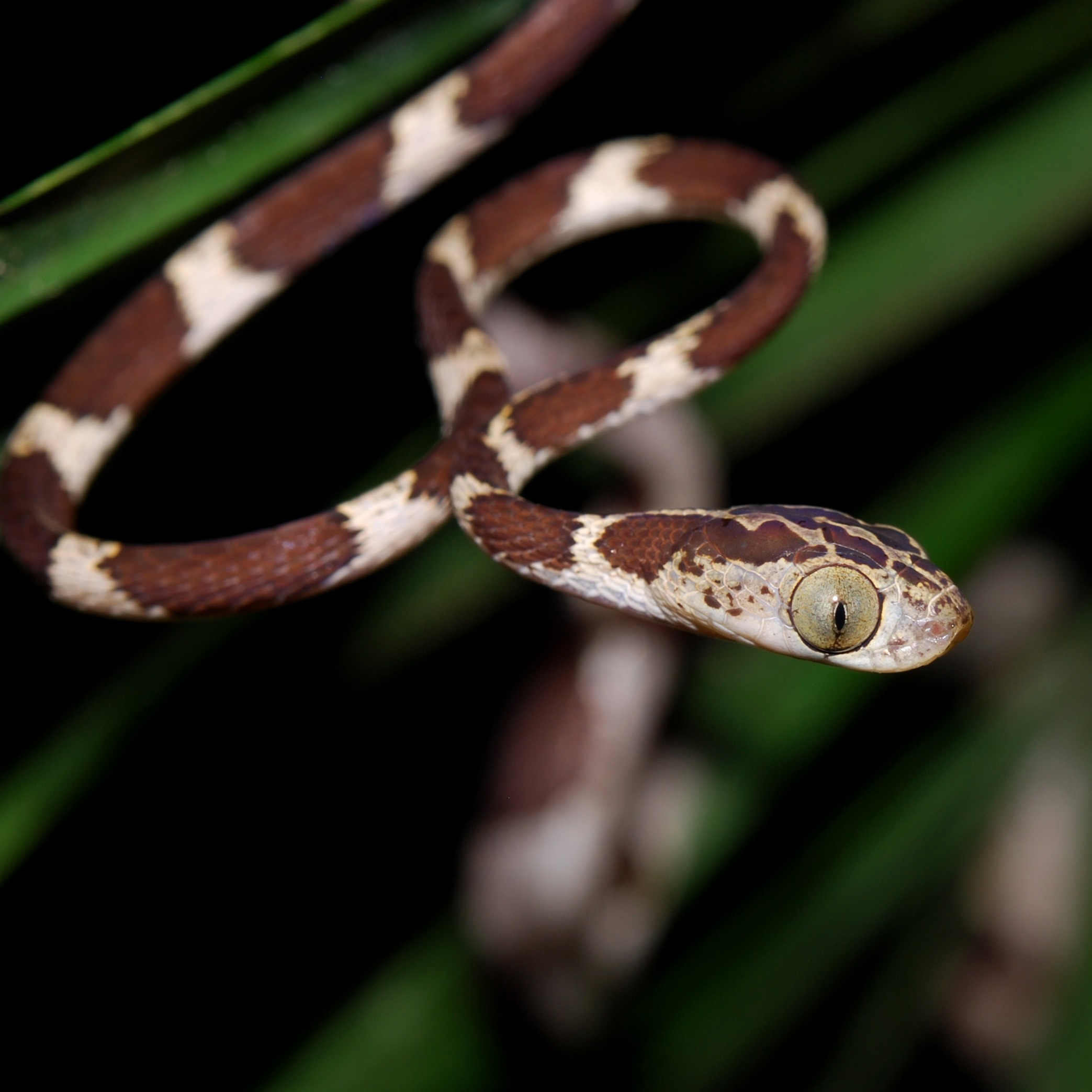
Imantodes cenchoa
Blunthead Tree Snake
(Linnaeus, 1758)
Added by
Anonymous Curator
Reviewed by
Under Review
Last modified by
Julia Trouin
TaxonomyBiological classification ranks placing this species within the tree of life, from Kingdom down to Genus.
Ecology & StatusHow this species lives: habitat preferences, diet, behavior, population status, and role in its ecosystem.
OriginWhether the species is native (evolved here), endemic (found only here), or introduced by human activity.
Native
Population TrendDirection of change in population size over time: increasing, stable, decreasing, or unknown.
Stable
Breeding SeasonTime of year when this species typically reproduces or flowers.
Wet Season
Trophic RolePosition in the food chain: producer, herbivore, carnivore, omnivore, decomposer, or parasite.
Carnivore
Recent SightingsWhether this species has been observed in the wild in Costa Rica within recent years.
Yes
Habitat SummaryOverview of the specific ecosystems and environments where this species is found in Costa Rica. Multi-lang
It primarily inhabits the low and middle strata of tropical rainforests, secondary forests, forest edges, and shaded perennial plantations such as coffee and cacao in the lowlands and premontane slopes of the Neotropics. It is widely distributed from Mexico, through all of Central America (being extremely common on both the Caribbean and Pacific slopes of Costa Rica), to the Amazon basin in South America. It is found from sea level up to approximately 1,500 meters in altitude, preferring areas with dense shrubby vegetation, vines, and the presence of bromeliads.BehaviourDaily activity patterns, movement, territory use, foraging style, and seasonal behavioral changes. Multi-lang
It is a strictly nocturnal and solitary reptile. It spends the day hidden in safe, humid sites such as the interior of large bromeliads, under loose bark, holes in rotting logs, or dense tangles of thatch in rural roofs. At nightfall, it emerges and displays an active but leisurely foraging behavior, moving with extraordinary fluidity along thin branches, leaves, and vines, using its prehensile tail to anchor its body while inspecting vegetation.Social ActivitySocial structure: whether the species is solitary, paired, or colonial; hierarchy and communication. Multi-lang
It is a completely solitary animal that lacks any social structure or behavior. It does not tolerate the presence of other conspecifics and completely ignores any individual outside of brief reproductive encounters. Upon detecting human threats or large predators, its first line of defense is to freeze completely, mimicking a thin vine branch, or to let its body fall limply to the forest floor to disappear among the leaf litter.Feeding GuildWhat the species eats, how it forages or hunts, and its role as a consumer in the food web. Multi-lang
Carnivore insectivore and specialist in small understory vertebrates. It primarily consumes leaf-vegetation frogs, mature arboreal tadpoles in bromeliads, sleeping diurnal lizards, and small nocturnal geckos. It rarely consumes large soft-bodied insects.Trophic Chain DetailsSpecific interactions in local food webs: prey species, predators, competitors, and scavengers. Multi-lang
It functions as a highly specialized secondary consumer in the low and middle arboreal strata. Its primary prey consists of nocturnal anuran amphibians (such as frogs from the Craugastoridae and Hylidae families) and lizards of the genus Anolis that rest exposed. It occasionally extracts eggs from bird nests or consumes small arboreal geckos. In turn, due to its extreme slenderness and lack of lethal venom for macrovertebrates, it is frequent prey for ophiophagous snakes (such as Clelia clelia), nocturnal raptors (Pulsatrix perspicillata), and small omnivorous mammals like coatis.Reproductive BehaviourMating strategies, courtship displays, nesting or spawning behavior, and parental care. Multi-lang
It is an oviparous species. Courtship takes place on branches during the rainy season, where the male follows the female's pheromone trails. The female lays small clutches ranging from 2 to 8 elongated, flexible-shelled eggs, which she stealthily deposits in protected sites with constant high humidity, such as the interior of fallen log cavities or deep accumulations of humus within large epiphytes. The incubation period lasts approximately 60 to 90 days, depending on the forest's ambient temperature. At hatching, the neonates are perfect, miniaturized replicas of the adults, measuring about 20 to 25 cm in length, and are immediately completely independent to hunt small amphibians.Physical Measures
Length (cm)
80.0 - 110.0 cm
Weight (Grams)
35 g - 65 g
Lifespan
Sexual MaturityAge at which the individual becomes capable of reproducing for the first time.
2 - 3 Years
Gestation / IncubationDuration from fertilization to birth (mammals) or to hatching (egg-laying species).
60 - 90