
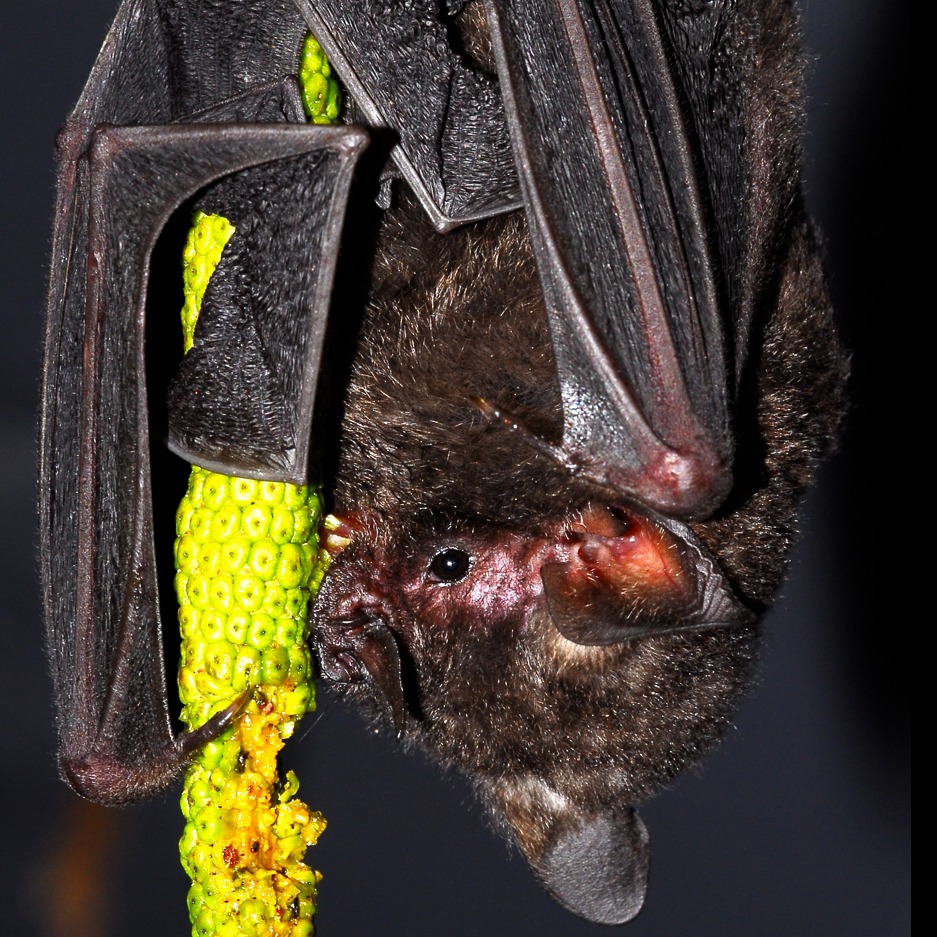
Carollia perspicillata
Seba's Short-tailed Bat
(Linnaeus, 1758)
Added by
Anonymous Curator
Reviewed by
Under Review
Last modified by
Julia Trouin
TaxonomyBiological classification ranks placing this species within the tree of life, from Kingdom down to Genus.
Ecology & StatusHow this species lives: habitat preferences, diet, behavior, population status, and role in its ecosystem.
OriginWhether the species is native (evolved here), endemic (found only here), or introduced by human activity.
Native
Population TrendDirection of change in population size over time: increasing, stable, decreasing, or unknown.
Stable
Breeding SeasonTime of year when this species typically reproduces or flowers.
Year Round
Trophic RolePosition in the food chain: producer, herbivore, carnivore, omnivore, decomposer, or parasite.
Herbivore
Recent SightingsWhether this species has been observed in the wild in Costa Rica within recent years.
Yes
Habitat SummaryOverview of the specific ecosystems and environments where this species is found in Costa Rica. Multi-lang
It is a habitat generalist, extremely adaptable and resilient to human disturbance. It thrives in primary wet forests but is even more abundant in secondary forests, ecotones, agricultural plantations, and rural gardens. To rest during the day, it uses a wide variety of dark roosts: caves, tunnels, abandoned mines, culverts, hollow logs, and often abandoned human structures. In Costa Rica, it is distributed throughout the territory from sea level to 1,500 meters in elevation.BehaviourDaily activity patterns, movement, territory use, foraging style, and seasonal behavioral changes. Multi-lang
It is an understory foraging bat. It goes out to forage right after sunset. It plucks the entire fruit in flight and takes it to a nocturnal 'feeding roost' to chew it, ingest the juice and small seeds, and spit out the fiber. They store an incredible spatial map in their memory, visiting the same patches of Piper plants night after night as new fruits ripen.Social ActivitySocial structure: whether the species is solitary, paired, or colonial; hierarchy and communication. Multi-lang
Highly gregarious species with a harem social structure. Colonies can group from dozens to hundreds of individuals. A dominant male actively defends a group of females (and the best roost site) against other rival males through vocalizations and wing strikes.Feeding GuildWhat the species eats, how it forages or hunts, and its role as a consumer in the food web. Multi-lang
Frugivore (Specialist in Piper spp., occasionally consumes insects and nectar).Trophic Chain DetailsSpecific interactions in local food webs: prey species, predators, competitors, and scavengers. Multi-lang
Primary consumer (Frugivore). Being so abundant, they are a fundamental link in the diet of nocturnal raptors, arboreal snakes (boas), giant cave spiders, and carnivorous bats like Vampyrum spectrum.Reproductive BehaviourMating strategies, courtship displays, nesting or spawning behavior, and parental care. Multi-lang
They exhibit bimodal polyestry, with two birth peaks per year that evolved to coincide with the maximum fruiting level of the forest (typically March-May and June-August). Gestation lasts 115 to 120 days. A single pup is born covered in sparse fur and with open eyes. The mother carries the pup during foraging flights for the first few days, a tremendous energetic cost.Physical Measures
Length (cm)
4.5 - 6.5 cm
Weight (Grams)
15 g - 25 g
Lifespan
Sexual MaturityAge at which the individual becomes capable of reproducing for the first time.
12 - 18 Months
Gestation / IncubationDuration from fertilization to birth (mammals) or to hatching (egg-laying species).
115 - 120