
Costa Rica Species
Galbula ruficauda
AnimaliaHighest rank in taxonomy. Groups all life into domains: Animalia, Plantae, Fungi, etc.IUCN LCInternational Union for Conservation of Nature — the world authority on species extinction risk, using standardized criteria. — Least Concern — widespread and abundant; not at immediate risk of extinction.In ProgressCurrent stage of this record in the editorial review workflow. Recent Sighting

Galbula ruficauda

Rufous-tailed Jacamar

Cuvier, 1816

Detailed Texts Multi-lang
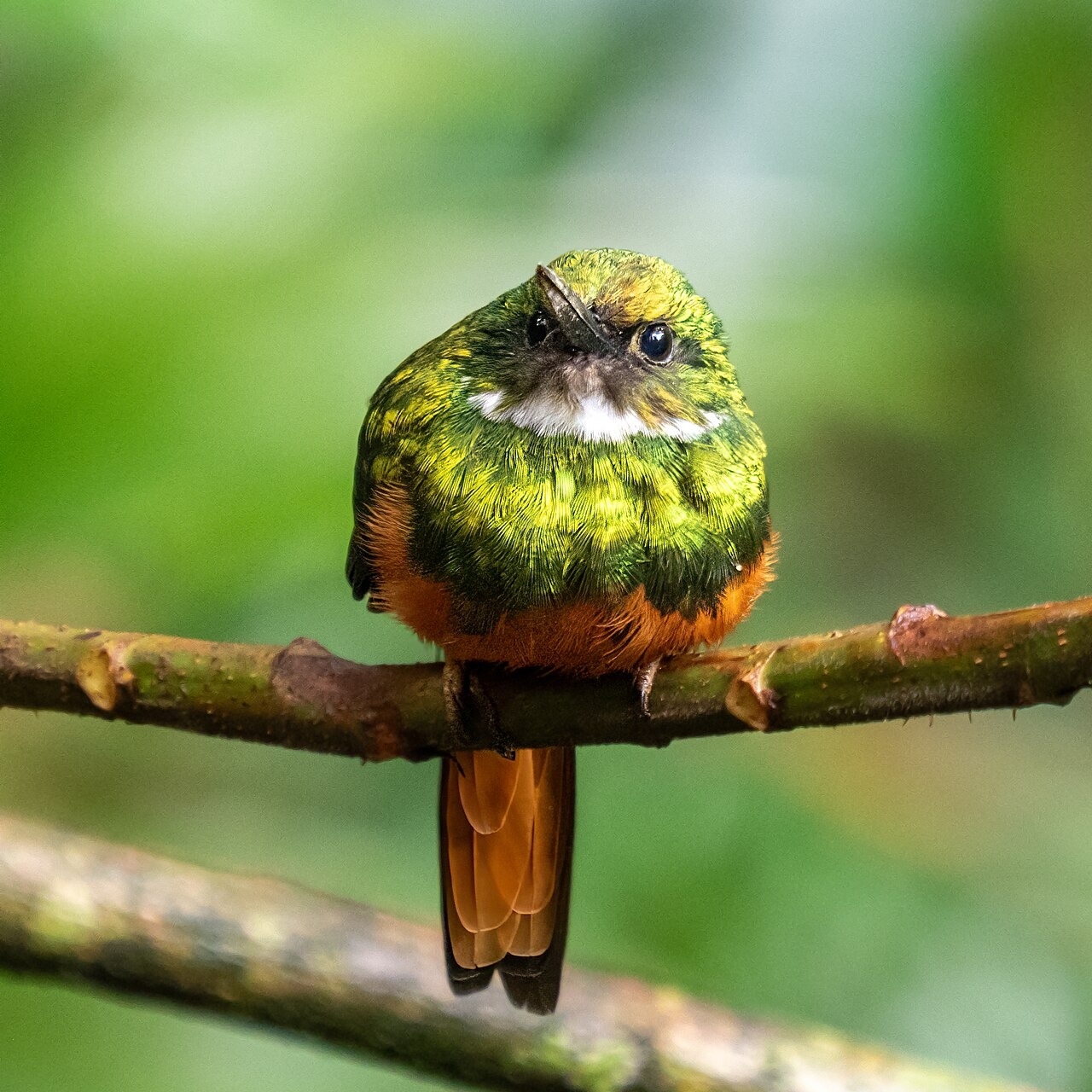
The Rufous-tailed Jacamar (Galbula ruficauda) is a slender, medium-sized bird of extraordinary elegance. Its head, mantle, and upper chest boast a dazzling metallic emerald green color that flashes gold and copper under direct sunlight. Its belly and the underside of its long, pointed tail are a rich rufous (reddish-orange) color. The most formidable feature of its anatomy is its bill: black, perfectly straight, thin, and exceptionally long (like a large needle), designed to act as precision tweezers in the air. Its legs are very short, with a zygodactyl arrangement, ideal for clinging securely to thin branches while stalking.

Added by

Anonymous Curator

Reviewed by

Under Review

Last modified by

Julia Trouin

TaxonomyBiological classification ranks placing this species within the tree of life, from Kingdom down to Genus.

PhylumRank below Kingdom. Groups organisms sharing a fundamental body plan (e.g., Chordata = vertebrates and some invertebrates).Chordata
ClassRank below Phylum. Subdivides by structural traits (e.g., Mammalia, Aves, Reptilia, Insecta).Aves
OrderRank below Class. Groups related families sharing common ancestry (e.g., Carnivora, Primates).Galbuliformes
FamilyRank below Order. Groups closely related genera (e.g., Felidae = cats, Canidae = dogs).Galbulidae
GenusRank just above Species. The first word in the two-part binomial scientific name.Galbula
Taxonomic AuthorityThe scientist who first formally described and published this species, followed by the year of publication.Cuvier, 1816
Record Completeness
85%
Coming soon

Ecology & StatusHow this species lives: habitat preferences, diet, behavior, population status, and role in its ecosystem.

OriginWhether the species is native (evolved here), endemic (found only here), or introduced by human activity.

Native

Population TrendDirection of change in population size over time: increasing, stable, decreasing, or unknown.

Decreasing

Breeding SeasonTime of year when this species typically reproduces or flowers.

Dry Season

Trophic RolePosition in the food chain: producer, herbivore, carnivore, omnivore, decomposer, or parasite.

Insectivore

Recent SightingsWhether this species has been observed in the wild in Costa Rica within recent years.

Yes

Habitat SummaryOverview of the specific ecosystems and environments where this species is found in Costa Rica. Multi-lang

It strongly prefers the edges of humid and dry forests, gallery forests along rivers, tall scrublands, and dense secondary growth. It rarely ventures into the dark interior of closed primary forests, preferring to hunt in transition zones (ecotones) where light penetrates and attracts flying insects. In Costa Rica, it is very common in the lowlands of the Pacific slope, the Central Valley, and parts of the Caribbean, from sea level up to 1,200 meters.

BehaviourDaily activity patterns, movement, territory use, foraging style, and seasonal behavioral changes. Multi-lang

It is a classic sit-and-wait hunter. It perches upright and completely still on a thin branch in the mid-story, moving only its head slowly from side to side to scan the air. When it spots a butterfly or dragonfly, it darts out in a lightning-fast direct flight, catches it mid-air with an audible snap of its bill, and glides back to the exact same perch to process its meal. They are territorial and very noisy birds, emitting a trilled song that accelerates into a squeak ('peep... pe-pe-pe-pe-peep!').

Social ActivitySocial structure: whether the species is solitary, paired, or colonial; hierarchy and communication. Multi-lang

They are normally observed in monogamous pairs throughout the year, or in small family groups (parents with recent fledglings). They maintain frequent vocal contact and jealously defend their hunting territory from other jacamars.

Feeding GuildWhat the species eats, how it forages or hunts, and its role as a consumer in the food web. Multi-lang

Aerial sally-striker insectivore.

Trophic Chain DetailsSpecific interactions in local food webs: prey species, predators, competitors, and scavengers. Multi-lang

Carnivore (Strictly Insectivore). It specializes in large flying insects, particularly diurnal butterflies (even the gigantic blue Morphos), dragonflies, bees, wasps, and large flies. Because of their exposed stalking posture, they occasionally fall victim to surprise attacks by small falcons (such as the Bat Falcon or Merlin) and agile arboreal snakes.

Reproductive BehaviourMating strategies, courtship displays, nesting or spawning behavior, and parental care. Multi-lang

They are monogamous birds. The pair collaborates using their bills and feet to excavate a deep cylindrical burrow (between 30 and 50 cm in length) in the vertical wall of an earth ravine, a riverbank, or even in the soil of uprooted tree roots; they occasionally nest in arboreal termitaria. They do not line the bottom of the nest. The female lays 2 to 4 round white eggs. Incubation is shared by the pair for about 19 to 23 days. The chicks hatch covered in dense down (unusual for this order) and are fed by both parents with large quantities of whole butterflies until they fledge at 21-26 days.

Physical Measures

Length (cm)

22.0 - 28.0 cm

Weight (Grams)

20 g - 30 g

Offspring per cycleTypical number of young (live births, eggs, or seeds) produced by one adult in a single reproductive event or breeding season.2 - 4
Sexual DimorphismObservable physical differences between males and females of the same species (e.g., size, coloration, features).Yes

Lifespan

Sexual MaturityAge at which the individual becomes capable of reproducing for the first time.

12 - 24 Months

Gestation / IncubationDuration from fertilization to birth (mammals) or to hatching (egg-laying species).

19 - 23

Lifespan EstimatedExpected duration of life from birth to natural death under wild conditions.
Males5 - 8 Years
Females5 - 8 Years

Sexual DimorphismPhysical differences in size, coloration, or morphology between males and females of this species.

Males Multi-lang

The adult male possesses a very bright and well-defined pure white patch on the throat, right below the bill, which contrasts dramatically with the green of the chest.

Females Multi-lang

The female is identical in size and proportions, but her throat is a pale rufous, cinnamon, or buff tone, completely lacking the dazzling white patch of the male.

Evolutionary AdaptationsInherited traits and behaviors that improve the species' survival and reproduction in its specific environment. Multi-lang

Precision Tweezers Beak: Its unusually long and thin bill is evolutionarily designed to catch dangerous insects (like wasps and bees) in mid-air, keeping them at a safe distance from its eyes and face to avoid fatal stings.
Butterfly Processing (Wing-beating): It is a specialist predator of large butterflies. After catching its prey in flight, it returns to its branch and violently beats the butterfly against the wood to snap off the large scaly wings, swallowing only the nutritious body.

Main ThreatsDocumented pressures reducing the population: habitat loss, hunting, disease, climate change, and invasive species. Multi-lang

Pesticide and Agrochemical Use: Being strict and exclusively insectivorous birds, the fumigation of agricultural crops and pastures adjacent to their forests eradicates their food source and causes fatal secondary poisoning.
Erosion and Ravine Destruction: They forcibly need earthen walls, ravines, and clay riverbanks to excavate their nests. The destruction of these slopes by mining, cattle ranching, or the diversion of water channels makes their reproduction impossible.

Interesting FactsSurprising or notable facts that highlight what makes this species unique or ecologically important. Multi-lang

The Fake Giant Hummingbird: Due to its dazzling iridescent metallic green color, its long pointed bill, and its quick movements, tourists and inexperienced observers frequently confuse the jacamar with a giant hummingbird, even though their diets and evolutionary history are completely different.
Wasp Hunters: They are not afraid of venomous insects. They are expert hunters of large bees and formidable wasps. They catch them by the thorax with the tip of their bill and immediately beat them furiously to snap off the stinger before swallowing them.