Costa Rica Species
Trogon melanocephalus
AnimaliaHighest rank in taxonomy. Groups all life into domains: Animalia, Plantae, Fungi, etc.IUCN LCInternational Union for Conservation of Nature — the world authority on species extinction risk, using standardized criteria. — Least Concern — widespread and abundant; not at immediate risk of extinction.In ProgressCurrent stage of this record in the editorial review workflow. Recent Sighting

Trogon melanocephalus

Black-headed Trogon

Gould, 1836

Detailed Texts Multi-lang
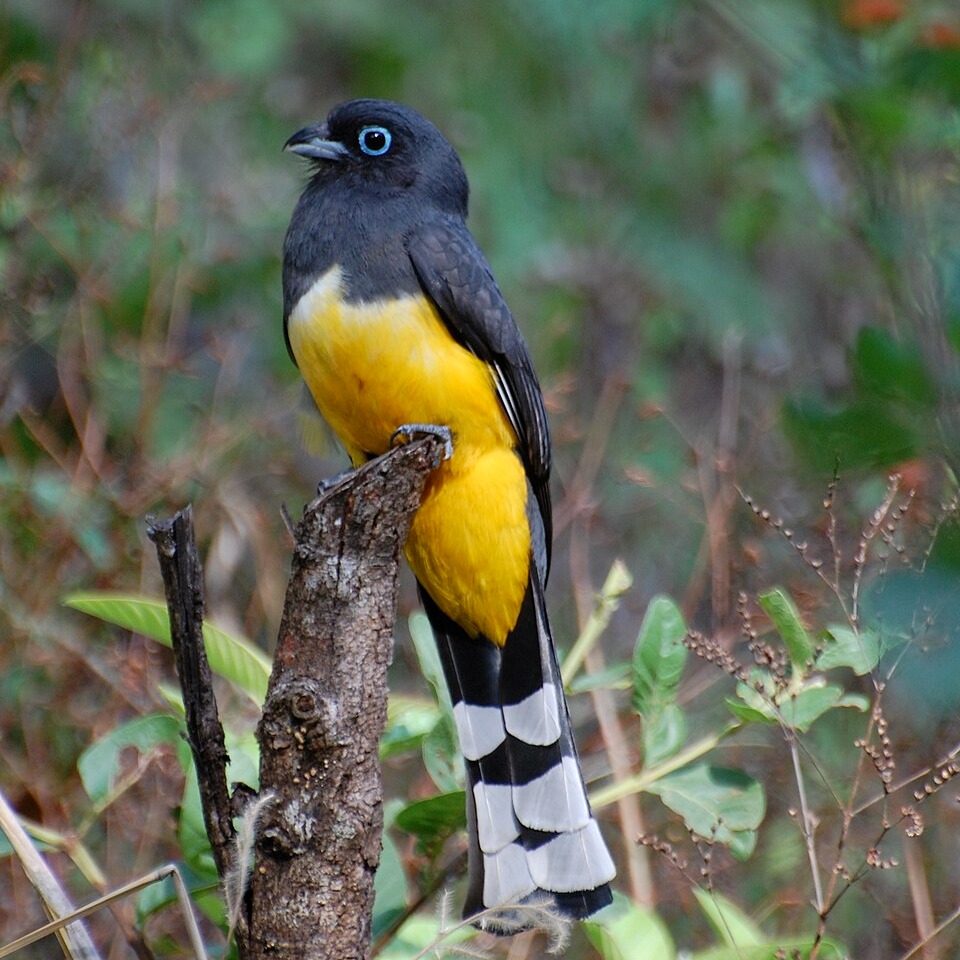
The Black-headed Trogon (Trogon melanocephalus) is a medium-sized bird with a characteristic upright posture and contrasting coloration. The adult male is unmistakable: its head, neck, and upper chest are a deep matte black, which contrasts dramatically with a bright, intense yellow belly. Its back and rump gleam with metallic green or blue-green tones depending on the light. Its most distinctive facial feature is a thick ring of bare, pale sky-blue skin around the eye. The underside of the tail is black, with large white panels at the tips of the outer feathers. Females share the yellow belly, but their head and back are a dark slate gray, and their blue eye-ring is much thinner or almost absent.

Added by

Anonymous Curator

Reviewed by

Under Review

Last modified by

Julia Trouin

TaxonomyBiological classification ranks placing this species within the tree of life, from Kingdom down to Genus.

PhylumRank below Kingdom. Groups organisms sharing a fundamental body plan (e.g., Chordata = vertebrates and some invertebrates).Chordata
ClassRank below Phylum. Subdivides by structural traits (e.g., Mammalia, Aves, Reptilia, Insecta).Aves
OrderRank below Class. Groups related families sharing common ancestry (e.g., Carnivora, Primates).Trogoniformes
FamilyRank below Order. Groups closely related genera (e.g., Felidae = cats, Canidae = dogs).Trogonidae
GenusRank just above Species. The first word in the two-part binomial scientific name.Trogon
Taxonomic AuthorityThe scientist who first formally described and published this species, followed by the year of publication.Gould, 1836
Record Completeness
85%
Coming soon

Ecology & StatusHow this species lives: habitat preferences, diet, behavior, population status, and role in its ecosystem.

OriginWhether the species is native (evolved here), endemic (found only here), or introduced by human activity.

Native

Population TrendDirection of change in population size over time: increasing, stable, decreasing, or unknown.

Stable

Breeding SeasonTime of year when this species typically reproduces or flowers.

Dry Season

Trophic RolePosition in the food chain: producer, herbivore, carnivore, omnivore, decomposer, or parasite.

Insectivore

Recent SightingsWhether this species has been observed in the wild in Costa Rica within recent years.

Yes

Habitat SummaryOverview of the specific ecosystems and environments where this species is found in Costa Rica. Multi-lang

It is predominantly a species of dry and semi-arid lowlands. It prefers deciduous forests, savannas with scattered trees, forest edges, gallery forests, dense secondary scrub, and mangroves. It avoids dark, dense rainforests. In Costa Rica, it is a classic and iconic inhabitant of the northwestern region (Guanacaste, Nicoya Peninsula) and parts of the northern plains, tolerating hot, dry climates well from sea level up to about 900 meters in elevation.

BehaviourDaily activity patterns, movement, territory use, foraging style, and seasonal behavioral changes. Multi-lang

They are solitary birds or travel in pairs. They spend a lot of time sitting silently and motionless on mid-level horizontal branches, carefully watching their surroundings. They have a direct but undulating and silent flight. During the breeding season, males emit a very characteristic territorial call from the canopy: a rhythmic, accelerating, guttural series of notes like 'coo-coo-coo-cwa-cwa-cwa', which echoes widely through the dry forests.

Social ActivitySocial structure: whether the species is solitary, paired, or colonial; hierarchy and communication. Multi-lang

They are solitary birds by nature, though they almost always form stable pairs during the breeding season and defend a territory. They do not form flocks or interact socially with other species.

Feeding GuildWhat the species eats, how it forages or hunts, and its role as a consumer in the food web. Multi-lang

Omnivore / Hover-gleaner.

Trophic Chain DetailsSpecific interactions in local food webs: prey species, predators, competitors, and scavengers. Multi-lang

Omnivore. Its diet is mixed; they consume a wide variety of small fruits (ficus, wild berries) which they swallow whole, later regurgitating the seeds, making them excellent dispersers. They supplement their diet with large insects (caterpillars, grasshoppers, cicadas, beetles) that they catch in flight or snatch from leaves. Their nests can be raided by arboreal snakes and the adults hunted by forest falcons (Micrastur).

Reproductive BehaviourMating strategies, courtship displays, nesting or spawning behavior, and parental care. Multi-lang

They are monogamous birds. The pair works as a team to excavate a cavity using their bills. They choose a large black termite mound hanging from a tree, or sometimes wasp nests or rotting wood. They dig an upward-sloping tunnel ending in an oval chamber. The female typically lays 2 to 3 pure white eggs directly on the debris at the bottom (without extra nesting material). Both parents share incubation, which lasts about 18 to 19 days, and collaborate intensely to feed the altricial chicks with insects and fruit until they fledge at about 25 days.

Physical Measures

Length (cm)

27.0 - 29.0 cm

Weight (Grams)

60 g - 90 g

Offspring per cycleTypical number of young (live births, eggs, or seeds) produced by one adult in a single reproductive event or breeding season.2 - 3
Sexual DimorphismObservable physical differences between males and females of the same species (e.g., size, coloration, features).Yes

Lifespan

Sexual MaturityAge at which the individual becomes capable of reproducing for the first time.

12 - 24 Months

Gestation / IncubationDuration from fertilization to birth (mammals) or to hatching (egg-laying species).

18 - 19

Lifespan EstimatedExpected duration of life from birth to natural death under wild conditions.
Males7 - 12 Years
Females7 - 12 Years

Sexual DimorphismPhysical differences in size, coloration, or morphology between males and females of this species.

Males Multi-lang

Matte black head and upper chest, metallic green back, bright yellow belly, and a conspicuous, thick bare eye-ring of pale sky-blue color.

Females Multi-lang

Head, chest, and back are dark slate-gray to brownish. Yellow belly. The blue eye-ring is very thin and fragmented, or completely absent.

Evolutionary AdaptationsInherited traits and behaviors that improve the species' survival and reproduction in its specific environment. Multi-lang

Heterodactyl Feet: All trogons possess a toe configuration unique in the avian world called heterodactyly (digits 3 and 4 point forward, while 1 and 2 point backward). This special anatomy allows them to grip horizontal branches firmly, enabling them to maintain their characteristic upright and motionless posture for long hours with minimal energy expenditure.
Hover-gleaning: Although they spend much time still, their feeding method is highly active. Upon locating a fruit or insect on the tip of a branch too thin to support their weight, the trogon flies towards it and hovers in the air (fluttering rapidly) for a brief second to snatch its prize with its bill without ever landing.

Main ThreatsDocumented pressures reducing the population: habitat loss, hunting, disease, climate change, and invasive species. Multi-lang

Loss of Nesting Sites: Because they depend strictly on large arboreal termite nests to reproduce, the felling of mature trees or the cleaning of termitaria on cattle ranches and agricultural farms directly eliminates their ability to nest.
Forest Fires: Usually confined to deciduous dry forest ecosystems, forest fires (often deliberately set to renew cattle pastures) during the dry season can devastate their habitat and nests.

Interesting FactsSurprising or notable facts that highlight what makes this species unique or ecologically important. Multi-lang

Nesting with the Enemy: To protect their young, Black-headed Trogon pairs excavate their nest directly inside large black arboreal termite mounds, or even in massive active paper wasp nests. Surprisingly, the host insects usually tolerate the birds or seal off the trogon's nest chamber, providing them with a nearly impenetrable fortress against predators like monkeys or snakes.
Sedentary Ninjas: Despite their brilliant colors (neon yellow and metallic green), they are very difficult to spot. This is due to their survival strategy: they perch under the shaded canopy with their backs to observers (showing their dark green/grey back) and remain absolutely motionless for long periods, becoming invisible among the leaves.