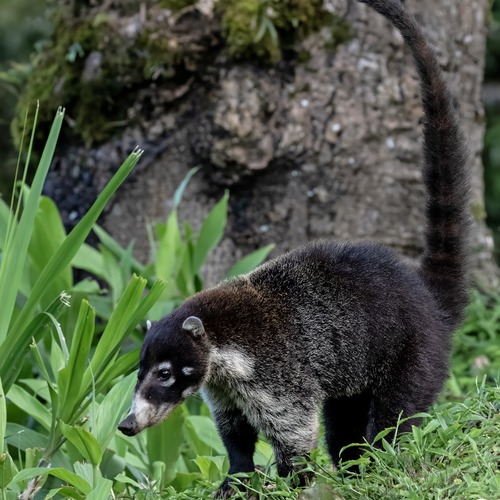
Nasua narica
White-nosed Coati
Linnaeus, 1766
Added by
Anonymous Curator
Reviewed by
Under Review
Last modified by
Julia Trouin
TaxonomyBiological classification ranks placing this species within the tree of life, from Kingdom down to Genus.
Ecology & StatusHow this species lives: habitat preferences, diet, behavior, population status, and role in its ecosystem.
OriginWhether the species is native (evolved here), endemic (found only here), or introduced by human activity.
Native
Population TrendDirection of change in population size over time: increasing, stable, decreasing, or unknown.
Increasing
Breeding SeasonTime of year when this species typically reproduces or flowers.
--
Trophic RolePosition in the food chain: producer, herbivore, carnivore, omnivore, decomposer, or parasite.
Omnivore
Recent SightingsWhether this species has been observed in the wild in Costa Rica within recent years.
Yes
Habitat SummaryOverview of the specific ecosystems and environments where this species is found in Costa Rica. Multi-lang
They inhabit tropical humid forests from sea level to 2,500 meters altitude. They prefer primary and secondary forests with closed canopy, although they adapt well to forest fragments and areas with dense secondary vegetation. They are found mainly in tropical humid forest life zones. They are primarily arboreal animals but frequently descend to the ground. They can occupy modified habitats such as forest edges, dense plantations, and parks with large trees.BehaviourDaily activity patterns, movement, territory use, foraging style, and seasonal behavioral changes. Multi-lang
Highly gregarious and social animals that live in groups of 4 to 25 individuals, usually led by dominant females. They are mainly diurnal, active in the early morning and at dusk. They spend most of their time in trees, but regularly descend to the ground to forage. They are excellent climbers and use their long tail to maintain balance. They build shelters in tree hollows or in complex branch structures. They are very vocal animals with a complex repertoire of sounds.Social ActivitySocial structure: whether the species is solitary, paired, or colonial; hierarchy and communication. Multi-lang
Highly social animals living in bands of 4 to 25 individuals led by adult females. There is a clear hierarchy with dominant and subordinate positions. Complex communication through vocalizations (grunts, clicks, whistles), body signals and chemical marking. Frequent social interaction including mutual grooming. Groups use a wide home range and regularly patrol to defend their territories.Feeding GuildWhat the species eats, how it forages or hunts, and its role as a consumer in the food web. Multi-lang
Omnivorous with a predominantly frugivorous diet (85%) but opportunistic and flexible. They feed on fruits, insects, small vertebrates and occasionally honey. They forage mainly in the forest canopy but also on the ground.Trophic Chain DetailsSpecific interactions in local food webs: prey species, predators, competitors, and scavengers. Multi-lang
They are mainly frugivorous, feeding on more than 90 species of fruits, especially of the genera Ficus, Dendropanax and Cecropia. They supplement their diet with small vertebrates (lizards, small snakes, frogs), invertebrates (insects, spiders), bird eggs and occasionally vegetation. They are predators of small mammals and amphibians. They play an important role in seed dispersal in the tropical forest.Reproductive BehaviourMating strategies, courtship displays, nesting or spawning behavior, and parental care. Multi-lang
Reproduction mainly from July to November with peaks in August-September. Females give birth in arboreal shelters. Aggressive interactions between males are observed during breeding season. Males participate little in offspring care.Physical Measures
Length (cm)
41.0 - 69.0 cm
Weight (Grams)
3.60 kg - 6.30 kg
Lifespan
Sexual MaturityAge at which the individual becomes capable of reproducing for the first time.
1.5 - 2.5 Years
Gestation / IncubationDuration from fertilization to birth (mammals) or to hatching (egg-laying species).
60 - 75