
AnimaliaIUCN LCIn Progress Recent Sighting
Nasua narica
White-nosed Coati
Linnaeus, 1766
Detailed Texts Multi-lang
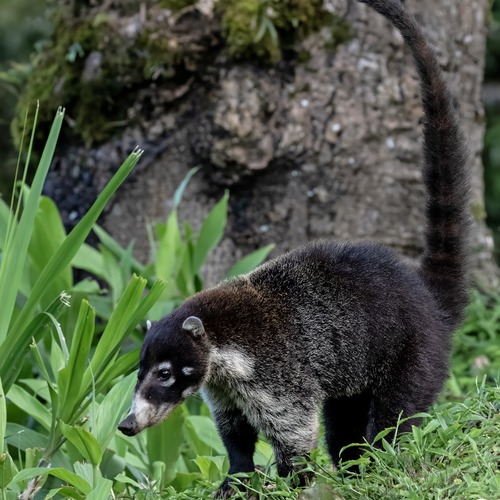
The white-nosed coati is a medium-sized mammal belonging to the Procyonidae family. It features an elongated and slender body with short legs, a small head with a characteristic elongated and pointed snout of white or grayish coloration. The ears are small and rounded. The tail is long and robust, frequently held erect, with black and orange bands that vary in pattern between individuals. The fur is coarse and generally dark brown to grayish in color. Males are considerably larger than females. They are very active, curious, intelligent, and gregarious animals that live organized in matriarchal groups of 4 to 25 individuals.
Added by
Anonymous Curator
Reviewed by
Under Review
Last modified by
Julia Trouin
Taxonomy
PhylumChordata
ClassMammalia
OrderCarnivora
FamilyProcyonidae
GenusNasua
Taxonomic AuthorityLinnaeus, 1766
Ecology & Status
Origin
Native
Population Trend
Increasing
Breeding Season
--
Trophic Role
Omnivore
Recent Sightings
Yes
Habitat Summary Multi-lang
They inhabit tropical humid forests from sea level to 2,500 meters altitude. They prefer primary and secondary forests with closed canopy, although they adapt well to forest fragments and areas with dense secondary vegetation. They are found mainly in tropical humid forest life zones. They are primarily arboreal animals but frequently descend to the ground. They can occupy modified habitats such as forest edges, dense plantations, and parks with large trees.Behaviour Multi-lang
Highly gregarious and social animals that live in groups of 4 to 25 individuals, usually led by dominant females. They are mainly diurnal, active in the early morning and at dusk. They spend most of their time in trees, but regularly descend to the ground to forage. They are excellent climbers and use their long tail to maintain balance. They build shelters in tree hollows or in complex branch structures. They are very vocal animals with a complex repertoire of sounds.Social Activity Multi-lang
Highly social animals living in bands of 4 to 25 individuals led by adult females. There is a clear hierarchy with dominant and subordinate positions. Complex communication through vocalizations (grunts, clicks, whistles), body signals and chemical marking. Frequent social interaction including mutual grooming. Groups use a wide home range and regularly patrol to defend their territories.Feeding Guild Multi-lang
Omnivorous with a predominantly frugivorous diet (85%) but opportunistic and flexible. They feed on fruits, insects, small vertebrates and occasionally honey. They forage mainly in the forest canopy but also on the ground.Trophic Chain Details Multi-lang
They are mainly frugivorous, feeding on more than 90 species of fruits, especially of the genera Ficus, Dendropanax and Cecropia. They supplement their diet with small vertebrates (lizards, small snakes, frogs), invertebrates (insects, spiders), bird eggs and occasionally vegetation. They are predators of small mammals and amphibians. They play an important role in seed dispersal in the tropical forest.Reproductive Behaviour Multi-lang
Reproduction mainly from July to November with peaks in August-September. Females give birth in arboreal shelters. Aggressive interactions between males are observed during breeding season. Males participate little in offspring care.Physical Measures
Length (cm)
41.0 - 69.0 cm
Weight (Grams)
3.60 kg - 6.30 kg
Offspring per cycle2 - 6
Sexual DimorphismYes
Lifespan
Sexual Maturity
1.5 - 2.5 Years
Gestation / Incubation
60 - 75
Lifespan Estimated
Males7 - 17 Years
Females8 - 18 Years
Sexual Dimorphism
Males Multi-lang
Males are significantly larger than females (up to 40% heavier). Males have broader heads, more robust snouts and more prominent canines. Fur color can vary with males frequently darker.
Females Multi-lang
Females are smaller and slimmer than males. They have a more stylized head and a finer snout. During the breeding season, nipples are visible and swollen.
Evolutionary Adaptations Multi-lang
Not specified
Main Threats Multi-lang
Not specified