
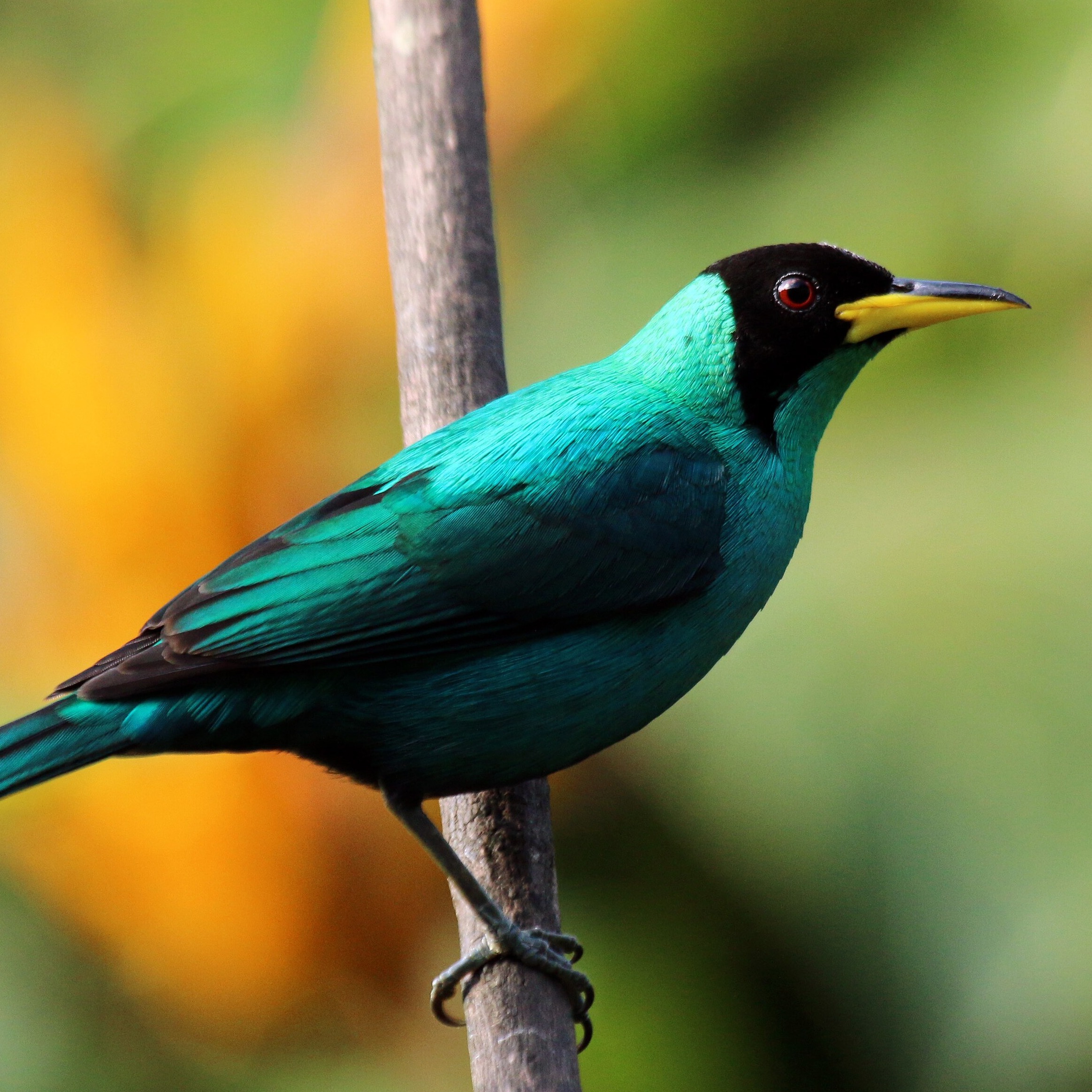
Chlorophanes spiza
Green Honeycreeper
(Linnaeus, 1758)
Added by
Anonymous Curator
Reviewed by
Under Review
Last modified by
Julia Trouin
TaxonomyBiological classification ranks placing this species within the tree of life, from Kingdom down to Genus.
Ecology & StatusHow this species lives: habitat preferences, diet, behavior, population status, and role in its ecosystem.
OriginWhether the species is native (evolved here), endemic (found only here), or introduced by human activity.
Native
Population TrendDirection of change in population size over time: increasing, stable, decreasing, or unknown.
Decreasing
Breeding SeasonTime of year when this species typically reproduces or flowers.
--
Trophic RolePosition in the food chain: producer, herbivore, carnivore, omnivore, decomposer, or parasite.
Omnivore
Recent SightingsWhether this species has been observed in the wild in Costa Rica within recent years.
Yes
Habitat SummaryOverview of the specific ecosystems and environments where this species is found in Costa Rica. Multi-lang
It inhabits the humid tropical regions from southern Mexico, through all of Central America, to the Amazon basin and northeastern Brazil. In Costa Rica, it is a common species in the lowlands and foothills of both slopes (Caribbean and Pacific), frequently reaching up to 1,200 meters in altitude. It is primarily located in the upper canopy and edges of tropical humid forests, tall secondary forests, shaded coffee plantations, regenerating forest areas, and botanical or residential gardens with an abundance of flowering native trees.BehaviourDaily activity patterns, movement, territory use, foraging style, and seasonal behavioral changes. Multi-lang
It is a diurnal bird, highly active and with fast, nervous movements. It moves restlessly through the upper foliage, making short hops and brief flights. It is commonly seen alone, in pairs, or participating in mixed-species flocks alongside other tanagers, euphonias, and other honeycreepers (such as Cyanerpes cyaneus) that roam the canopy in search of flowering trees or ripe fruits. While not strictly territorial when feeding at large food sources, males may exhibit warning displays by flicking their wings if another individual gets too close.Social ActivitySocial structure: whether the species is solitary, paired, or colonial; hierarchy and communication. Multi-lang
It is a primarily social bird outside the breeding season, showing low intraspecific aggressiveness. It frequently travels in stable monogamous pairs that remain together throughout the year. It integrates with great ease into noisy mixed-species flocks of the upper canopy, using short, high-pitched calls to coordinate its movements with other group members and take advantage of collective safety against aerial predators.Feeding GuildWhat the species eats, how it forages or hunts, and its role as a consumer in the food web. Multi-lang
Broad-spectrum omnivore, specialized in nectar and fruits. Its diet includes nectar from leguminous trees and epiphytic inflorescences, a large quantity of small whole berries and fruits (especially mistletoes of the Loranthaceae family), and pulp extracted from larger fruits. It supplements this energy intake by capturing small arthropods, caterpillars, aphids, and spiders through short flights into the foliage.Trophic Chain DetailsSpecific interactions in local food webs: prey species, predators, competitors, and scavengers. Multi-lang
It functions as a primary and secondary consumer in the canopy, playing an essential role as a pollinator of epiphytic plants, mistletoes, and forest trees (especially of the genus Inga), as well as a disperser of small seeds (such as those of Ficus). It consumes nectar, fruit pulp, and a significant amount of small insects and spiders gleaned from the undersides of leaves. It shares its niche with the Red-legged Honeycreeper, the Shining Honeycreeper, and various canopy hummingbirds. It is potential prey for small falcons (such as Micrastur) and arboreal snakes (such as Oxybelis).Reproductive BehaviourMating strategies, courtship displays, nesting or spawning behavior, and parental care. Multi-lang
During the breeding season, pairs become discreet and territorial around the nest site. The female alone builds a small, deep cup-shaped nest, exceptionally well-camouflaged among mosses, epiphytic ferns, or aerial roots at heights ranging from 3 to 12 meters above the ground. She usually lays 2 grayish-white or pale bluish eggs with dense brown or reddish speckles on the wide end. The female incubates alone for 13 to 14 days, while the male frequently feeds her with regurgitated nectar and fruit. Both parents intensely feed the chicks with a mixture of soft insects and fruit pulp until they fledge at 14 to 16 days.Physical Measures
Length (cm)
13.0 - 14.0 cm
Weight (Grams)
16 g - 23 g
Lifespan
Sexual MaturityAge at which the individual becomes capable of reproducing for the first time.
1 Years
Gestation / IncubationDuration from fertilization to birth (mammals) or to hatching (egg-laying species).
13 - 14