Costa Rica Species
Mycteria americana
AnimaliaHighest rank in taxonomy. Groups all life into domains: Animalia, Plantae, Fungi, etc.IUCN LCInternational Union for Conservation of Nature — the world authority on species extinction risk, using standardized criteria. — Least Concern — widespread and abundant; not at immediate risk of extinction.In ProgressCurrent stage of this record in the editorial review workflow. Recent Sighting

Mycteria americana

Wood Stork

Linnaeus, 1758

Detailed Texts Multi-lang
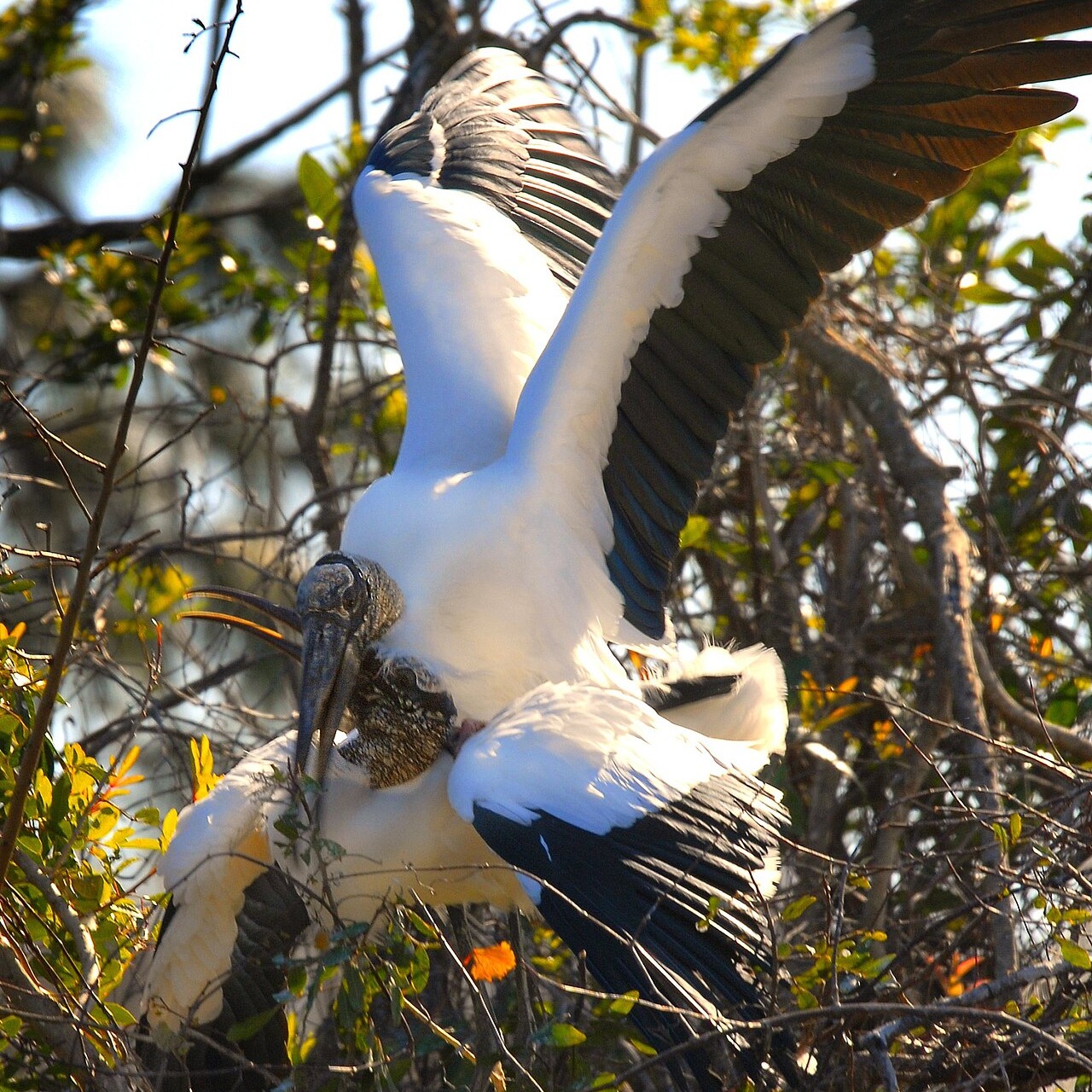
The Wood Stork (Mycteria americana) is a large wading bird with an undeniably prehistoric appearance. Its plumage is predominantly white, which vividly contrasts with the black flight feathers (primaries and secondaries) and tail, clearly visible when it extends its broad wings. Its most distinctive anatomical feature is its head and upper neck, which are completely devoid of feathers, revealing dark, rugged, scaly skin that is dark gray or blackish. It possesses a massive bill, thick at the base and markedly curved downward, ranging from blackish to yellowish depending on age. Its long legs are dark but end in feet of a surprising pinkish or yellowish hue.

Added by

Anonymous Curator

Reviewed by

Under Review

Last modified by

Julia Trouin

TaxonomyBiological classification ranks placing this species within the tree of life, from Kingdom down to Genus.

PhylumRank below Kingdom. Groups organisms sharing a fundamental body plan (e.g., Chordata = vertebrates and some invertebrates).Chordata
ClassRank below Phylum. Subdivides by structural traits (e.g., Mammalia, Aves, Reptilia, Insecta).Aves
OrderRank below Class. Groups related families sharing common ancestry (e.g., Carnivora, Primates).Ciconiiformes
FamilyRank below Order. Groups closely related genera (e.g., Felidae = cats, Canidae = dogs).Ciconiidae
GenusRank just above Species. The first word in the two-part binomial scientific name.Mycteria
Taxonomic AuthorityThe scientist who first formally described and published this species, followed by the year of publication.Linnaeus, 1758
Record Completeness
85%
Coming soon

Ecology & StatusHow this species lives: habitat preferences, diet, behavior, population status, and role in its ecosystem.

OriginWhether the species is native (evolved here), endemic (found only here), or introduced by human activity.

Native

Population TrendDirection of change in population size over time: increasing, stable, decreasing, or unknown.

Decreasing

Breeding SeasonTime of year when this species typically reproduces or flowers.

Dry Season

Trophic RolePosition in the food chain: producer, herbivore, carnivore, omnivore, decomposer, or parasite.

Carnivore

Recent SightingsWhether this species has been observed in the wild in Costa Rica within recent years.

Yes

Habitat SummaryOverview of the specific ecosystems and environments where this species is found in Costa Rica. Multi-lang

It is a bird inseparably linked to wetland ecosystems, both freshwater and brackish. It inhabits cypress swamps, mangroves, marshes, flooded savannas, and river margins. It critically depends on seasonal water level variations (hydroperiod): it requires shallow water (10 to 40 cm) to wade and forage effectively. In Costa Rica, it is distributed in the lowlands of both slopes, being particularly abundant in the Tempisque River basin and the mangroves of the Pacific coast.

BehaviourDaily activity patterns, movement, territory use, foraging style, and seasonal behavioral changes. Multi-lang

They are majestic birds in flight, often soaring in circles on thermal currents, keeping their neck and legs completely extended. On the ground, they walk slowly through shallow waters, often dragging one foot on the bottom or partially opening their wings to startle and corral fish toward their bill. They are highly gregarious both for foraging and nesting, forming colonies that can number hundreds of pairs, vocalizing through hoarse croaks and the clattering (snapping of mandibles) of their bills.

Social ActivitySocial structure: whether the species is solitary, paired, or colonial; hierarchy and communication. Multi-lang

Highly gregarious. They forage in large flocks and nest in massive colonies (called 'rookeries'), often sharing trees with other herons, spoonbills, and ibises.

Feeding GuildWhat the species eats, how it forages or hunts, and its role as a consumer in the food web. Multi-lang

Carnivore / Piscivore.

Trophic Chain DetailsSpecific interactions in local food webs: prey species, predators, competitors, and scavengers. Multi-lang

Apex predator of shallow waters. Its diet consists mainly of fish (which make up over 70% of its food), frogs, crayfish, large insects, and even small caimans or rodents. Healthy adults do not typically have predators. Eggs and chicks in the nesting colonies are preyed upon by raccoons, snakes, and hawks.

Reproductive BehaviourMating strategies, courtship displays, nesting or spawning behavior, and parental care. Multi-lang

They are monogamous during the breeding season. Reproduction is triggered by falling water levels, ensuring abundant concentrated food. They build large stick platforms high in tree branches, usually over water or on islands to protect against terrestrial predators. They lay 2 to 4 eggs which they incubate for about a month. The chicks grow rapidly and are noisy, requiring the parents to make countless daily trips to bring them huge amounts of regurgitated fish.

Physical Measures

Length (cm)

85.0 - 115.0 cm

Weight (Grams)

2.00 kg - 3.30 kg

Offspring per cycleTypical number of young (live births, eggs, or seeds) produced by one adult in a single reproductive event or breeding season.2 - 4
Sexual DimorphismObservable physical differences between males and females of the same species (e.g., size, coloration, features).Yes

Lifespan

Sexual MaturityAge at which the individual becomes capable of reproducing for the first time.

36 - 48 Months

Gestation / IncubationDuration from fertilization to birth (mammals) or to hatching (egg-laying species).

28 - 32

Lifespan EstimatedExpected duration of life from birth to natural death under wild conditions.
Males10 - 20 Years
Females10 - 20 Years

Sexual DimorphismPhysical differences in size, coloration, or morphology between males and females of this species.

Males Multi-lang

Males tend to be slightly taller, heavier, and possess a longer bill, although the difference is subtle in the field.

Females Multi-lang

Slightly smaller than males, with identical plumage.

Evolutionary AdaptationsInherited traits and behaviors that improve the species' survival and reproduction in its specific environment. Multi-lang

Lightning-Fast Bite Reflex (Grope Feeding): To hunt in murky waters, they walk with their bill submerged and slightly open. They have extremely sensitive tactile receptors inside. When a fish touches the bill, it snaps shut in a mere 25 milliseconds, one of the fastest reflexes recorded in any vertebrate.
Sanitary Bald Head: The lack of feathers on the head and neck prevents mud, slime, fish scales, or blood from accumulating when constantly plunging its face into swampy waters to feed, facilitating cleanliness and preventing infections.

Main ThreatsDocumented pressures reducing the population: habitat loss, hunting, disease, climate change, and invasive species. Multi-lang

Hydroperiod Alteration: The construction of dams and canals, coupled with climate change, alters the natural cycles of drought and flooding. If the water does not drop enough during the dry season, fish do not concentrate in pools, preventing the storks from finding enough food to feed their chicks.
Loss of Mangrove Forests: The clearing of mangroves for aquaculture or coastal development destroys the tall, robust trees they need to establish their large nesting colonies.

Interesting FactsSurprising or notable facts that highlight what makes this species unique or ecologically important. Multi-lang

Tough Nicknames: In many regions, they are known as 'Ironhead' or 'Flinthead' due to the dark, scaly, and petrified-looking skin covering their bare skull.
Evaporative Cooling (Urohidrosis): Like vultures, Wood Storks defecate a white liquid onto their own legs. As the water in the feces evaporates, it cools the blood circulating through the legs, helping them regulate their body temperature in the torrid wetlands.