
Costa Rica Species
Stenella attenuata
AnimaliaHighest rank in taxonomy. Groups all life into domains: Animalia, Plantae, Fungi, etc.IUCN LCInternational Union for Conservation of Nature — the world authority on species extinction risk, using standardized criteria. — Least Concern — widespread and abundant; not at immediate risk of extinction.In ProgressCurrent stage of this record in the editorial review workflow. Recent Sighting

Stenella attenuata

Pantropical Spotted Dolphin

(Gray, 1846)

Detailed Texts Multi-lang
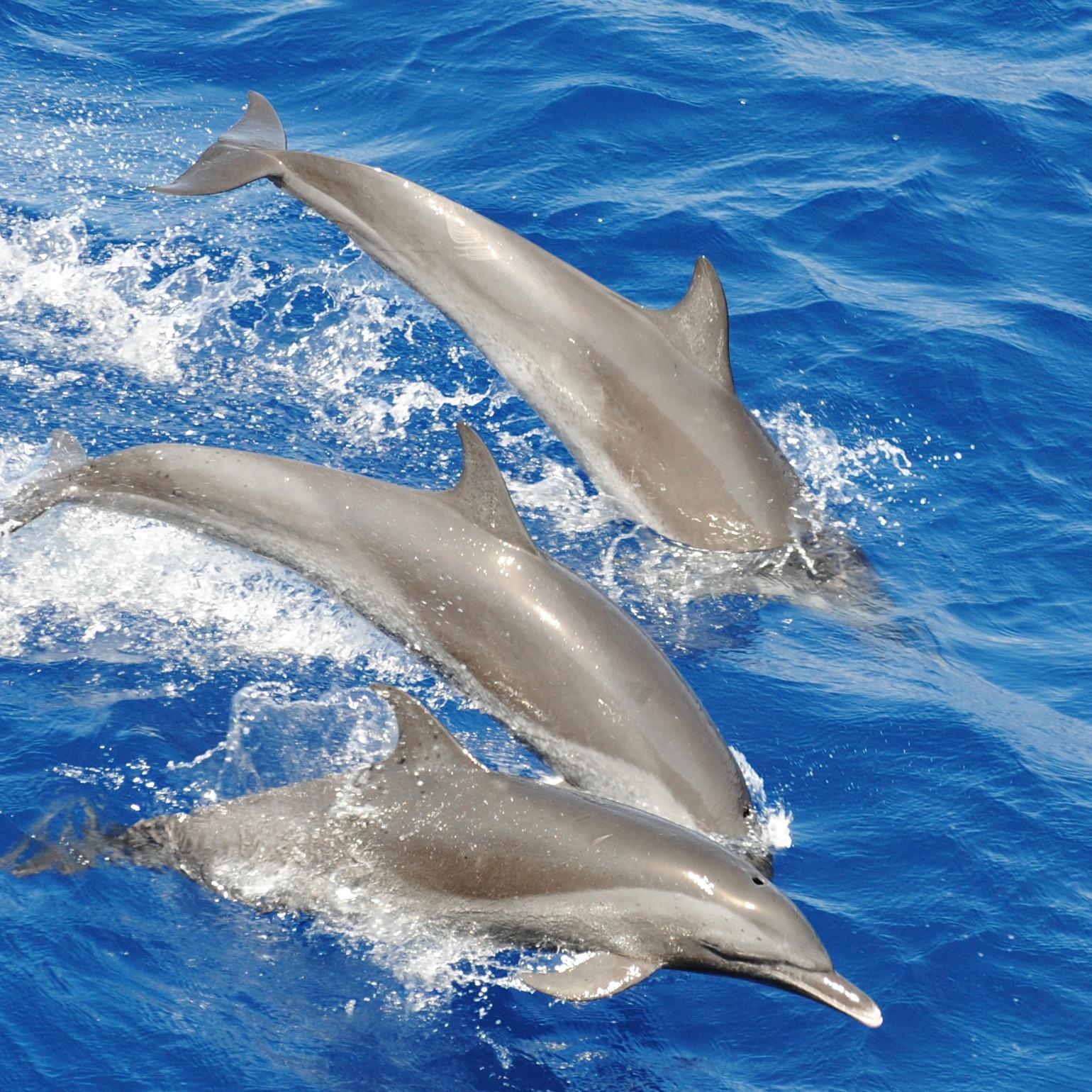
The pantropical spotted dolphin (Stenella attenuata) is one of the most abundant and frequently sighted cetaceans of the Eastern Tropical Pacific Ocean, belonging to the family Delphinidae. It is a medium-sized dolphin with a slender, hydrodynamic body, an elongated, thin beak well differentiated from the melon — the fatty forehead structure that acts as an acoustic lens. The spotting pattern that gives the species its name is dynamic and ontogenetic: calves are born completely unspotted, with a simple bicolor coloration pattern — dark gray on the back and creamy white on the belly —; as the individual matures, pale spots progressively appear over the dark back and dark spots over the pale belly, until old adults present a densely spotted body where the original bicolor pattern is almost completely obscured. The back is dark gray to bluish black, with a lighter gray lateral dorsal band extending from the eye to the caudal region. The belly is white to creamy white. The beak is black at the tip with white lips — 'cape lips' — that persist from the juvenile to the adult stage and allow species identification at a distance. The dorsal fin is tall, erect, swept back, and slightly rounded at the tip, located in the posterior third of the body. The pectoral flippers are moderately sized. Adult males are marginally larger than females and on average display higher spot density. Its distribution is circum-tropical across all tropical and subtropical oceans of the world between latitudes 40°N and 40°S.

Added by

Anonymous Curator

Reviewed by

Under Review

Last modified by

Julia Trouin

TaxonomyBiological classification ranks placing this species within the tree of life, from Kingdom down to Genus.

PhylumRank below Kingdom. Groups organisms sharing a fundamental body plan (e.g., Chordata = vertebrates and some invertebrates).Chordata
ClassRank below Phylum. Subdivides by structural traits (e.g., Mammalia, Aves, Reptilia, Insecta).Mammalia
OrderRank below Class. Groups related families sharing common ancestry (e.g., Carnivora, Primates).Cetacea
FamilyRank below Order. Groups closely related genera (e.g., Felidae = cats, Canidae = dogs).Delphinidae
GenusRank just above Species. The first word in the two-part binomial scientific name.Stenella
Taxonomic AuthorityThe scientist who first formally described and published this species, followed by the year of publication.(Gray, 1846)
Record Completeness
96%
Coming soon

Ecology & StatusHow this species lives: habitat preferences, diet, behavior, population status, and role in its ecosystem.

OriginWhether the species is native (evolved here), endemic (found only here), or introduced by human activity.

Native

Population TrendDirection of change in population size over time: increasing, stable, decreasing, or unknown.

Decreasing

Breeding SeasonTime of year when this species typically reproduces or flowers.

Year Round

Trophic RolePosition in the food chain: producer, herbivore, carnivore, omnivore, decomposer, or parasite.

Carnivore

Recent SightingsWhether this species has been observed in the wild in Costa Rica within recent years.

Yes

Habitat SummaryOverview of the specific ecosystems and environments where this species is found in Costa Rica. Multi-lang

The pantropical spotted dolphin is essentially an oceanic pelagic species associated with deep (generally more than 200 meters), warm (above 25°C), low primary productivity, high transparency waters — the so-called 'blue waters' of the open tropical ocean. It is found primarily in the open ocean far from coasts, though in certain regions it also frequents deep coastal waters and upwelling zones. Its distribution in Costa Rica is primarily in the Pacific Ocean, where it is the most abundant dolphin in the Costa Rican Eastern Tropical Pacific — especially in waters of Cocos Island National Park, the Coco-Galápagos-Malpelo marine corridor, and the pelagic waters of the Gulf of Papagayo and the Central Pacific. In the Costa Rican Caribbean it is considerably less frequent. The most numerous sightings in Costa Rica occur on diving and snorkeling expeditions from Cocos Island, where groups of hundreds to thousands of individuals are routinely observed. It associates its distribution with the 28-30°C isotherm, following the seasonal migrations of this temperature band in both hemispheres, and with the distribution of yellowfin tuna (Thunnus albacares), with whom it maintains one of the most documented and ecologically significant interspecific associations of all oceans.

BehaviourDaily activity patterns, movement, territory use, foraging style, and seasonal behavioral changes. Multi-lang

The spotted dolphin is diurnal and highly active, living in complex, dynamic social groups. It makes broad diurnal and seasonal movements following the distribution of its prey and water temperature. Foraging activities occur primarily during daylight hours — especially at dawn and dusk — and frequently at night when mesopelagic fish ascend toward the surface. Among the most conspicuous social activities are repeated acrobatic jumps ('breaching'), porpoising during rapid travel, bow-riding or surfing the bow waves of vessels, and social grooming between group members. Bow-riding — surfing the bow waves of boats — is a playful behavior documented in virtually all populations of the species and is one of the reasons the spotted dolphin is the most frequently sighted cetacean by sailors and tourists in the Costa Rican Pacific. Interactions with divers and snorkelers at Cocos Island are routinely curious and prolonged, without signs of fear.

Social ActivitySocial structure: whether the species is solitary, paired, or colonial; hierarchy and communication. Multi-lang

The spotted dolphin lives in complex, dynamic social groups with constant fission-fusion — groups continuously split and merge based on activity (foraging, reproduction, rest), predation pressure, and resource availability. Typical foraging groups contain 10 to 50 individuals, though travel groups can reach hundreds and supergroups observed at Cocos Island can exceed 3,000 individuals. Social structure is organized around long-term bonds between specific individuals — especially between mothers and offspring during the first 3-4 years of life — and between adult males who form cooperative alliances for access to females. 'Signature whistles' — highly individualized vocalizations that function as proper names — allow individual recognition at a distance and maintenance of group cohesion in open waters where optical visibility is limited.

Feeding GuildWhat the species eats, how it forages or hunts, and its role as a consumer in the food web. Multi-lang

Pelagic piscivore-cephalopodivore of active cooperative hunting. It forages primarily during the day in surface waters (0-100 m) in association with yellowfin tuna, and at night captures mesopelagic fish that ascend to the thermocline. Hunting is active and coordinated: groups encircle fish schools while tuna herd them from below, creating compression layers where fish are concentrated in a reduced space. Main prey are epipelagic and mesopelagic fish (myctophids, engraulids, clupeids) 5 to 25 cm in length, and squid of similar sizes. It uses echolocation to locate prey in darkness and at depths where visibility is limited. It does not exhibit food storage behavior.

Trophic Chain DetailsSpecific interactions in local food webs: prey species, predators, competitors, and scavengers. Multi-lang

Pelagic secondary consumer specialized in fast-moving nektonic prey. The diet consists primarily of small to medium epipelagic and mesopelagic fish (5-25 cm) — especially myctophids (lanternfish), small scombridae, anchovetas, and sardines — as well as cephalopods (squid and small octopus) captured during nocturnal ascents to the thermocline. Hunting occurs frequently in association with yellowfin tuna (Thunnus albacares) and occasionally with skipjack tuna (Katsuwonus pelamis), creating multi-species hunting communities where collective success exceeds individual performance. Its main natural predators are the tiger shark (Galeocerdo cuvier), oceanic whitetip shark (Carcharhinus longimanus), and silky shark (Carcharhinus falciformis) — the three shark species most associated with pelagic habitats in the Costa Rican Eastern Tropical Pacific — and occasionally the orca (Orcinus orca) and false killer whale (Pseudorca crassidens). Juveniles and calves are more vulnerable to the silky shark (Carcharhinus falciformis) that frequents the same warm surface waters as dolphin groups.

Reproductive BehaviourMating strategies, courtship displays, nesting or spawning behavior, and parental care. Multi-lang

The spotted dolphin reproduces year-round in tropical waters, though seasonal reproductive peaks are documented in spring and autumn associated with periods of higher oceanic productivity. Mating is promiscuous, with multiple males competing for a single female in estrous cycle. Gestation lasts approximately 11 to 12 months — the longest in the set. Females give birth to a single calf every 2 to 3 years. Calves are born completely unspotted — the only way to definitively identify a young juvenile individual — and weigh approximately 10-14 kg. Lactation lasts 12 to 19 months, though calves begin capturing solid prey progressively from 4-5 months. The mother-calf bond is the strongest in the social structure: the mother remains in close proximity to the calf for the first 3-4 years, teaching it foraging routes, cooperative hunting techniques with tuna, and group vocalizations. The age of complete social independence is 4-5 years. Females reach sexual maturity at 9-11 years and males between 10-15 years.

Physical Measures

Length (cm)

160.0 - 245.0 cm

Weight (Grams)

90.00 kg - 120.00 kg

Offspring per cycleTypical number of young (live births, eggs, or seeds) produced by one adult in a single reproductive event or breeding season.1 - 1
Sexual DimorphismObservable physical differences between males and females of the same species (e.g., size, coloration, features).Yes

Lifespan

Sexual MaturityAge at which the individual becomes capable of reproducing for the first time.

9 - 15 Years

Gestation / IncubationDuration from fertilization to birth (mammals) or to hatching (egg-laying species).

330 - 365

Lifespan EstimatedExpected duration of life from birth to natural death under wild conditions.
Males35 - 45 Years
Females35 - 45 Years

Sexual DimorphismPhysical differences in size, coloration, or morphology between males and females of this species.

Males Multi-lang

Adult males are marginally larger than females — a 5-10% difference in length and 10-15% in average weight — distinguishable only in direct comparison between individuals of the same age class. Adult males display on average higher density of dark spots on the belly and pale spots on the back, reflecting the ontogenetic pattern of greater development in older individuals — who tend to be males in the most advanced age classes. In the water, the only reliable sex-diagnostic character without capture is the presence of two genital openings spaced apart in the male's ventral region (genital and anal separated) versus the single opening of the female.

Females Multi-lang

Adult females are marginally smaller than males on average, with the same general morphology and chromatic pattern. At equal age, females tend to show a slightly less dense spot pattern than males of the same age class, though the overlap between individuals is considerable. The only reliable sex-diagnostic field character without capture is the ventral region: females show a single continuous cloacal opening versus the two separated openings (genital and anal) of the male. Lactating females may show slightly swollen mammary glands in the posterior ventral region, visible in very close approaches. The female is socially associated with her calf continuously and closely for 3-4 years, which is the most effective behavioral sex identification method in the field.

Evolutionary AdaptationsInherited traits and behaviors that improve the species' survival and reproduction in its specific environment. Multi-lang

High-precision echolocation system: the pantropical spotted dolphin emits series of high-frequency ultrasonic clicks (100-150 kHz) through the melon organ — the fatty forehead prominence that acts as a focal acoustic lens — and receives reflected echoes through the lower jaw, whose acoustically conductive fat transmits signals to the inner ear. This system allows the species to detect individual prey at distances of up to 100 meters in total darkness, discriminate between fish species by their internal acoustic structure, and communicate with other group individuals through narrow-band, highly individualized whistles ('signature whistles') that function as equivalents to proper names.
Facultative mutualistic association with yellowfin tuna (Thunnus albacares): the pantropical spotted dolphin maintains one of the most documented interspecific associations of the marine world. Tuna congregate below dolphin groups following their surface movements, taking advantage of the dolphins' ability to locate fish schools via echolocation and keep them concentrated near the surface. In turn, the dolphins exploit the tuna's ability to dive deeper and herd fish upward from below. This multi-species coordinated hunting increases the capture success of both species compared to solitary hunting. Eastern Pacific fishermen learned to exploit this association by visually identifying the aerial maneuvers of dolphins to locate tuna schools below, with catastrophic consequences for dolphin populations during the 20th century.
Extreme hydrodynamic morphology with drag reduction: the pantropical spotted dolphin's body is one of the most hydrodynamic forms produced by convergent evolution among vertebrates. The torpedo silhouette, with the maximum diameter section located in the first third of the body, the stabilizing dorsal fin, and the airfoil-profiled pectoral flippers allow it to reach swimming speeds of up to 40 km/h in short sprints and maintain cruise speeds of 15-20 km/h for hours. The 'porpoising' effect — repeated leaps out of the water during travel — reduces overall drag because air offers less resistance than water, being energetically more efficient for high speeds.
Osmoregulation and thermal control in marine environment: the pantropical spotted dolphin maintains a body temperature of 36-37°C in tropical waters of 28-30°C thanks to a countercurrent heat exchange network in the flippers and tail — the peripheral tissues with greatest exposure to cool water — where veins returning to the body interweave with arteries carrying warm blood toward the extremities, preventing heat loss. This adaptation allows the species to thermoregulate efficiently in a medium with thermal conductivity 25 times greater than air, without the energy cost that heat loss without this mechanism would entail.

Main ThreatsDocumented pressures reducing the population: habitat loss, hunting, disease, climate change, and invasive species. Multi-lang

Massive historical incidental capture in Eastern Pacific purse seine tuna nets: between 1960 and 1990, the industrial Eastern Pacific tuna fleet drowned between 6 and 7 million pantropical spotted dolphins by deliberately encircling dolphin herds associated with tuna schools. The collapse of the species' eastern populations — which declined from an estimated 3 million individuals to fewer than 600,000 during that period — was the largest documented episode of direct mortality from industrial fishing activity on a marine mammal species in history. Although the adoption of the Agreement on the International Dolphin Conservation Program (AIDCP, 1998) drastically reduced direct mortality to fewer than 2,000 dolphins per year, Eastern Pacific populations have shown no significant recovery in four decades.
Pollution by plastics and persistent organic pollutants (POPs): ingestion of microplastics and bioaccumulation of PCBs, DDT and its metabolites, organic mercury, and other fat-soluble contaminants represent a growing threat to all oceanic delphinids. Eastern Pacific spotted dolphins accumulate PCB loads exceeding immunosuppression thresholds documented in laboratory studies, reducing their resistance to viral infections — especially cetacean morbillivirus (CeMV) — and altering female fertility.
Acoustic disturbance from anthropogenic noise and climate change: underwater noise produced by intense maritime traffic, hydrocarbon seismic exploration, active low-frequency military sonars, and maritime construction activities can interfere with the echolocation and communication of spotted dolphins, causing disorientation, strandings, and abandonment of critical foraging habitats. Ocean warming associated with climate change displaces the 28°C isotherm toward higher latitudes, altering the distribution of yellowfin tuna and consequently that of spotted dolphins, with impacts on reproductive synchronization and prey availability.

Interesting FactsSurprising or notable facts that highlight what makes this species unique or ecologically important. Multi-lang

The Eastern Pacific spotted dolphin is the involuntary protagonist of one of the most influential marine conservation movements of modern history: the 'Dolphin Safe' campaign. In 1990, after decades of protests over the mass mortality of dolphins in tuna nets, the company Star-Kist announced it would only market tuna caught without encircling dolphins. The US supermarket chain adopted the 'Dolphin Safe' label that same year, causing virtually the entire global tuna industry to adhere to the standard within months. This is considered one of the first victories of ethical consumerism as a driver of change in the global food industry, and the 'Dolphin Safe' label remains today the most widely recognized animal welfare certification standard in the tuna industry.
The spotted dolphin's spot pattern functions as an individual identification system comparable to a fingerprint: each individual develops a unique pattern of dark and pale spots whose distribution, size, and density allow researchers to identify and follow specific individuals throughout their lives via dorsal fin photography and spot pattern analysis. Photographic mark-recapture studies at Cocos Island have identified more than 800 individual individuals with multiple resightings over decades, constituting one of the most complete cetacean databases in Central America.
Spotted dolphins are one of the few mammal species where intergenerational cultural learning has been scientifically documented — transmission of knowledge from mothers to calves that transcends genetic capacity. Migration routes, preferred specific foraging sites, coordinated hunting techniques with tuna, and individualized 'signature whistles' are transmitted by social learning from generation to generation, not by instinct. This means that the capture of experienced adults destroys not only individuals but also the accumulated 'traditional ecological knowledge' of decades of experience that cannot be genetically recovered.
Cocos Island — 550 km from the Costa Rican Pacific coast — is one of the world's greatest cetacean biodiversity hotspots and the best spotted dolphin sighting location in Costa Rica. The waters of Cocos Island National Park are a convergence point for four major oceanic currents — the Costa Rica Current, the North Equatorial Countercurrent, the Cromwell Current, and the California Current — which create zones of high biological productivity that concentrate fish and consequently cetaceans. Aerial census records and diving expeditions document supergroups of spotted dolphins of up to 3,000-5,000 individuals in these waters, with multiple cetacean species — spinner dolphin (Stenella longirostris), bottlenose dolphin (Tursiops truncatus), humpback whale (Megaptera novaeangliae) — present simultaneously in the same oceanic sector.