FungiIUCN NEIn Progress Recent Sighting
Lycoperdon perlatum
Common Puffball
Pers., 1796
Detailed Texts Multi-lang
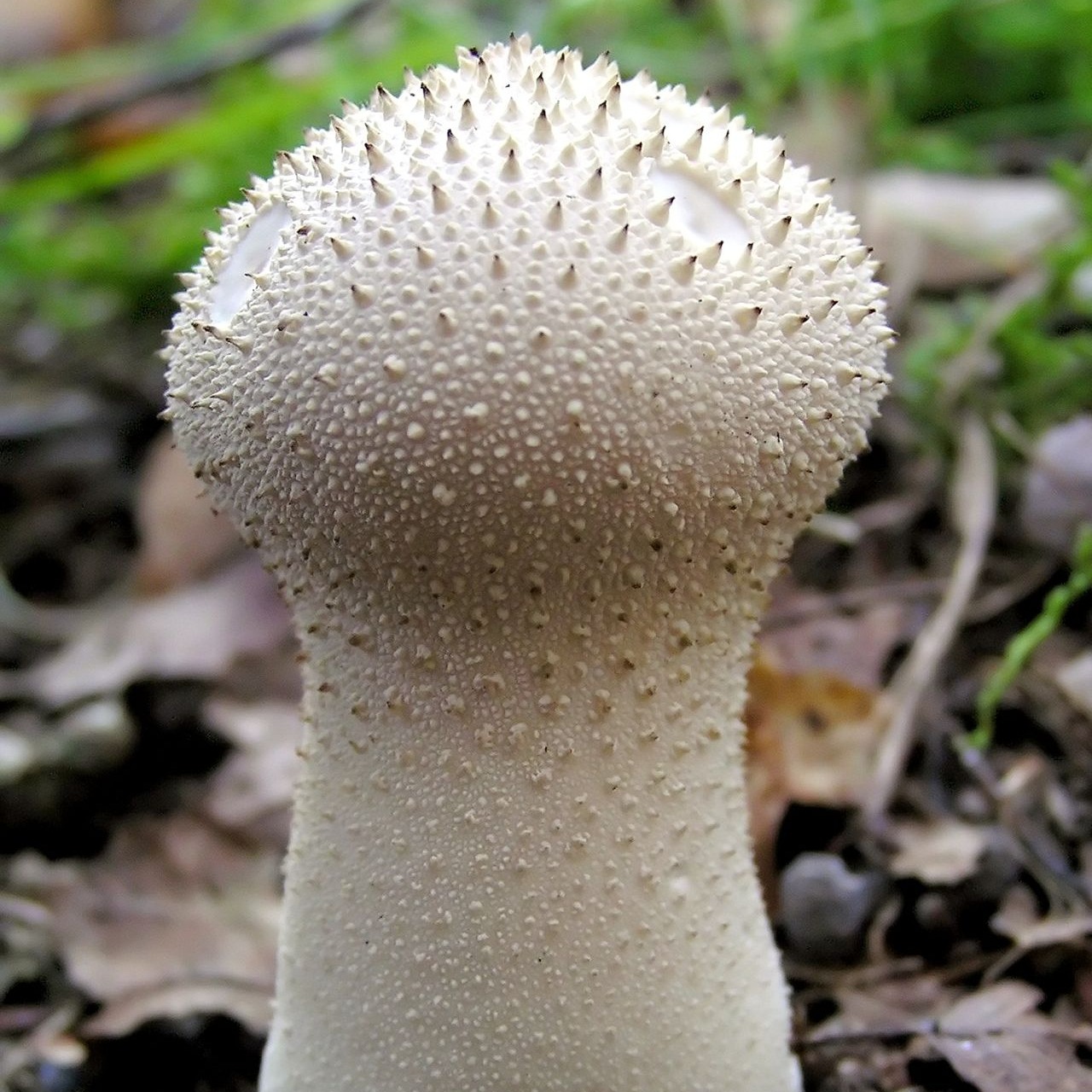
Fungus with a globose or inverted pear-shaped fruiting body. Its surface is covered with small white conical warts or spines that shed easily, leaving a circular scar. Upon maturity, the interior (gleba) turns into a mass of brown spores released through an apical pore.
Added by
Anonymous Curator
Reviewed by
Under Review
Last modified by
Julia Trouin
Other Names (Global)
 Cuesco de loboBejín perlado
 Gem-studded puffballDevil's snuff-box
Taxonomy
PhylumBasidiomycota
ClassAgaricomycetes
OrderAgaricales
FamilyAgaricaceae
GenusLycoperdon
Taxonomic AuthorityPers., 1796
Ecology & Status
Origin
Native
Population Trend
Stable
Edibility
--
Cap Shape
--
Hymenium Type
--
Fruiting Season
Wet Season
Recent Sightings
Yes
Habitat Summary Multi-lang
Frequently found in coniferous and deciduous forests, as well as meadows and forest clearings. It is a cosmopolitan species, present almost worldwide on humus-rich soils or heavily decayed wood.Substrate Multi-lang
Information not available in English. Help us expand this record!Behaviour Multi-lang
It is a saprophytic fungus that decomposes organic matter. Its dispersal strategy is mechanical: raindrops or passing animals press the elastic body, ejecting puffs of spores like a bellows.Physical Measures
Length (cm)
3.0 - 8.0 cm
Hymenium Structures
No hymenium surface images available.
Evolutionary Adaptations Multi-lang
Bellows structure that uses external kinetic energy (rain/impact) for spore dispersal.
Detachable spines that may serve as a temporary physical barrier against small insects before maturity.
Main Threats Multi-lang
Intensive harvesting in protected areas can reduce the local spore load.
Accumulation of heavy metals in contaminated soils, affecting its health and viability.
Interesting Facts Multi-lang
It is edible as long as the interior is completely white and firm; once it starts to yellow or turn brown, it is indigestible or toxic.
The powder from mature spores was formerly used in folk medicine to stop external bleeding.