
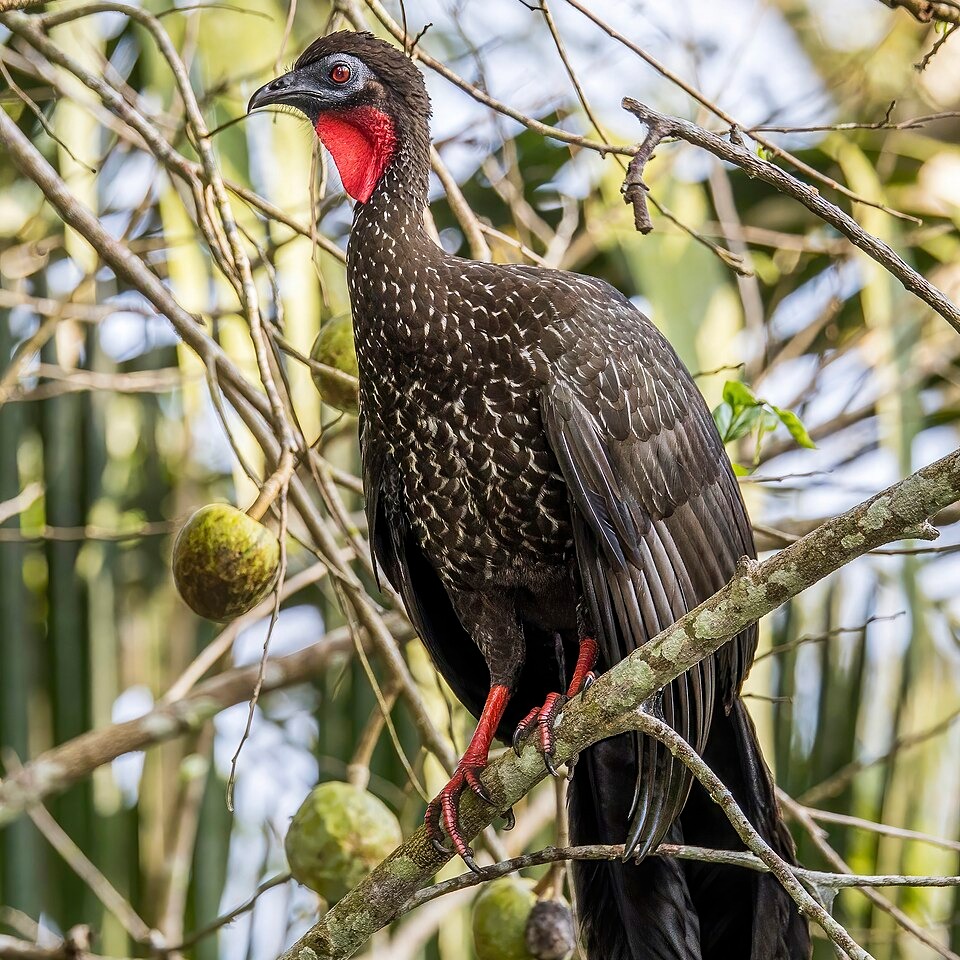
Penelope purpurascens
Crested Guan
(Wagler, 1830)
Added by
Anonymous Curator
Reviewed by
Under Review
Last modified by
Julia Trouin
TaxonomyBiological classification ranks placing this species within the tree of life, from Kingdom down to Genus.
Ecology & StatusHow this species lives: habitat preferences, diet, behavior, population status, and role in its ecosystem.
OriginWhether the species is native (evolved here), endemic (found only here), or introduced by human activity.
Native
Population TrendDirection of change in population size over time: increasing, stable, decreasing, or unknown.
Decreasing
Breeding SeasonTime of year when this species typically reproduces or flowers.
--
Trophic RolePosition in the food chain: producer, herbivore, carnivore, omnivore, decomposer, or parasite.
Frugivore
Recent SightingsWhether this species has been observed in the wild in Costa Rica within recent years.
Yes
Habitat SummaryOverview of the specific ecosystems and environments where this species is found in Costa Rica. Multi-lang
The crested guan occupies a wide variety of forested and semi-open habitats, being notably more ecologically plastic than the great curassow (Crax rubra). It inhabits the canopy and subcanopy of lowland and premontane tropical moist and dry forests, secondary forests at different stages of succession, forest edges, shade coffee plantations with dense tree cover, wooded riversides, mangroves with good-sized trees, and forest patches in agricultural matrices. It can persist in moderately sized forest fragments — from 50 hectares — if there is sufficient canopy connectivity and fruit tree availability. It is recorded from sea level to 2,400 meters altitude, although most abundant between 0 and 1,500 meters. In Costa Rica it is present on both slopes and in virtually all the country's forest ecosystems, being one of the most widely distributed cracids. It tolerates some hunting pressure, though population density decreases markedly in areas without effective protection.BehaviourDaily activity patterns, movement, territory use, foraging style, and seasonal behavioral changes. Multi-lang
The crested guan is primarily diurnal and arboreal, with greatest activity in the early morning hours and at dusk. It spends most of its active time in the canopy and subcanopy at 8–30 meters height, moving with surprising agility through branches of variable diameter. Unlike the curassow, it rarely descends to the ground except to drink and occasionally to search for invertebrates in the leaf litter. In groups of 3 to 12 individuals it covers territories of 40 to 100 hectares with relatively stable foraging routes. Upon detecting a predator, it reacts with the cascading alarm vocalization that alerts the entire group and neighboring species. In areas without hunting — such as Corcovado and Tortuguero National Parks — it is notably trusting and can be observed from distances of 3 to 5 meters from a trail. Its frequent presence at the edges of tourist trails makes it the most easily observable cracid in Costa Rica's ecotourism.Social ActivitySocial structure: whether the species is solitary, paired, or colonial; hierarchy and communication. Multi-lang
The crested guan lives in permanent social groups of 3 to 12 individuals — averaging 5 to 7 — that maintain cohesion throughout the year. Groups can be family-based — the breeding pair plus juveniles from previous seasons — or non-family, especially outside the breeding season when individuals from different origins may aggregate. Group communication is predominantly vocal: soft contact calls during movement between trees, cascading alarms at predators, and courtship vocalizations in the breeding season. Groups defend foraging territories against other same-species groups, especially in areas with high density of fruit trees. Mutual preening (allopreening) between group members is frequent and reinforces social bonds. Group juveniles may participate in nest guarding and chick feeding as 'helpers', though this behavior is less frequent than in the fiery-billed aracari (Pteroglossus frantzii).Feeding GuildWhat the species eats, how it forages or hunts, and its role as a consumer in the food web. Multi-lang
Arboreal frugivore-folivore with seasonal insectivorous supplement. The diet consists primarily of ripe canopy fruits of multiple botanical families — Moraceae, Burseraceae, Myristicaceae, Meliaceae, Palmae, Urticaceae — tender and mature leaves of up to 30-40% of the diet during the dry season, flowers, apical buds, and in lesser proportion bark invertebrates, arboreal snails, and occasionally small vertebrates. It forages primarily in the canopy and subcanopy at 8–30 meters height, moving between branches with its prehensile feet. Mature leaves — consumed primarily when fruits are scarce — are processed through intestinal fermentation by its specific microbiota. It does not store food.Trophic Chain DetailsSpecific interactions in local food webs: prey species, predators, competitors, and scavengers. Multi-lang
Frugivorous-folivorous primary consumer and seed disperser of significant ecosystem importance in the canopy of tropical forests. It primarily consumes ripe canopy fruits (Ficus spp., Cecropia spp., Bursera spp., Tetragastris spp., Virola spp., arboreal palms), tender and mature leaves, flowers, buds, and bark invertebrates in lesser proportion. By defecating intact or scarified seeds at distances of up to 400 meters from the mother tree, it actively contributes to canopy regeneration of secondary forests. Its main predators are the jaguar (Panthera onca) — for adult individuals on the ground — puma (Puma concolor), collared forest-falcon (Micrastur semitorquatus), Cooper's hawk (Accipiter cooperii) for juveniles in flight, harpy eagle (Harpia harpyja), and boa constrictor (Boa constrictor) for resting individuals. Eggs and chicks in the nest are vulnerable to arboreal snakes such as the parrot snake (Leptophis ahaetulla) and mammals such as the Central American squirrel monkey (Saimiri oerstedii) and raccoon (Procyon lotor).Reproductive BehaviourMating strategies, courtship displays, nesting or spawning behavior, and parental care. Multi-lang
The breeding season in Costa Rica extends primarily from February to June, coinciding with the onset of the rainy season and the greatest availability of ripe fruits. Courtship includes intense dawn vocalizations from the male on prominent perches, male pursuits of the female through the canopy over days, and plumage displays with the swollen, inflated dewlap that intensifies its red coloration. The nest is a platform of branches, leaves, vines, and moss built in the canopy at 5–25 meters height, generally in the fork of a horizontal branch or in the dense vegetation of a vine. The clutch consists of 2 to 3 white eggs with a somewhat rough shell. Both sexes incubate, with greater participation by the female, for 28 to 30 days. Chicks hatch semi-precocial: with open eyes and covered in dense down, they can clamber awkwardly within a few hours of hatching but depend on both parents for feeding and thermoregulation for 3 to 4 weeks. The social group may participate in nest surveillance. Juveniles reach adult size at 6-8 months and sexual maturity at 2-3 years. A pair can attempt up to two clutches per season if the first fails.Physical Measures
Length (cm)
75.0 - 91.0 cm
Weight (Grams)
1.50 kg - 2.50 kg
Lifespan
Sexual MaturityAge at which the individual becomes capable of reproducing for the first time.
2 - 3 Years
Gestation / IncubationDuration from fertilization to birth (mammals) or to hatching (egg-laying species).
28 - 30