
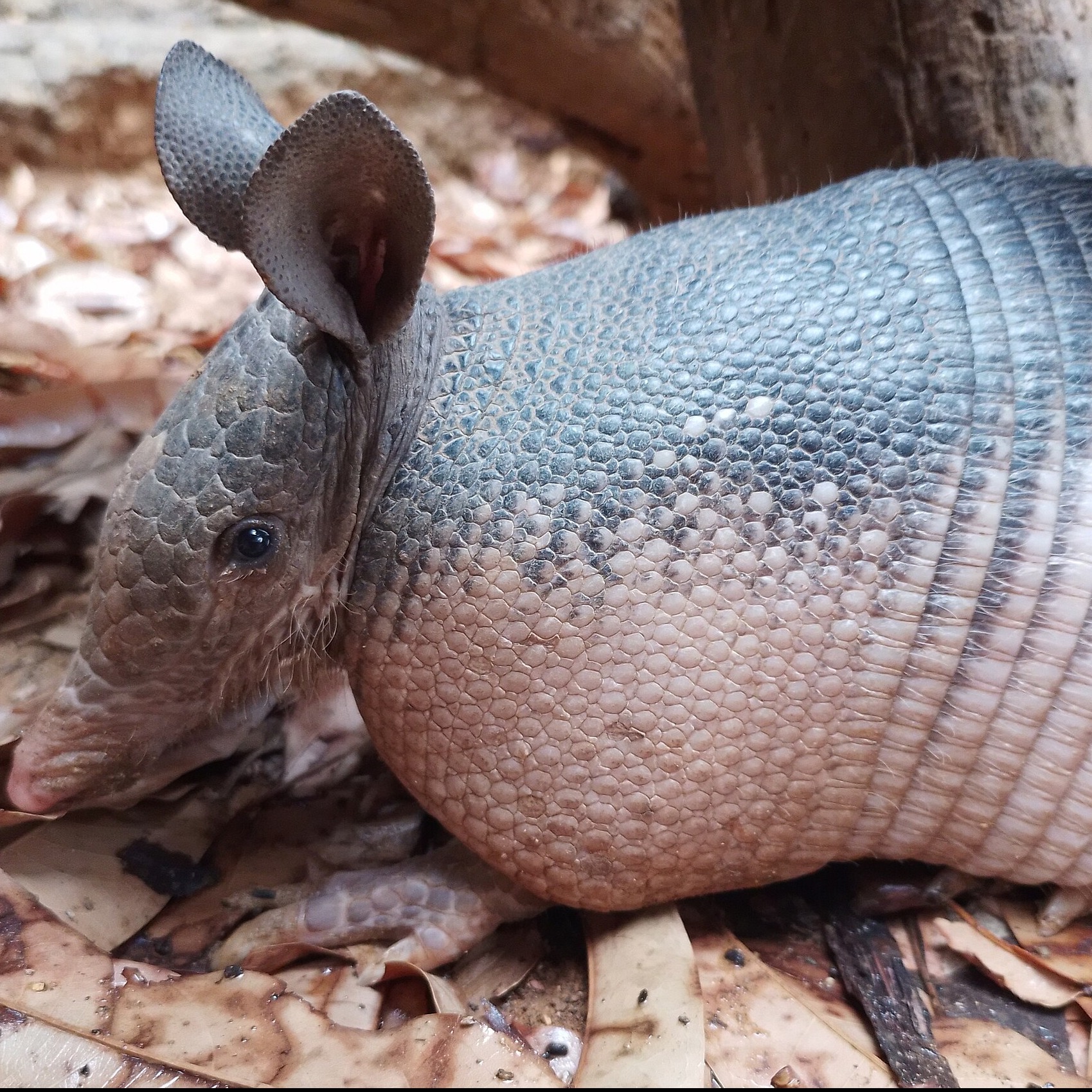
Dasypus novemcinctus
Nine-banded Armadillo
Linnaeus, 1758
Added by
Anonymous Curator
Reviewed by
Under Review
Last modified by
Julia Trouin
TaxonomyBiological classification ranks placing this species within the tree of life, from Kingdom down to Genus.
Ecology & StatusHow this species lives: habitat preferences, diet, behavior, population status, and role in its ecosystem.
OriginWhether the species is native (evolved here), endemic (found only here), or introduced by human activity.
Native
Population TrendDirection of change in population size over time: increasing, stable, decreasing, or unknown.
Increasing
Breeding SeasonTime of year when this species typically reproduces or flowers.
Year Round
Trophic RolePosition in the food chain: producer, herbivore, carnivore, omnivore, decomposer, or parasite.
Insectivore
Recent SightingsWhether this species has been observed in the wild in Costa Rica within recent years.
Yes
Habitat SummaryOverview of the specific ecosystems and environments where this species is found in Costa Rica. Multi-lang
The nine-banded armadillo is one of the mammal species with the greatest habitat plasticity in Latin America. It occupies tropical moist and dry forests, shrublands, savannas, wooded grasslands, secondary forests at all stages of succession, crop margins, plantations, and peri-urban gardens. It requires friable, soft soils that it can easily excavate for burrow construction and food searching, and therefore avoids rocky substrates and highly compacted clay soils. It prefers zones with sufficient low vegetation cover for concealment, but adapts with remarkable flexibility to anthropized environments. In Costa Rica it is present in virtually all ecosystems from sea level to 2,700 meters in altitude, including urban and peri-urban zones of the Greater Metropolitan Area.BehaviourDaily activity patterns, movement, territory use, foraging style, and seasonal behavioral changes. Multi-lang
The nine-banded armadillo is primarily crepuscular and nocturnal, although in areas with low human pressure it may have diurnal activity, especially in cooler months. It spends most of the day resting in burrows excavated beneath roots, fallen logs, or on sloping ground. An individual may maintain up to 12 active burrows simultaneously distributed within its home range of 1 to 10 hectares. It moves with its head low, constantly sniffing the ground, and frequently stops to excavate brief pits in search of invertebrates. Upon detecting a predator, it typically reacts with a rapid zigzagging flight, a sudden vertical jump, or takes refuge in the nearest burrow. It can travel between 1 and 3 km per night during foraging routes.Social ActivitySocial structure: whether the species is solitary, paired, or colonial; hierarchy and communication. Multi-lang
The nine-banded armadillo is fundamentally solitary. Adult individuals actively avoid each other outside the reproductive period and maintain individual home ranges that may partially overlap but are not shared. Intraspecific communication occurs primarily through chemical signals — urinary marks and secretions from glands on the feet and snout deposited on soil and vegetation — and, to a lesser extent, low-frequency nasal vocalizations when two individuals meet. During courtship, the male follows the female for several days. In winter, at the colder latitudes of the northern part of its range, several individuals may share a burrow to conserve heat, but this cohabitation is transitory and does not imply a stable social structure.Feeding GuildWhat the species eats, how it forages or hunts, and its role as a consumer in the food web. Multi-lang
Fossorial insectivore-omnivore. Its diet is dominated by soil invertebrates: beetle larvae (especially dung beetles and rhinoceros beetles), termites, ants, earthworms, millipedes, sowbugs, and spiders. It opportunistically supplements with bird and reptile eggs located in the ground, small vertebrates (lizards, small snakes, amphibians), carrion, fungi, fleshy roots, and fallen fruits. It uses its sensory snout to detect food beneath the surface and its robust forelimb claws for excavation. It does not store food. The exact diet composition varies notably by region and season.Trophic Chain DetailsSpecific interactions in local food webs: prey species, predators, competitors, and scavengers. Multi-lang
Insectivorous-omnivorous primary consumer. Its diet is composed primarily of soil invertebrates — beetle larvae, termites, ants, earthworms, millipedes, and spiders — supplemented by small vertebrates, carrion, fungi, roots, and fallen fruits. By actively excavating the soil in search of food, it generates substrate disturbance that benefits soil aeration and fungal spore dispersal. Its main predators are the puma (Puma concolor), jaguar (Panthera onca), ocelot (Leopardus pardalis), tayra (Eira barbara), boa constrictor (Boa constrictor), and coyote (Canis latrans) in the northernmost parts of its range. The gray fox (Urocyon cinereoargenteus) and domestic dogs represent additional predators in peri-urban areas.Reproductive BehaviourMating strategies, courtship displays, nesting or spawning behavior, and parental care. Multi-lang
Reproduction features a characteristic unique among mammals: obligate monozygotic polyembryony. The female produces a single egg per reproductive cycle, which after fertilization obligatorily divides into four genetically identical embryos. There is also a facultative embryonic diapause of up to 14 weeks, during which the blastocyst remains free in the uterus without implanting, which can postpone birth until environmental conditions are favorable. Effective gestation, once implantation is complete, lasts between 120 and 150 days. The four young are born with open eyes, a soft carapace that is already partially calcified, and can walk within hours. Lactation lasts approximately 3 months. Young reach sexual maturity between 9 and 12 months. The carapace reaches its definitive hardness at 6–8 months of life.Physical Measures
Length (cm)
38.0 - 58.0 cm
Weight (Grams)
2.50 kg - 8.00 kg
Lifespan
Sexual MaturityAge at which the individual becomes capable of reproducing for the first time.
9 - 12 Months
Gestation / IncubationDuration from fertilization to birth (mammals) or to hatching (egg-laying species).
120 - 150