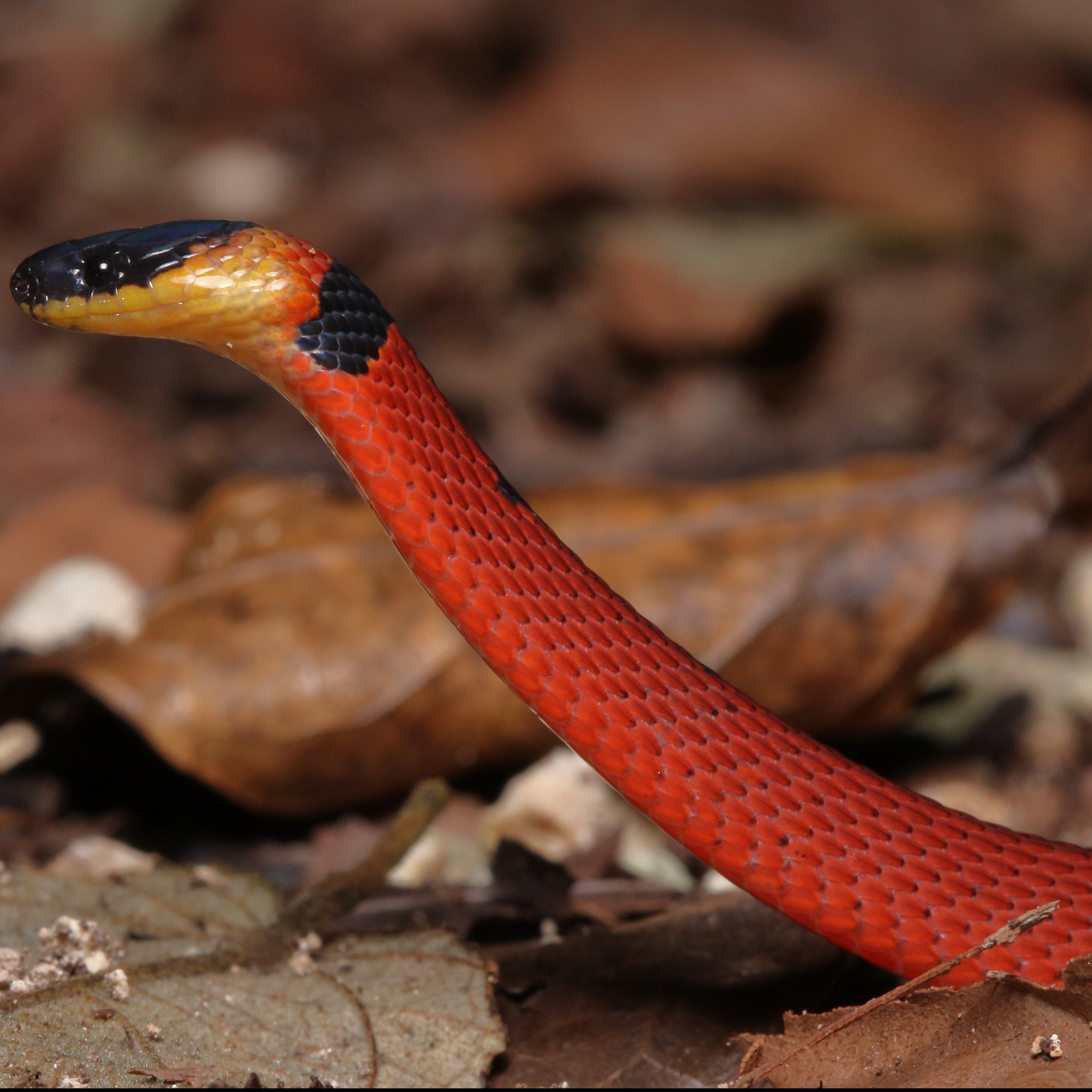
Ninia sebae
Coffee Snakelet
(Duméril, Bibron & Duméril, 1854)
Added by
Anonymous Curator
Reviewed by
Under Review
Last modified by
Julia Trouin
TaxonomyBiological classification ranks placing this species within the tree of life, from Kingdom down to Genus.
Ecology & StatusHow this species lives: habitat preferences, diet, behavior, population status, and role in its ecosystem.
OriginWhether the species is native (evolved here), endemic (found only here), or introduced by human activity.
Native
Population TrendDirection of change in population size over time: increasing, stable, decreasing, or unknown.
Stable
Breeding SeasonTime of year when this species typically reproduces or flowers.
Wet Season
Trophic RolePosition in the food chain: producer, herbivore, carnivore, omnivore, decomposer, or parasite.
Carnivore
Recent SightingsWhether this species has been observed in the wild in Costa Rica within recent years.
Yes
Habitat SummaryOverview of the specific ecosystems and environments where this species is found in Costa Rica. Multi-lang
Inhabits the forest floor, preferring areas with abundant leaf litter, decaying logs, and dense vegetation. It is found from humid tropical rainforests and cloud forests to altered areas like coffee plantations (from which its common name derives) and shaded gardens. It is a species highly adapted to humid and shady microhabitats.BehaviourDaily activity patterns, movement, territory use, foraging style, and seasonal behavioral changes. Multi-lang
Reptile with cryptic habits and predominantly diurnal activity, although it can be active at twilight. It moves constantly under the leaf litter, patrolling the damp ground in search of food. It is a very calm animal, preferring to hide rather than try to flee quickly. Being small in size, it avoids open areas and prefers the refuge of dense vegetation.Social ActivitySocial structure: whether the species is solitary, paired, or colonial; hierarchy and communication. Multi-lang
Solitary animal, it does not exhibit gregarious behaviors. Its life focuses on the constant search for food in the lower stratum, avoiding encounters with others of its species outside the reproductive season. Its survival strategy is based on remaining unnoticed.Feeding GuildWhat the species eats, how it forages or hunts, and its role as a consumer in the food web. Multi-lang
Specialized carnivore. Its diet consists almost exclusively of slugs and snails. It possesses a flexible jaw that allows it to extract its prey from shells with remarkable dexterity. It consumes the prey quickly to minimize exposure time to predators.Trophic Chain DetailsSpecific interactions in local food webs: prey species, predators, competitors, and scavengers. Multi-lang
Acts as a specialized consumer of small invertebrates, being a vital link for the control of slug and earthworm populations. Its role is fundamental to decomposition by regulating organisms that feed on leaf litter. It is preyed upon by small predators, such as insectivorous birds, small mammals, and other ophiophagous snakes.Reproductive BehaviourMating strategies, courtship displays, nesting or spawning behavior, and parental care. Multi-lang
Oviparous species. Females deposit 2 to 6 eggs in humid and protected places, such as hollow logs or under rocks. Incubation is delicate and requires very specific humidity levels. Upon birth, the young are fully independent and already show the characteristic color pattern, starting to hunt from the first moment.Physical Measures
Length (cm)
20.0 - 35.0 cm
Weight (Grams)
10 g - 30 g
Lifespan
Sexual MaturityAge at which the individual becomes capable of reproducing for the first time.
1 - 2 Years
Gestation / IncubationDuration from fertilization to birth (mammals) or to hatching (egg-laying species).
30 - 40