
Costa Rica Species
Semnornis frantzii
AnimaliaHighest rank in taxonomy. Groups all life into domains: Animalia, Plantae, Fungi, etc.IUCN LCInternational Union for Conservation of Nature — the world authority on species extinction risk, using standardized criteria. — Least Concern — widespread and abundant; not at immediate risk of extinction.In ProgressCurrent stage of this record in the editorial review workflow. Recent Sighting

Semnornis frantzii

Prong-billed Barbet

(Sclater, 1864)

Detailed Texts Multi-lang
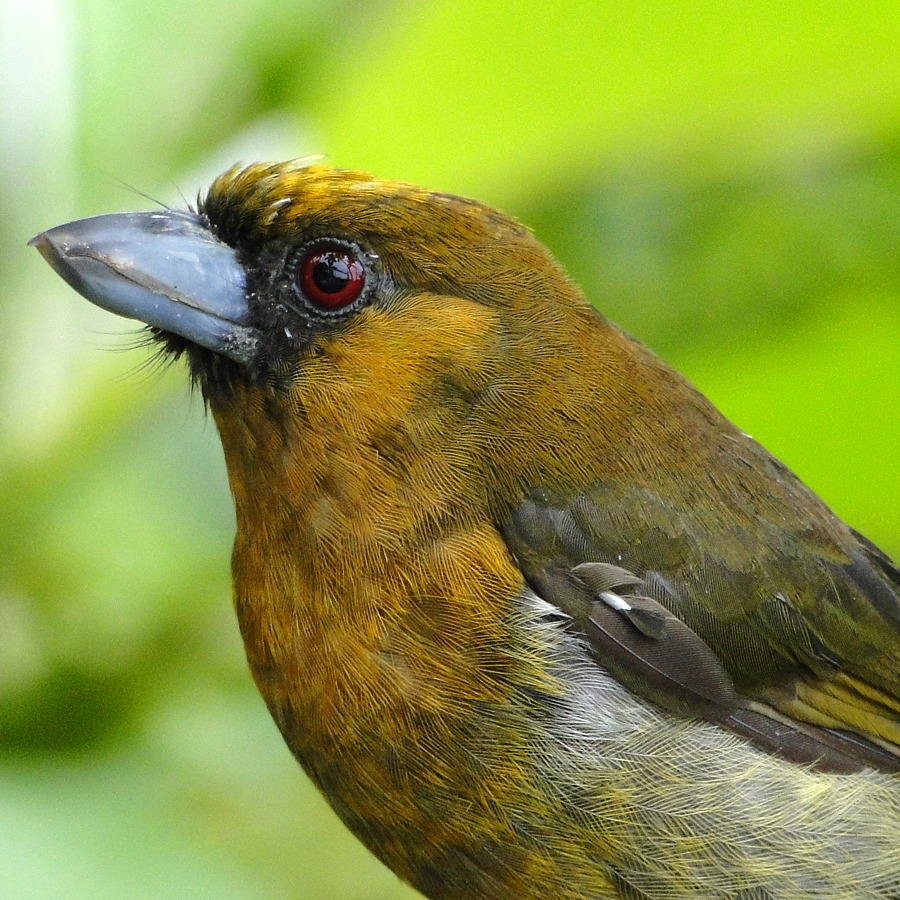
The Prong-billed Barbet (Semnornis frantzii) is a plump, short-necked bird with a disproportionately large head that gives it a very endearing appearance. Its plumage is primarily dark olive-green on the back and wings, but it stands out with a bluish-gray face and nape, and a striking golden-orange or tawny cinnamon chest and belly. At the base of the bill, it sports dark bristles that look like a mustache. Its most diagnostic feature is its unusual robust, silvery bill: the upper mandible is slightly split or bifurcated at the tip (like a two-pronged fork), and the lower mandible fits perfectly into this gap. Males possess a small patch of black feathers on the nape.

Added by

Anonymous Curator

Reviewed by

Under Review

Last modified by

Julia Trouin

TaxonomyBiological classification ranks placing this species within the tree of life, from Kingdom down to Genus.

PhylumRank below Kingdom. Groups organisms sharing a fundamental body plan (e.g., Chordata = vertebrates and some invertebrates).Chordata
ClassRank below Phylum. Subdivides by structural traits (e.g., Mammalia, Aves, Reptilia, Insecta).Aves
OrderRank below Class. Groups related families sharing common ancestry (e.g., Carnivora, Primates).Piciformes
FamilyRank below Order. Groups closely related genera (e.g., Felidae = cats, Canidae = dogs).Semnornithidae
GenusRank just above Species. The first word in the two-part binomial scientific name.Semnornis
Taxonomic AuthorityThe scientist who first formally described and published this species, followed by the year of publication.(Sclater, 1864)
Record Completeness
85%
Coming soon

Ecology & StatusHow this species lives: habitat preferences, diet, behavior, population status, and role in its ecosystem.

OriginWhether the species is native (evolved here), endemic (found only here), or introduced by human activity.

Endemic

Population TrendDirection of change in population size over time: increasing, stable, decreasing, or unknown.

Decreasing

Breeding SeasonTime of year when this species typically reproduces or flowers.

Dry Season

Trophic RolePosition in the food chain: producer, herbivore, carnivore, omnivore, decomposer, or parasite.

Frugivore

Recent SightingsWhether this species has been observed in the wild in Costa Rica within recent years.

Yes

Habitat SummaryOverview of the specific ecosystems and environments where this species is found in Costa Rica. Multi-lang

It is a strictly endemic species to the highlands of Costa Rica and extreme western Panama. It prefers the dense canopy and edges of cloud forests, humid montane forests, and areas with an abundance of moss and epiphytes. They are commonly seen in fruiting trees overhanging high-elevation pastures. It is typically distributed between 1,200 and 2,500 meters above sea level along the main volcanic and Talamanca mountain ranges.

BehaviourDaily activity patterns, movement, territory use, foraging style, and seasonal behavioral changes. Multi-lang

It is a bird of a heavy, boisterous nature, and very active during the day. They move with short, heavy, and direct flights between epiphyte-laden branches. Instead of walking along the branches, they move by taking large lateral hops. They are highly curious, and it is common for an entire family group to line up and peer down to investigate any unusual noise in the cloud forest.

Social ActivitySocial structure: whether the species is solitary, paired, or colonial; hierarchy and communication. Multi-lang

Highly social. They are rarely seen alone. They travel, forage, sing, and sleep in tight-knit small family groups, typically of 4 to 6 individuals, although in the roosts extended families of more than 15 birds can congregate.

Feeding GuildWhat the species eats, how it forages or hunts, and its role as a consumer in the food web. Multi-lang

Frugivore / Montane canopy forager.

Trophic Chain DetailsSpecific interactions in local food webs: prey species, predators, competitors, and scavengers. Multi-lang

Primary consumer (Frugivore). Although it eats some beetles and insects to obtain protein, its main diet is composed of over 80% humid forest fruits, with a notable predilection for wild avocados (Lauraceae) and the gummy fruits of Clusia. This makes them crucial seed dispersers. Their nests can be raided by snakes, weasels, or monkeys.

Reproductive BehaviourMating strategies, courtship displays, nesting or spawning behavior, and parental care. Multi-lang

Monogamous birds with occasional cooperative breeding. The pair uses their sturdy bills to excavate a cavity in decaying vertical trunks or soft wood snags, generally at a height of 3 to 18 meters. They use no additional lining. The female typically lays between 2 and 5 white eggs. Both parents (and often juvenile helpers from the previous year) take turns incubating for about 15 days. The altricial chicks are born completely naked and are fed assiduously with fruit and insect protein by the group until they leave the hole around the first month of life.

Physical Measures

Length (cm)

15.0 - 18.0 cm

Weight (Grams)

55 g - 72 g

Offspring per cycleTypical number of young (live births, eggs, or seeds) produced by one adult in a single reproductive event or breeding season.2 - 5
Sexual DimorphismObservable physical differences between males and females of the same species (e.g., size, coloration, features).Yes

Lifespan

Sexual MaturityAge at which the individual becomes capable of reproducing for the first time.

12 - 18 Months

Gestation / IncubationDuration from fertilization to birth (mammals) or to hatching (egg-laying species).

14 - 16

Lifespan EstimatedExpected duration of life from birth to natural death under wild conditions.
Males5 - 10 Years
Females5 - 10 Years

Sexual DimorphismPhysical differences in size, coloration, or morphology between males and females of this species.

Males Multi-lang

Possesses a distinctive tuft or patch of fine, glossy black feathers on the nape (occiput).

Females Multi-lang

Lacks the black patch on the nape, this area being the same dark olive green or grayish color as the rest of the crown.

Evolutionary AdaptationsInherited traits and behaviors that improve the species' survival and reproduction in its specific environment. Multi-lang

Specialized Tool Bill (Pronged Bill): The unique structure of its bill, with the bifurcated tip, acts as a wedge and nutcracker simultaneously. This adaptation allows them to tear and crush the thick rinds of hard fruits and efficiently extract sticky seeds from epiphytic plants (like those of the Clusiaceae family).
Communal Thermal Roosting: To withstand the biting cold and rains of the mountain nights, these birds have developed the habit of sleeping together. An entire family flock (up to 15 or more individuals) crowds into the same small cavity of a dead trunk to share body heat, identically to aracaris.

Main ThreatsDocumented pressures reducing the population: habitat loss, hunting, disease, climate change, and invasive species. Multi-lang

Climate Change (Mist Deficit): Being physiologically adapted to cold cloud forests, rising temperatures are pushing mist ecosystems towards the summits, drastically reducing their available habitat and isolating them on mountain peaks.
Loss of Dead Wood (Snag Removal): Since they excavate their own nests and roosts in the soft wood of decaying trees, the cleaning of dead snags in rural areas leaves them without shelter or breeding opportunities.

Interesting FactsSurprising or notable facts that highlight what makes this species unique or ecologically important. Multi-lang

Synchronized Choruses: Their song is unmistakable. Pairs or family groups sing in highly synchronized duets or choruses. They emit a hoarse, deep, and repetitive sound, similar to a rhythmic croak ('cwa-cwa-cwa-cwa!') that can last for several uninterrupted minutes and echo for a long distance in the mountain.
Forest Engineers: Unlike toucans that use ready-made nests, barbets use their strong bills to patiently excavate holes in rotting trunks. Upon abandoning these holes over time, they become the main providers of nests for other montane bird species that cannot dig.