
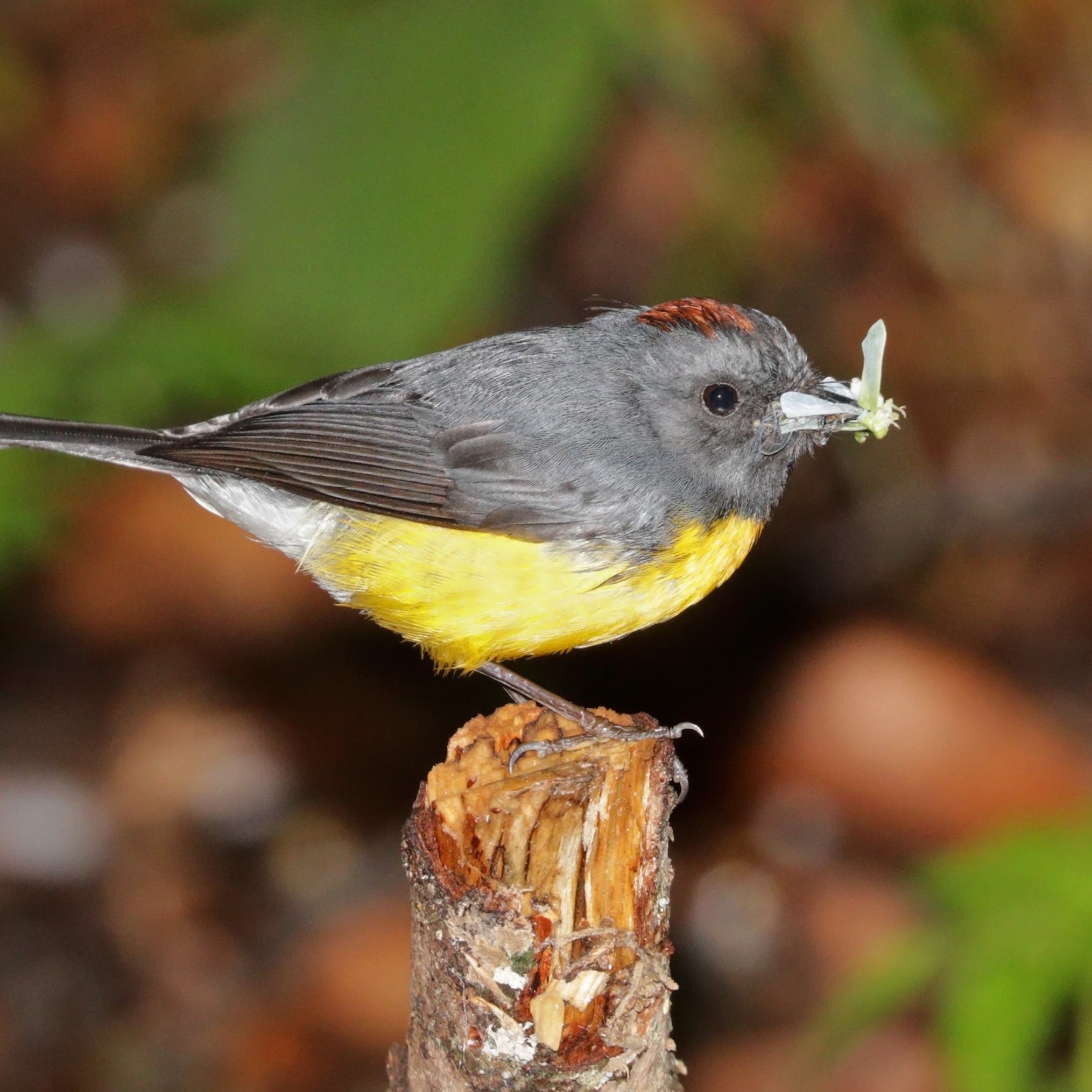
Myioborus miniatus
Slate-throated Redstart
Swainson, 1827
Added by
Anonymous Curator
Reviewed by
Under Review
Last modified by
Julia Trouin
TaxonomyBiological classification ranks placing this species within the tree of life, from Kingdom down to Genus.
Ecology & StatusHow this species lives: habitat preferences, diet, behavior, population status, and role in its ecosystem.
OriginWhether the species is native (evolved here), endemic (found only here), or introduced by human activity.
Native
Population TrendDirection of change in population size over time: increasing, stable, decreasing, or unknown.
Stable
Breeding SeasonTime of year when this species typically reproduces or flowers.
--
Trophic RolePosition in the food chain: producer, herbivore, carnivore, omnivore, decomposer, or parasite.
Insectivore
Recent SightingsWhether this species has been observed in the wild in Costa Rica within recent years.
Yes
Habitat SummaryOverview of the specific ecosystems and environments where this species is found in Costa Rica. Multi-lang
It primarily inhabits the middle and lower levels (understory and mid-story) of humid mountain forests, cloud forests, oak forests, and forest edges in the Neotropical region, ranging widely from Mexico to Bolivia. In Costa Rica and Central America, it is highly common in mountain ranges between 700 and 2,500 meters in altitude. It well tolerates mature secondary forests, shade-grown coffee plantations, and semi-open areas adjacent to dense primary forests.BehaviourDaily activity patterns, movement, territory use, foraging style, and seasonal behavioral changes. Multi-lang
It is an extremely active, restless, and territorial bird. It spends the day patrolling the understory and mid-story, performing short, acrobatic flights to capture prey. It maintains a characteristic body posture with slightly drooped wings and a partially raised, fanned tail, flashing the white pattern of its rectrices as a warning to other individuals of its species.Social ActivitySocial structure: whether the species is solitary, paired, or colonial; hierarchy and communication. Multi-lang
During the non-breeding season, it is a very frequent and nuclear member of mixed-species flocks traveling through the understory, often acting as an acoustic sentinel thanks to its sharp alarm calls. During the breeding season, it becomes strictly territorial, defending its area in monogamous pairs through intense physical chases against conspecific intruders.Feeding GuildWhat the species eats, how it forages or hunts, and its role as a consumer in the food web. Multi-lang
Strict and highly dynamic insectivore. It captures a wide variety of small flying and crawling arthropods, including flies, mosquitoes, small beetles, moths, winged ants, and spiders. It uses flush-chasing and short-distance acrobatic sallying techniques within the lower vegetation layers.Trophic Chain DetailsSpecific interactions in local food webs: prey species, predators, competitors, and scavengers. Multi-lang
It acts as a specialized secondary consumer of insects and small arthropods. It effectively controls populations of flies, moths, small beetles, and spiders in the understory. Within the food web, it is a common prey item for small arboreal raptors, understory hunting snakes, and small arboreal mammals such as squirrels, which prey on its ground-level nests.Reproductive BehaviourMating strategies, courtship displays, nesting or spawning behavior, and parental care. Multi-lang
It forms stable monogamous pairs during the breeding season. The nest is built primarily by the female and is a compact, roofed, dome-shaped or oven-like structure with a side entrance, constructed from dry leaves, moss, rootlets, and fine fibers, located directly on the ground, hidden on steep banks, earthen slopes, or beneath exposed roots. She usually lays 2 to 3 creamy-white eggs speckled with brown. Incubation is done by the female for 13 to 15 days in a highly stealthy manner. Chicks are born altricial (naked and blind) and are fed by both parents for 12 to 14 days until they fledge.Physical Measures
Length (cm)
13.0 - 14.0 cm
Weight (Grams)
8 g - 11 g
Lifespan
Sexual MaturityAge at which the individual becomes capable of reproducing for the first time.
1 Years
Gestation / IncubationDuration from fertilization to birth (mammals) or to hatching (egg-laying species).
13 - 15