
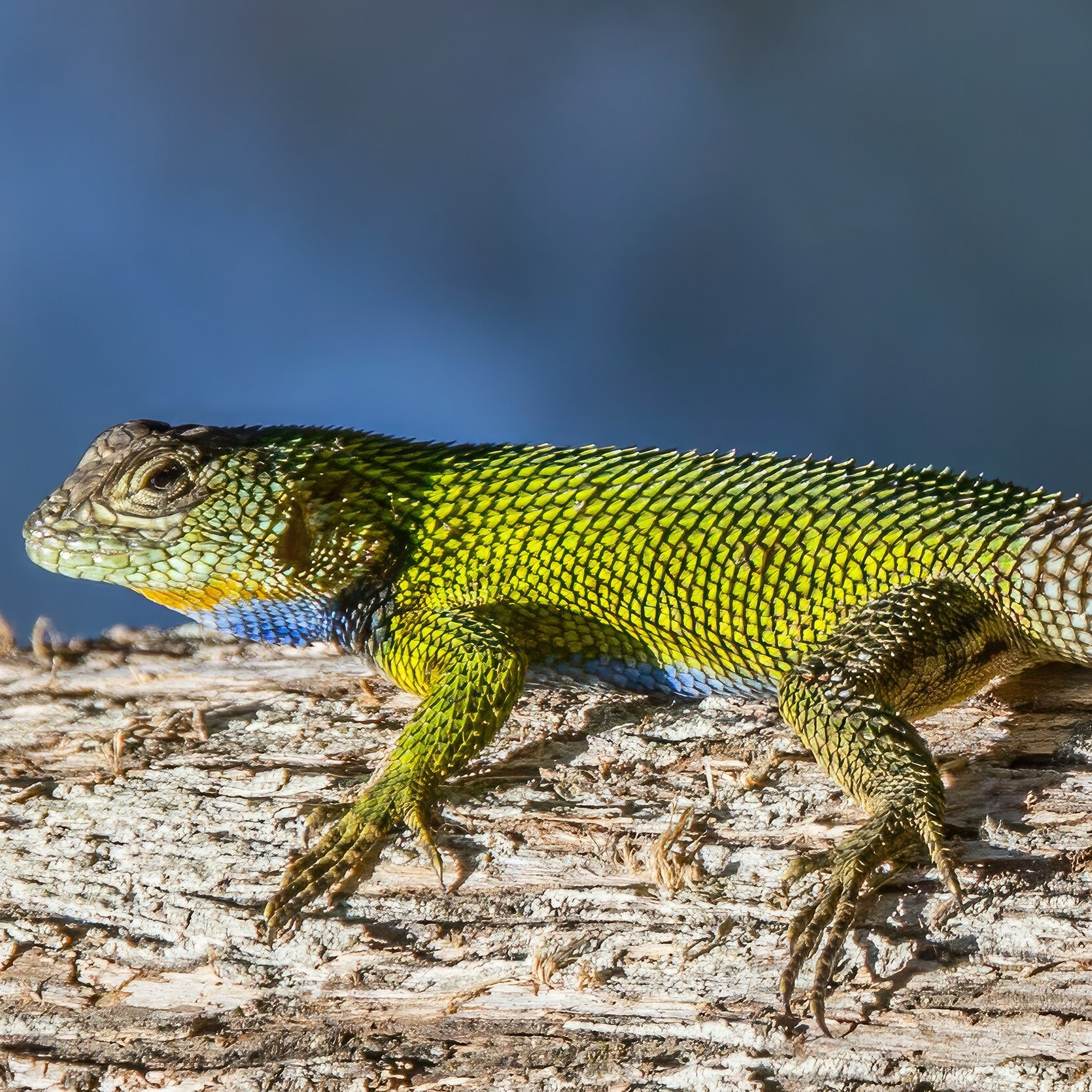
Sceloporus malachiticus
Green Spiny Lizard
Cope, 1864
Added by
Anonymous Curator
Reviewed by
Under Review
Last modified by
Julia Trouin
TaxonomyBiological classification ranks placing this species within the tree of life, from Kingdom down to Genus.
Ecology & StatusHow this species lives: habitat preferences, diet, behavior, population status, and role in its ecosystem.
OriginWhether the species is native (evolved here), endemic (found only here), or introduced by human activity.
Native
Population TrendDirection of change in population size over time: increasing, stable, decreasing, or unknown.
Stable
Breeding SeasonTime of year when this species typically reproduces or flowers.
--
Trophic RolePosition in the food chain: producer, herbivore, carnivore, omnivore, decomposer, or parasite.
Insectivore
Recent SightingsWhether this species has been observed in the wild in Costa Rica within recent years.
Yes
Habitat SummaryOverview of the specific ecosystems and environments where this species is found in Costa Rica. Multi-lang
Inhabits mainly cloud forests and highland zones, from 1000 to 3000 meters above sea level. It prefers forest edges, clearings, living fences, and rocky areas where it can find sufficient direct sunlight to thermoregulate.BehaviourDaily activity patterns, movement, territory use, foraging style, and seasonal behavioral changes. Multi-lang
Primarily diurnal reptile. It spends much of its day on tree trunks, rocks, or buildings, patrolling and basking. It is a very active and territorial animal, capable of rhythmic push-up displays to communicate its presence. It is notably resistant to the cool highland temperatures, allowing it to remain active when other reptiles hide.Social ActivitySocial structure: whether the species is solitary, paired, or colonial; hierarchy and communication. Multi-lang
Solitary and territorial animal. During the breeding season, encounters between individuals are more frequent and usually involve aggressive interactions between males competing for control of sunny areas and groups of females.Feeding GuildWhat the species eats, how it forages or hunts, and its role as a consumer in the food web. Multi-lang
Generalist insectivore. Consumes a wide variety of arthropods, including beetles, flies, moths, spiders, and ants. Its hunting technique is active: it observes from an elevated point and pounces quickly on any prey it detects on the ground or on nearby vegetation.Trophic Chain DetailsSpecific interactions in local food webs: prey species, predators, competitors, and scavengers. Multi-lang
Functions as a key predator of invertebrates in high-elevation ecosystems, keeping populations of flying and terrestrial insects under control. It is preyed upon by various mountain birds of prey, predatory snakes, and small mammals, acting as an intermediary in the food web between arthropods and higher-level predators.Reproductive BehaviourMating strategies, courtship displays, nesting or spawning behavior, and parental care. Multi-lang
Viviparous species. The female retains the developing embryos inside her body until they are fully formed. Upon giving birth, the offspring are independent and must seek food and shelter immediately. This reproductive strategy allows for greater survival in cold climates.Physical Measures
Length (cm)
15.0 - 22.0 cm
Weight (Grams)
10 g - 25 g
Lifespan
Sexual MaturityAge at which the individual becomes capable of reproducing for the first time.
1 - 2 Years
Gestation / IncubationDuration from fertilization to birth (mammals) or to hatching (egg-laying species).
3 - 4