
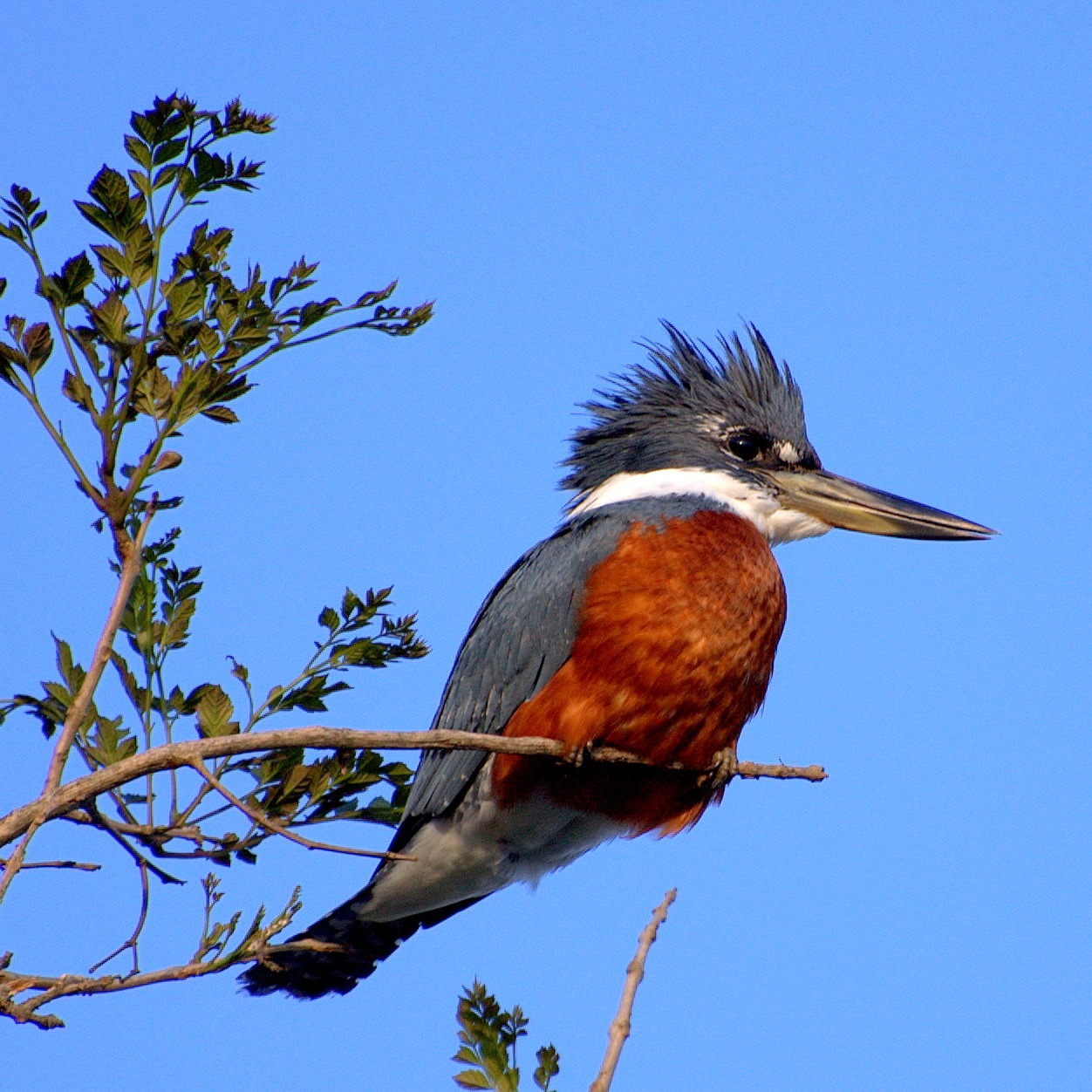
Megaceryle torquata
Ringed Kingfisher
(Linnaeus, 1766)
Added by
Anonymous Curator
Reviewed by
Under Review
Last modified by
Julia Trouin
TaxonomyBiological classification ranks placing this species within the tree of life, from Kingdom down to Genus.
Ecology & StatusHow this species lives: habitat preferences, diet, behavior, population status, and role in its ecosystem.
OriginWhether the species is native (evolved here), endemic (found only here), or introduced by human activity.
Native
Population TrendDirection of change in population size over time: increasing, stable, decreasing, or unknown.
Stable
Breeding SeasonTime of year when this species typically reproduces or flowers.
--
Trophic RolePosition in the food chain: producer, herbivore, carnivore, omnivore, decomposer, or parasite.
Carnivore
Recent SightingsWhether this species has been observed in the wild in Costa Rica within recent years.
Yes
Habitat SummaryOverview of the specific ecosystems and environments where this species is found in Costa Rica. Multi-lang
The ringed kingfisher inhabits exclusively aquatic environments or their immediate vicinity: large and medium rivers with slow, clear water, lakes, lagoons, estuaries, mangroves, rocky or sandy marine coasts, reservoirs, wooded irrigation canals, and coastal coconut groves. It requires the combination of water with sufficient visibility to locate fish from the air, elevated perches from which to survey and execute hunting dives — overhanging branches above water, cables, poles, standing dead trees beside water — and earth or sand embankments for excavating the nesting tunnel. It tolerates modified environments well as long as clean water and perches are available. In Costa Rica it is present on both slopes and is one of the most visible and frequently detected aquatic birds in rivers, lagoons, and coastal zones of the country, from sea level to 1,500 meters in altitude. In the Caribbean it is especially abundant in the river systems of Tortuguero National Park and the Sarapiquí River basin.BehaviourDaily activity patterns, movement, territory use, foraging style, and seasonal behavioral changes. Multi-lang
The ringed kingfisher is diurnal and solitary outside the breeding season. It spends most of its active time perched motionless on fixed perches above water — branches, cables, poles, protruding rocks — from which it surveys the surface with its head tilted downward and executes hunting dives upon locating a fish. It may remain on the same perch for periods of 10 to 60 minutes between captures. Its riparian territories vary between 1 and 3 km of river or coastal length, actively defended through aerial pursuits of same-species individuals and alarm vocalizations — a harsh, loud rattling — audible at 300-400 meters distance. The same individual uses the same river stretch for years, allowing individuals to be tracked with high precision in long-term studies. When returning to the perch with a fish, it strikes it repeatedly against the branch to stun it before swallowing it whole head-first.Social ActivitySocial structure: whether the species is solitary, paired, or colonial; hierarchy and communication. Multi-lang
The ringed kingfisher is markedly solitary and territorial throughout the year. Each individual maintains an exclusive riparian territory of 1-3 km in length actively defended against same-species individuals through territorial vocalizations — a harsh, penetrating rattling — and direct aerial pursuits over water. Territorial encounters between same-sex individuals may include low parallel flights over water and intimidatory pecking positions. The only exceptions to solitude are mutual tolerance during courtship and formation of the breeding pair, which remains together during the nesting season with a seasonal monogamous bond. Outside the breeding season, even pairs from the previous year separate and resume their individual territories. It does not form mixed groups with other kingfisher species, though it may share the same river stretch with Chloroceryle amazona and Chloroceryle americana at vertically separated foraging positions.Feeding GuildWhat the species eats, how it forages or hunts, and its role as a consumer in the food web. Multi-lang
Specialized piscivore with capture method exclusively by diving from perch or from hovering flight. It forages from fixed elevated perches — generally 3-10 meters above water — from which it surveys the surface and plunges upon detecting a fish within one meter of the surface. It occasionally performs stationary hovering flights over water before the dive. It primarily consumes fish of 5-18 cm — the maximum size limited by the bill gape and the ability to swallow whole — supplemented by aquatic crustaceans and occasionally amphibians. It strikes live prey repeatedly against the perch to stun it and always ingests it whole with the head facing forward. It regurgitates compact pellets of indigestible material 1-2 times per day from the resting perch.Trophic Chain DetailsSpecific interactions in local food webs: prey species, predators, competitors, and scavengers. Multi-lang
Specialized piscivorous secondary consumer. Its diet consists primarily of fish 5 to 18 cm in length of multiple species — especially Cichlidae such as the blue acara (Andinoacara coeruleopunctatus), Characidae such as the sardine (Astyanax spp.), and Poeciliidae — occasionally supplemented by freshwater crabs, freshwater shrimp, aquatic lizards, frogs, and large aquatic insects. The maximum fish size it can capture is limited by the gape of its bill — approximately 5-6 cm in diameter — and its ability to swallow it whole. It is one of the main biotic regulators of small and medium fish biomass in Costa Rican rivers where it is present. Its main predators are the osprey (Pandion haliaetus) — which may steal fish from it — the collared forest-falcon (Micrastur semitorquatus), boa constrictor (Boa constrictor), and crocodiles (Crocodylus acutus) in Pacific and Caribbean rivers. Eggs and chicks in the nesting tunnel are vulnerable to snakes such as the fer-de-lance (Bothrops asper) and mammals such as the coati (Nasua narica).Reproductive BehaviourMating strategies, courtship displays, nesting or spawning behavior, and parental care. Multi-lang
The breeding season in Costa Rica extends primarily from February to May, though it may begin earlier in zones with little climatic seasonality. Courtship includes acrobatic aerial pursuits by the male after the female along the river — often producing continuous rattling in flight —, fish transfer from male to female as a courtship gift, and displays from prominent perches with the bill pointing upward. Both sexes excavate the nesting tunnel collaboratively over 3 to 7 days using the bill as a drilling tool and the feet to dislodge soil. The tunnel measures 60 to 150 cm in length and ends in an ovoid chamber 15-20 cm in diameter that is not lined with nesting material. The clutch consists of 3 to 6 glossy white eggs. Both sexes incubate, with the male generally taking the nocturnal turn, for 22 to 26 days. Chicks hatch altricial — blind and without down — and are fed by both parents with fish brought to the tunnel at a frequency of 8 to 15 times per day. The tunnel residency period is 33 to 38 days. Young reach independence 5-8 weeks after leaving the nest and sexual maturity at one year of age.Physical Measures
Length (cm)
38.0 - 41.0 cm
Weight (Grams)
280 g - 340 g
Lifespan
Sexual MaturityAge at which the individual becomes capable of reproducing for the first time.
1 Years
Gestation / IncubationDuration from fertilization to birth (mammals) or to hatching (egg-laying species).
22 - 26