
Costa Rica Species
Pteroglossus torquatus
AnimaliaHighest rank in taxonomy. Groups all life into domains: Animalia, Plantae, Fungi, etc.IUCN LCInternational Union for Conservation of Nature — the world authority on species extinction risk, using standardized criteria. — Least Concern — widespread and abundant; not at immediate risk of extinction.In ProgressCurrent stage of this record in the editorial review workflow. Recent Sighting

Pteroglossus torquatus

Collared Aracari

(Gmelin, 1788)

Detailed Texts Multi-lang
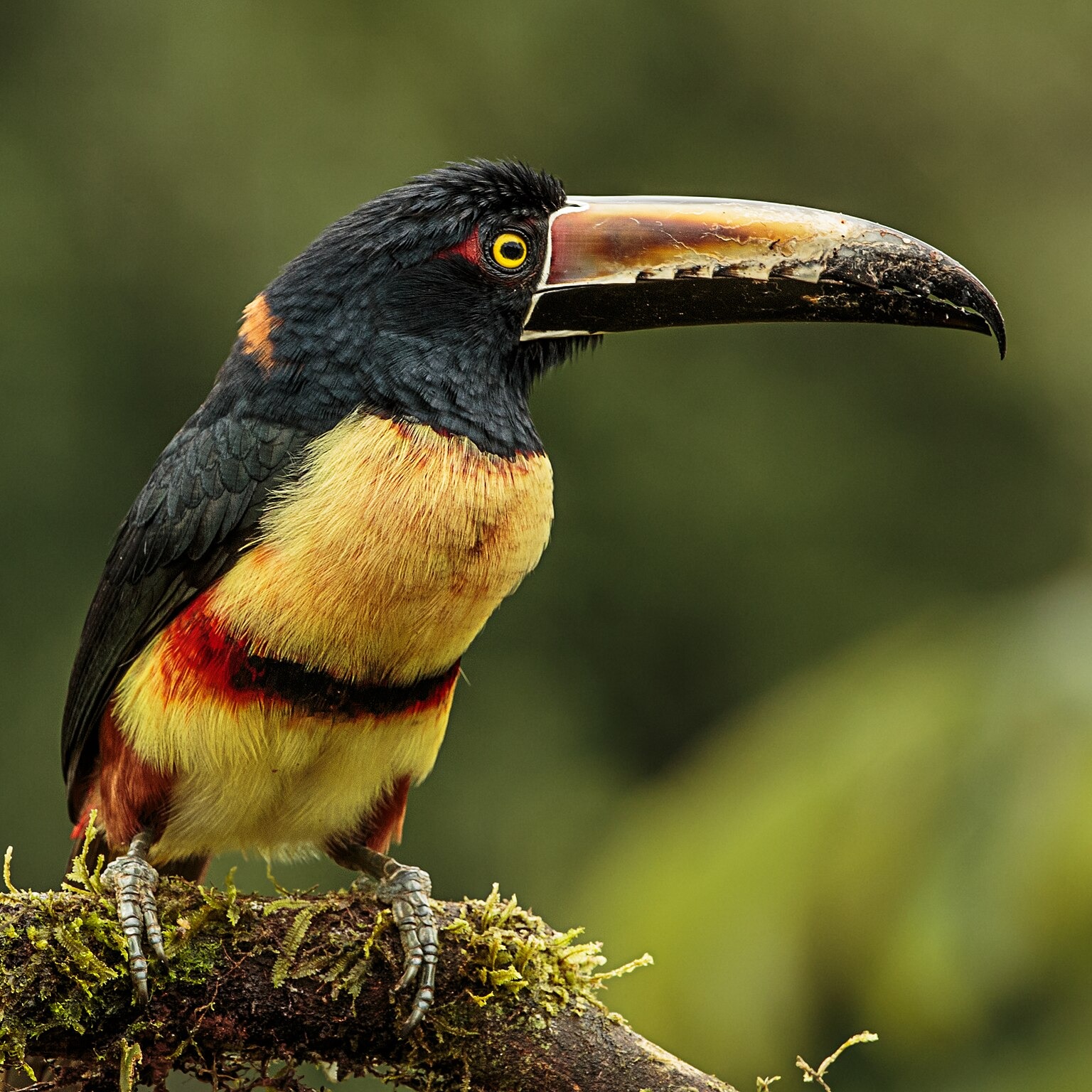
The Collared Aracari (Pteroglossus torquatus) is a medium-sized toucan with an extraordinarily striking plumage pattern. Its head, neck, and upper chest are black, contrasting sharply with a bright yellow belly that is crossed by a black spot in the center and a distinctive horizontal band (collar) of red and black. Its back and wings are dark olive green, and its rump is red. Its most spectacular feature is its long, curved bill: the upper mandible is a pale grayish-yellow with a black 'sawtooth' pattern along the cutting edge, while the lower mandible is entirely black. Its large yellow eyes are surrounded by a patch of bare, deep red skin.

Added by

Anonymous Curator

Reviewed by

Under Review

Last modified by

Julia Trouin

TaxonomyBiological classification ranks placing this species within the tree of life, from Kingdom down to Genus.

PhylumRank below Kingdom. Groups organisms sharing a fundamental body plan (e.g., Chordata = vertebrates and some invertebrates).Chordata
ClassRank below Phylum. Subdivides by structural traits (e.g., Mammalia, Aves, Reptilia, Insecta).Aves
OrderRank below Class. Groups related families sharing common ancestry (e.g., Carnivora, Primates).Piciformes
FamilyRank below Order. Groups closely related genera (e.g., Felidae = cats, Canidae = dogs).Ramphastidae
GenusRank just above Species. The first word in the two-part binomial scientific name.Pteroglossus
Taxonomic AuthorityThe scientist who first formally described and published this species, followed by the year of publication.(Gmelin, 1788)
Record Completeness
95%
Coming soon

Ecology & StatusHow this species lives: habitat preferences, diet, behavior, population status, and role in its ecosystem.

OriginWhether the species is native (evolved here), endemic (found only here), or introduced by human activity.

Native

Population TrendDirection of change in population size over time: increasing, stable, decreasing, or unknown.

Decreasing

Breeding SeasonTime of year when this species typically reproduces or flowers.

Dry Season

Trophic RolePosition in the food chain: producer, herbivore, carnivore, omnivore, decomposer, or parasite.

Omnivore

Recent SightingsWhether this species has been observed in the wild in Costa Rica within recent years.

Yes

Habitat SummaryOverview of the specific ecosystems and environments where this species is found in Costa Rica. Multi-lang

It is a highly adaptable bird that inhabits rainforests, deciduous dry forests, forest edges, tall secondary growth, and plantations (such as cacao and fruit trees). It prefers the mid and upper strata of the forest canopy. Unlike large toucans, it tolerates human alteration very well as long as large trees remain. In Costa Rica, it is very common on both slopes (Caribbean and Pacific), from sea level up to approximately 1,200 meters in elevation.

BehaviourDaily activity patterns, movement, territory use, foraging style, and seasonal behavioral changes. Multi-lang

They are extremely social and active birds that move through the mid and upper canopy in noisy flocks of 5 to 15 individuals. They have a characteristic 'follow the leader' flight style: they fly one after another across forest clearings in a fast, direct flight with rapid wingbeats. They maintain constant communication by emitting a sharp, piercing sound that resembles the squeak of a rubber toy or a 'psiiik, psiiik!'.

Social ActivitySocial structure: whether the species is solitary, paired, or colonial; hierarchy and communication. Multi-lang

Permanently gregarious birds. They feed, allopreen, roost, and breed cooperatively within the same closed family group.

Feeding GuildWhat the species eats, how it forages or hunts, and its role as a consumer in the food web. Multi-lang

Omnivore / Canopy frugivore and Nest-predator.

Trophic Chain DetailsSpecific interactions in local food webs: prey species, predators, competitors, and scavengers. Multi-lang

Strict omnivore. Its base diet is composed of fleshy fruits (wild figs, cecropias, papayas, and palm fruits), playing a vital role as seed dispersers. However, their animal protein consumption is very high: they hunt large insects, lizards, and are prolific thieves of eggs and chicks from other birds. Adults are preyed upon by crested eagles, bicolored hawks, and large owls; while snakes and tayras raid their roosting holes.

Reproductive BehaviourMating strategies, courtship displays, nesting or spawning behavior, and parental care. Multi-lang

They have a fascinating cooperative breeding system. They nest in deep natural cavities or old nests of large woodpeckers. The dominant monogamous pair lays 3 to 4 white eggs directly on a bed of regurgitated seeds. Incubation takes about 16 days. Remarkably, the pair receives help from up to three or four subordinate adults (usually offspring from previous years' broods) who actively help feed and defend the altricial chicks. The young fledge and leave the cavity after about 6 weeks.

Physical Measures

Length (cm)

39.0 - 43.0 cm

Weight (Grams)

190 g - 275 g

Offspring per cycleTypical number of young (live births, eggs, or seeds) produced by one adult in a single reproductive event or breeding season.3 - 4
Sexual DimorphismObservable physical differences between males and females of the same species (e.g., size, coloration, features).No

Lifespan

Sexual MaturityAge at which the individual becomes capable of reproducing for the first time.

12 - 24 Months

Gestation / IncubationDuration from fertilization to birth (mammals) or to hatching (egg-laying species).

15 - 17

Lifespan EstimatedExpected duration of life from birth to natural death under wild conditions.
Males10 - 15 Years
Females10 - 15 Years

Evolutionary AdaptationsInherited traits and behaviors that improve the species' survival and reproduction in its specific environment. Multi-lang

Multi-tool Sawtooth Bill: The edges of its bill are not smooth but have notches that mimic saw teeth. This adaptation is perfect for tearing into hard, leathery fruits, but it also allows it to firmly grip slippery chicks and lizards, or dismember prey before swallowing.
Folded Roosting: So that an entire gang of aracaris can sleep inside the same narrow tree hole, they have developed special joints at the base of the tail. Upon entering the nest, they fold their long tail completely forward over their own back, turning into a compact ball of feathers.

Main ThreatsDocumented pressures reducing the population: habitat loss, hunting, disease, climate change, and invasive species. Multi-lang

Loss of Old Trees: Since they cannot excavate their own nests in hard wood, they obligatorily depend on old nests of large woodpeckers (like the Lineated Woodpecker) in dead or dying trees. The felling of these trees because they are considered 'dangerous' or useless in agricultural areas leaves them without shelter.
Wildlife Trafficking: Their manageable size, exotic appearance, and highly intelligent, social behavior make them frequent targets of illegal capture to supply the domestic and international pet trade.

Interesting FactsSurprising or notable facts that highlight what makes this species unique or ecologically important. Multi-lang

Dormitory Gangs: They are among the few birds that roost communally. At dusk, entire groups of up to 6 to 15 aracaris can be seen lining up to squeeze one by one, pushing each other, into a single woodpecker hole, where they will spend the night piled together for warmth and protection.
The Terror of the Nests: Despite being avid frugivores, they have a sinister reputation in the forest. They are methodical nest predators. The gang combs the forest inspecting every corner; when they find nests of oropendolas, flycatchers, or doves, they ruthlessly eat the eggs and dismember the live chicks.