
AnimaliaIUCN LCApproved Recent Sighting
Anolis cupreus
Copper Anole
Hallowell, 1860
Detailed Texts Multi-lang
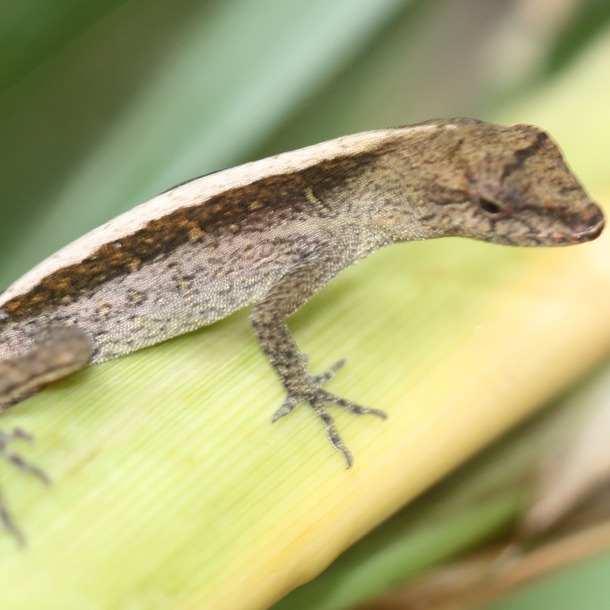
Small to medium-sized lizard with skin that often features characteristic copper or bronze reflections. It possesses a distinctive dewlap used for social displays.
Added by
Anonymous Curator
Reviewed by
Julia Trouin
Last modified by
Julia Trouin
Taxonomy
PhylumChordata
ClassReptilia
OrderSquamata
FamilyDactyloidae
GenusAnolis
Taxonomic AuthorityHallowell, 1860
Ecology & Status
Origin
Native
Population Trend
Stable
Breeding Season
Year Round
Trophic Role
Insectivore
Recent Sightings
Yes
Habitat Summary Multi-lang
Distributed primarily in the Pacific region of Costa Rica, occupying areas from dry and transitional forests to shrublands and human-altered areas.Behaviour Multi-lang
Diurnal, very active during the sunniest hours on trunks and foliage.Social Activity Multi-lang
Highly territorial; males actively defend small arboreal areas.Feeding Guild Multi-lang
Sit-and-wait foraging; waits for prey to pass nearby before launching a quick ambush.Trophic Chain Details Multi-lang
Generalist insectivore; hunts small prey on tree trunks.Reproductive Behaviour Multi-lang
Oviparous; the female deposits a single egg in moist and protected locations.Physical Measures
Length (cm)
4.0 - 7.0 cm
Weight (Grams)
2 g - 6 g
Offspring per cycle1 - 1
Sexual DimorphismYes
Lifespan
Sexual Maturity
1 Years
Gestation / Incubation
45 - 60
Lifespan Estimated
Males--
Females--
Sexual Dimorphism
Males Multi-lang
Males are larger and have much more conspicuous dewlaps.
Females Multi-lang
Females usually have more cryptic color patterns to camouflage during nesting.
Evolutionary Adaptations Multi-lang
Highly developed dewlap: Used for intraspecific communication, allowing for efficient territory delimitation and mate attraction.
Main Threats Multi-lang
Habitat fragmentation due to urban and agricultural expansion, as well as competition with invasive species in peri-urban areas.
Interesting Facts Multi-lang
Males compete aggressively by displaying their brightly colored dewlap to intimidate other males and ensure access to females.