
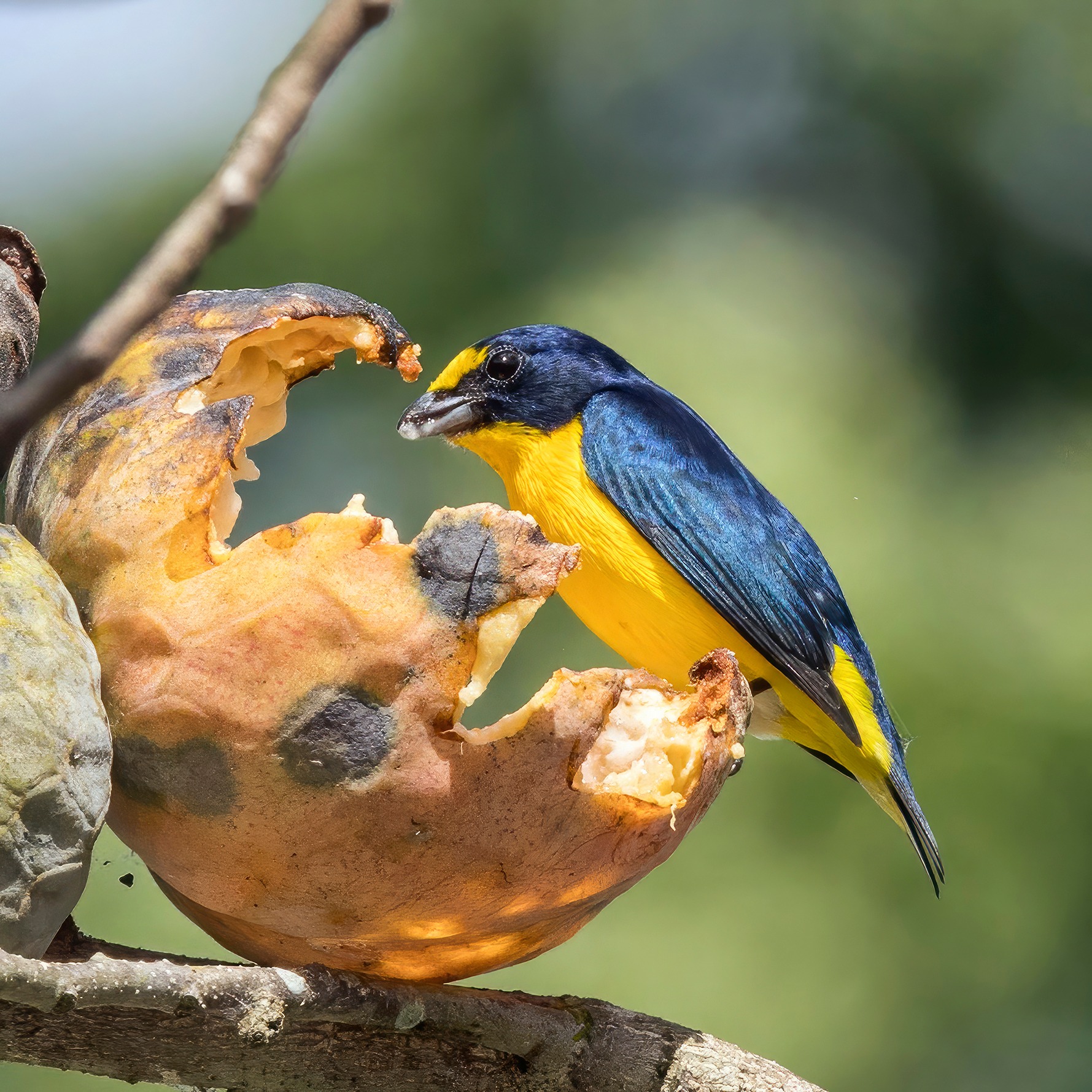
Euphonia hirundinacea
Yellow-throated Euphonia
Bonaparte, 1838
Added by
Anonymous Curator
Reviewed by
Under Review
Last modified by
Julia Trouin
TaxonomyBiological classification ranks placing this species within the tree of life, from Kingdom down to Genus.
Ecology & StatusHow this species lives: habitat preferences, diet, behavior, population status, and role in its ecosystem.
OriginWhether the species is native (evolved here), endemic (found only here), or introduced by human activity.
Native
Population TrendDirection of change in population size over time: increasing, stable, decreasing, or unknown.
Stable
Breeding SeasonTime of year when this species typically reproduces or flowers.
--
Trophic RolePosition in the food chain: producer, herbivore, carnivore, omnivore, decomposer, or parasite.
Frugivore
Recent SightingsWhether this species has been observed in the wild in Costa Rica within recent years.
Yes
Habitat SummaryOverview of the specific ecosystems and environments where this species is found in Costa Rica. Multi-lang
It is distributed from Mexico, throughout Central America, to northwestern Colombia. In Costa Rica, it is a common and widely distributed species in the lowlands and foothills of both slopes (Pacific and Caribbean), living from sea level to approximately 1,400 meters in altitude. It is primarily found along the edges of humid and dry forests, young secondary forests, wooded agricultural areas, coffee plantations, pastures with scattered trees, and urban or suburban gardens with an abundance of epiphytic and parasitic plants.BehaviourDaily activity patterns, movement, territory use, foraging style, and seasonal behavioral changes. Multi-lang
It is a diurnal, restless, and highly gregarious bird. It continuously moves through the middle and upper strata of vegetation, flying with rapid and direct wingbeats that generate a subtle sound. Outside the breeding season, it travels in small family groups or flocks of 6 to 30 individuals of its own species, searching for trees with an abundance of parasitic fruits. Its communication is constant; males emit a melodious, clear, two-note whistle that sounds like 'bii-bii' or 'chii-chii', interspersed with short metallic clicks to maintain group contact.Social ActivitySocial structure: whether the species is solitary, paired, or colonial; hierarchy and communication. Multi-lang
It exhibits markedly social behavior outside the breeding season, congregating freely with conspecifics and participating in mixed flocks with other euphonias and small tanagers. However, during the reproductive period, it is strictly territorial and monogamous, vigorously defending the chosen nesting tree through intense singing and warning flights against rival males.Feeding GuildWhat the species eats, how it forages or hunts, and its role as a consumer in the food web. Multi-lang
Frugivore highly specialized in the consumption of arils and berries. Its diet relies almost entirely on parasitic plants of the Phoradendron and Psittacanthus genera. It complements this caloric source with small wild figs and softer fruit pulp, occasionally ingesting small soft arthropods during the spring.Trophic Chain DetailsSpecific interactions in local food webs: prey species, predators, competitors, and scavengers. Multi-lang
It acts as a specialist consumer and crucial intermediary in the arboreal food web. It is the primary dispersal agent for mistletoe (Phoradendron and Oryctanthus), a hemiparasitic plant whose fruits are vital for forest biodiversity. It also consumes small berries of Ficus and from the Melastomataceae family. Although primarily frugivorous, it consumes small soft insects during chick rearing. It is preyed upon by small falcons such as the Bat Falcon (Falco albigularis), medium-sized nocturnal raptors, and arboreal snakes like Imantodes.Reproductive BehaviourMating strategies, courtship displays, nesting or spawning behavior, and parental care. Multi-lang
It is a monogamous bird notable for constructing a globular or enclosed nest with a side entrance, similar to a small oven. Both sexes actively cooperate in its building, using green moss, fine rootlets, plant fibers, and spider webs, commonly placing it at heights between 2 and 8 meters, hidden within dense masses of epiphytes, orchids, or mistletoes. The female lays 3 to 5 white eggs with reddish-brown spots or freckles. Incubation is performed exclusively by the female for a period of 13 to 14 days. Both parents feed the chicks via regurgitation with a thick paste of fruit and soft insects for 15 to 17 days until they fledge.Physical Measures
Length (cm)
9.5 - 10.5 cm
Weight (Grams)
14 g - 17 g
Lifespan
Sexual MaturityAge at which the individual becomes capable of reproducing for the first time.
1 Years
Gestation / IncubationDuration from fertilization to birth (mammals) or to hatching (egg-laying species).
13 - 14