
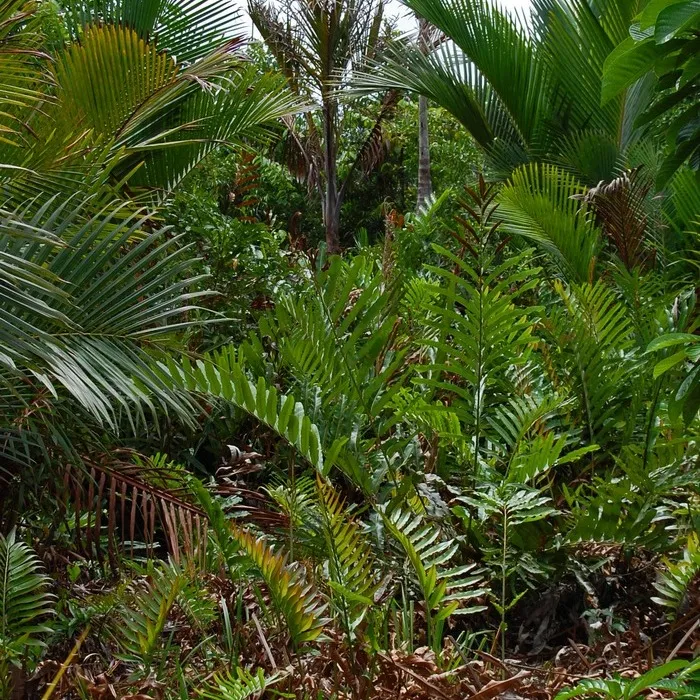
Acrostichum aureum
Golden Leather Fern
L.
Added by
Anonymous Curator
Reviewed by
Under Review
Last modified by
Julia Trouin
TaxonomyBiological classification ranks placing this species within the tree of life, from Kingdom down to Genus.
Ecology & StatusHow this species lives: habitat preferences, diet, behavior, population status, and role in its ecosystem.
OriginWhether the species is native (evolved here), endemic (found only here), or introduced by human activity.
Native
Population TrendDirection of change in population size over time: increasing, stable, decreasing, or unknown.
Unknown
Trophic RolePosition in the food chain: producer, herbivore, carnivore, omnivore, decomposer, or parasite.
Herbivore
Growth HabitPhysical form and structure of the plant: tree, shrub, herb, vine, epiphyte, aquatic, etc.
--
Leaf TypeLeaf characteristics: deciduous (seasonal shed), evergreen, simple, compound, needle-like, etc.
--
Flowering SeasonTime of year when this species typically reproduces or flowers.
Year Round
Recent SightingsWhether this species has been observed in the wild in Costa Rica within recent years.
Yes
Habitat SummaryOverview of the specific ecosystems and environments where this species is found in Costa Rica. Multi-lang
Widely distributed throughout pantropical coastal zones, coastal marshes, and estuarine environments worldwide. It thrives primarily along the landward margins of mangrove forests, interior brackish swamps, coastal lagoons, and wet saline lowlands. It is highly efficient at establishing itself in areas with high light exposure and fluctuating water levels where salt concentrations are moderate to high.Light & Water NeedsSunlight intensity and moisture levels this plant needs to grow and reproduce successfully. Multi-lang
Information not available in English. Help us expand this record!BehaviourDaily activity patterns, movement, territory use, foraging style, and seasonal behavioral changes. Multi-lang
Acts as a dominant, long-lived macro-pteridophyte colonizer. It plays a major role in sediment accumulation along tropical shorelines. It exhibits opportunistic growth patterns, expanding rapidly via clonal rhizome division when high-light gaps open in coastal canopies, effectively building thick peat-like mounds over time.Toxicity / UsesToxic compounds present and their documented effects on humans or other organisms. Multi-lang
Information not available in English. Help us expand this record!Physical Measures
Length (cm)
100.0 - 350.0 cm