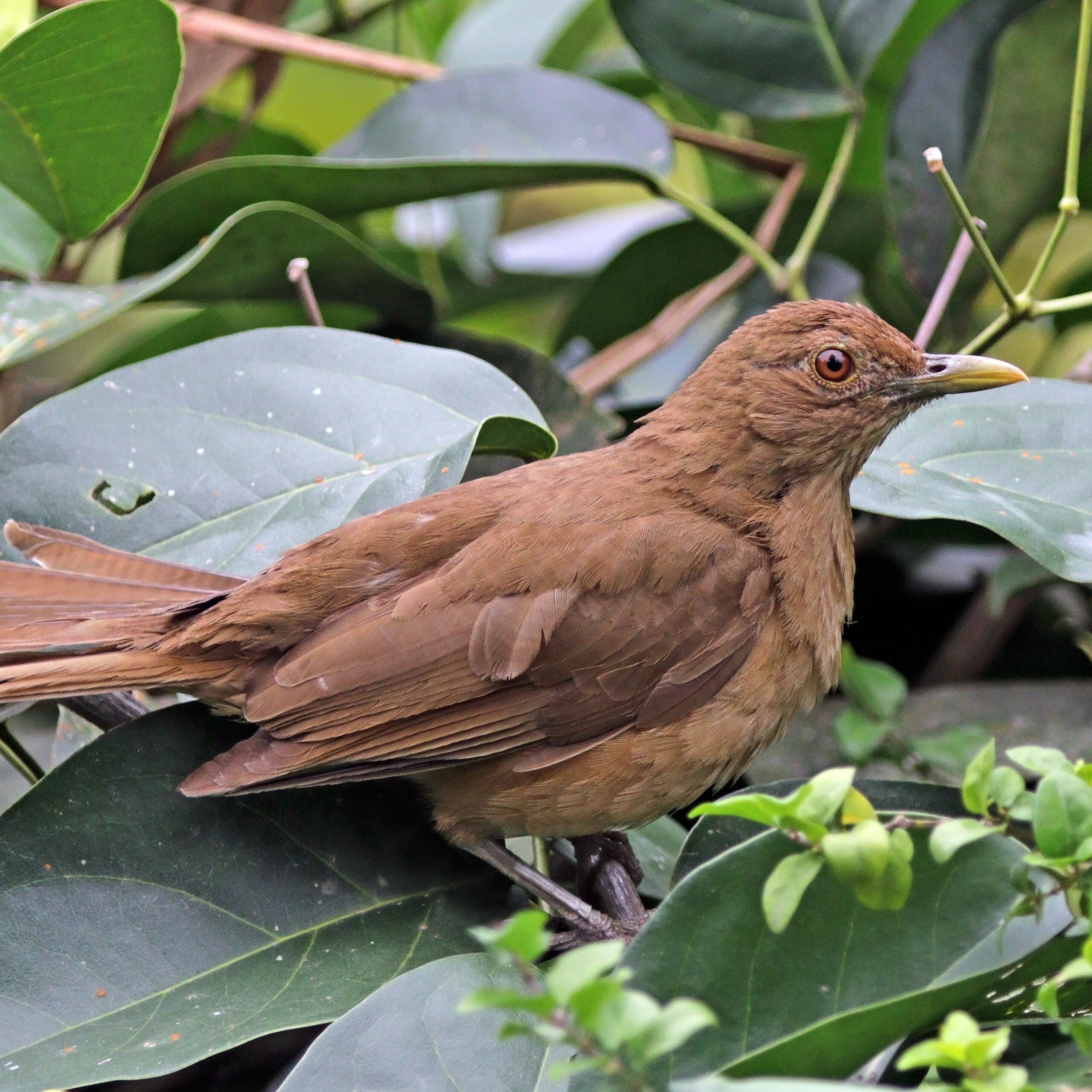
Turdus grayi
Clay-colored Thrush
Bonaparte, 1838
Added by
Anonymous Curator
Reviewed by
Under Review
Last modified by
Julia Trouin
TaxonomyBiological classification ranks placing this species within the tree of life, from Kingdom down to Genus.
Ecology & StatusHow this species lives: habitat preferences, diet, behavior, population status, and role in its ecosystem.
OriginWhether the species is native (evolved here), endemic (found only here), or introduced by human activity.
Native
Population TrendDirection of change in population size over time: increasing, stable, decreasing, or unknown.
Increasing
Breeding SeasonTime of year when this species typically reproduces or flowers.
--
Trophic RolePosition in the food chain: producer, herbivore, carnivore, omnivore, decomposer, or parasite.
Omnivore
Recent SightingsWhether this species has been observed in the wild in Costa Rica within recent years.
Yes
Habitat SummaryOverview of the specific ecosystems and environments where this species is found in Costa Rica. Multi-lang
The clay-colored thrush is one of the birds with the greatest ecological niche breadth in Costa Rica, surpassed only by the great kiskadee in tolerance to human disturbance. It inhabits forest edges, open and semi-open secondary forests, wooded gardens, orchards, shade coffee plantations, urban and suburban parks, pastures with isolated trees, wooded riversides, shrublands with available leaf litter, and virtually any environment with forested or tree vegetation and accessible soil for foraging. It requires the combination of elevated perches for singing and nesting sites — trees, dense shrubs, crevices in walls — with leaf litter-covered or moist earth ground where it can search for invertebrates and fallen fruits. It is omnipresent in the Greater Metropolitan Area of Costa Rica, inter-Andean valleys, and peri-urban surroundings of all cities in the country. It is recorded from sea level to 2,800 meters altitude, being especially abundant between 800 and 1,800 meters on both slopes. It is the species that most frequently visits gardens with fruit feeders in urban and residential zones.BehaviourDaily activity patterns, movement, territory use, foraging style, and seasonal behavioral changes. Multi-lang
The clay-colored thrush is diurnal and leads a markedly terrestrial and arboreal life depending on the activity. During foraging, it spends most of its time on the ground walking through leaf litter with rapid movements and abrupt stops, tossing leaves with its bill to search for invertebrates or collecting fallen fruits. For singing, resting, and monitoring its territory, it moves to high, exposed perches — canopy branches, electric cables, poles, rooftops — from where its song is audible at great distances. The male's territorial song is most intense at dawn and in the hours before rain; this association of the song with rain was what generated the popular belief that the clay-colored thrush 'calls' the rains. It does not migrate but performs seasonal altitudinal movements of up to 500-1,000 meters. It is the bird that most frequently visits fruit feeders in Costa Rican urban gardens. Its presence is so constant in the national soundscape that many Costa Ricans do not 'hear' it consciously in their daily lives — a phenomenon of perceptual habituation — until they travel abroad and notice its absence.Social ActivitySocial structure: whether the species is solitary, paired, or colonial; hierarchy and communication. Multi-lang
The clay-colored thrush is primarily solitary or lives in stable monogamous pairs during the breeding season. Pairs are territorial and defend their territory through the male's prolonged song from prominent perches and pursuits of same-species intruders. Outside the breeding season, individual territories are more diffuse and small groups of 5-20 individuals may congregate in trees with high ripe fruit production. The most frequent social contact is the courtship duet between the pair — where male and female respond to each other in the same tree — and collective alarms at predators. The clay-colored thrush responds to playbacks of its own song with immediacy and aggressiveness, making it very easy to detect via playback technique during surveys. It does not regularly associate with mixed flocks of other species.Feeding GuildWhat the species eats, how it forages or hunts, and its role as a consumer in the food web. Multi-lang
Terrestrial-arboreal omnivore with dual strategies. It forages both on the ground and in low and mid vegetation. On the ground: walks slowly tossing leaves with its bill (leaf-turning), actively listens to detect earthworm movements, excavates with its bill in moist earth, and searches under rocks or fallen logs. In the vegetation: takes ripe fruits directly from branches and vines, occasionally captures insects in short flight. The diet includes earthworms (the most important protein fraction), soil larvae and insects, arachnids, snails, small lizards, bird eggs, soft ripe fruits of multiple botanical families, and small seeds. The proportion of each component varies seasonally: during the dry season a higher proportion of soil invertebrates; during the rainy season a higher proportion of fruits. It actively consumes from fruit feeders placed in gardens.Trophic Chain DetailsSpecific interactions in local food webs: prey species, predators, competitors, and scavengers. Multi-lang
Omnivorous primary consumer with variable trophic position. By consuming fruits and dispersing seeds it acts as a primary consumer and disperser; by consuming earthworms and soil invertebrates (organic matter consumers) it acts as a secondary consumer. Its diet includes earthworms, beetle larvae, beetles, crickets, isopods, arachnids, land snails, small lizards, eggs of other birds, and soft ripe fruits of various species (Ficus spp., Cecropia spp., Rubus spp., Solanum spp., Cestrum spp., Bursera spp., Trema micrantha). It is an important seed disperser of understory and mid-stratum plants whose seeds can be swallowed whole and defecated far from the mother tree. Its main predators are the broad-winged hawk (Buteo platypterus), sharp-shinned hawk (Accipiter striatus), the boa constrictor (Boa constrictor) for adults, and the tiger ratsnake (Spilotes pullatus). Nests are preyed upon by cats (Felis catus), rats (Rattus rattus), coatis (Nasua narica), and several arboreal snakes.Reproductive BehaviourMating strategies, courtship displays, nesting or spawning behavior, and parental care. Multi-lang
The breeding season in Costa Rica extends primarily from March to July, with the peak of nesting in April-May, coinciding with the beginning of the rainy season. The male intensifies his territorial song weeks before nesting begins. Courtship includes duet vocalizations, aerial pursuits of the female by the male, and food offerings. The female builds the nest almost alone — the male participates little — over 5 to 10 days. The nest is a deep, robust cup of roots, grass stems, leaves, mud, and diverse plant material, with the interior lined with finer fibers. It is placed in a branch fork, on a building ledge, in a clay flowerpot, or on any suitable horizontal support available, at heights of 1 to 12 meters. The clutch consists of 2 to 4 eggs — most frequently 3 — bluish-green with brownish or reddish spots. Only the female incubates for 13 to 14 days. Chicks hatch altricial and are fed by both parents with earthworms and insects for 14 to 16 days in the nest. Young reach independence 2 to 3 weeks after leaving the nest and sexual maturity at one year of age. A pair can produce up to three successful clutches per season.Physical Measures
Length (cm)
23.0 - 27.0 cm
Weight (Grams)
74 g - 95 g
Lifespan
Sexual MaturityAge at which the individual becomes capable of reproducing for the first time.
1 Years
Gestation / IncubationDuration from fertilization to birth (mammals) or to hatching (egg-laying species).
13 - 14