
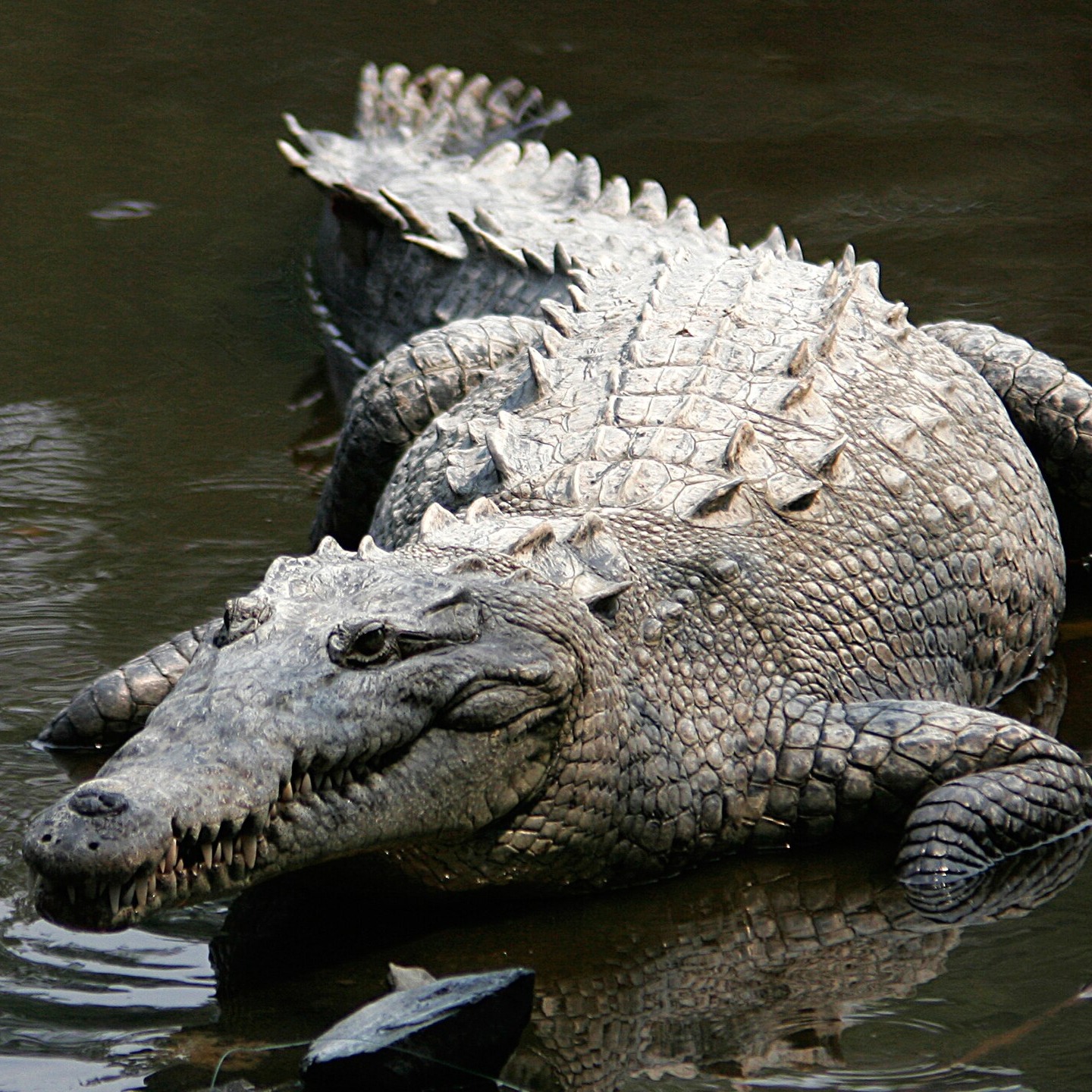
Crocodylus acutus
American Crocodile
Cuvier, 1807
Added by
Anonymous Curator
Reviewed by
Under Review
Last modified by
Julia Trouin
TaxonomyBiological classification ranks placing this species within the tree of life, from Kingdom down to Genus.
Ecology & StatusHow this species lives: habitat preferences, diet, behavior, population status, and role in its ecosystem.
OriginWhether the species is native (evolved here), endemic (found only here), or introduced by human activity.
Native
Population TrendDirection of change in population size over time: increasing, stable, decreasing, or unknown.
Decreasing
Breeding SeasonTime of year when this species typically reproduces or flowers.
--
Trophic RolePosition in the food chain: producer, herbivore, carnivore, omnivore, decomposer, or parasite.
Carnivore
Recent SightingsWhether this species has been observed in the wild in Costa Rica within recent years.
Yes
Habitat SummaryOverview of the specific ecosystems and environments where this species is found in Costa Rica. Multi-lang
It is a species highly adaptable to salinity, thriving in coastal ecosystems where freshwater mixes with the sea. Its primary habitats include mangrove swamps, estuaries, coastal lagoons, canals, river mouths, and beaches. However, it also travels kilometers inland up large river channels, establishing itself in slow-moving rivers, freshwater swamps, and reservoirs. They require sun-exposed sand or mudbanks for thermoregulation and nesting, and waters deep enough to hide and ambush prey. In Costa Rica, the Tárcoles River and Palo Verde National Park (Tempisque River) represent their most emblematic and highest-density habitats.BehaviourDaily activity patterns, movement, territory use, foraging style, and seasonal behavioral changes. Multi-lang
It is an ectothermic (cold-blooded) reptile whose daily activity is governed by ambient temperature. In the mornings and afternoons, it congregates on muddy banks to practice basking. They frequently exhibit a behavior called 'gaping' (mouth open), which facilitates cooling by thermal evaporation from the moist tissues of the mouth. At noon, during the peak heat, they retreat to deep water or the protective shade of the mangroves. Although they appear lethargic and clumsy on land, they are capable of alarming bursts of speed over short distances (up to 15 km/h). They are predominantly nocturnal hunters, floating motionless on the water's surface, exposing only their eyes and nostrils, waiting with infinite patience for prey to approach the water's edge to drink.Social ActivitySocial structure: whether the species is solitary, paired, or colonial; hierarchy and communication. Multi-lang
It is a hierarchical species. Although they congregate in large numbers to peacefully bask on riverbanks (even stacking on top of each other), access to the best thermal sites is dictated by size. Dominant males, usually the most massive, claim the best territories in deep water and react extremely aggressively towards rivals of similar size during the mating season, inflicting mutilating bites, roaring, and slapping their heads against the water. Younger and smaller individuals must keep their distance to avoid being cannibalized or killed due to territoriality.Feeding GuildWhat the species eats, how it forages or hunts, and its role as a consumer in the food web. Multi-lang
Carnivore (Ambush predator). Its entire anatomy is perfected to go unnoticed under murky water. They patiently wait for terrestrial birds or mammals to come down to drink, launching like a torpedo and gripping the victim with dozens of conical teeth designed to hold, not cut. After capture, they drown their prey. Since they cannot chew, they swallow food whole. For prey too large to fit in their throat, they utilize the infamous 'death roll': they grab a piece and violently spin on their longitudinal axis in the water to dismember or tear off chunks of meat.Trophic Chain DetailsSpecific interactions in local food webs: prey species, predators, competitors, and scavengers. Multi-lang
It is the absolute apex predator in the estuarine systems and rivers it inhabits. As hatchlings, their diet is dominated by insects, crustaceans, snails, and small amphibians. As juveniles, they integrate crabs, small fish, turtles, and waterfowl. Adults hunt almost any prey they can catch and swallow: large fish (like snook and mullet), iguanas, pelicans, raccoons, coatis, monkeys, feral dogs, calves, and, on rare occasions, adult cattle. They are essential to the ecosystem as they recycle nutrients, control mesopredator populations (like raccoons that would otherwise destroy sea turtle nests), and remove carrion from waterways. Only as hatchlings are they vulnerable to herons, ospreys, coatis, and large fish; a healthy adult has no natural predators other than humans and, infrequently, jaguars in certain protected areas.Reproductive BehaviourMating strategies, courtship displays, nesting or spawning behavior, and parental care. Multi-lang
The courtship season occurs in the dry season (February to May). Females construct nests by excavating deep holes in exposed sandy banks, where they deposit between 30 and 60 eggs. Unlike turtles and other reptiles that abandon their nests, mother crocodiles fiercely protect the area against any intruder during the ~85 days of incubation. Upon hatching, the babies emit high-pitched chirps from under the dirt. Hearing them, the mother unearths the sand and astonishingly transports the delicate hatchlings inside her colossal jaws to the water's edge for their first swim. Despite this initial maternal care, infant mortality is extreme: over 90% of hatchlings will succumb to predators before their first year of life.Physical Measures
Length (cm)
250.0 - 600.0 cm
Weight (Grams)
150.00 kg - 900.00 kg
Lifespan
Sexual MaturityAge at which the individual becomes capable of reproducing for the first time.
8 - 15 Years
Gestation / IncubationDuration from fertilization to birth (mammals) or to hatching (egg-laying species).
80 - 90