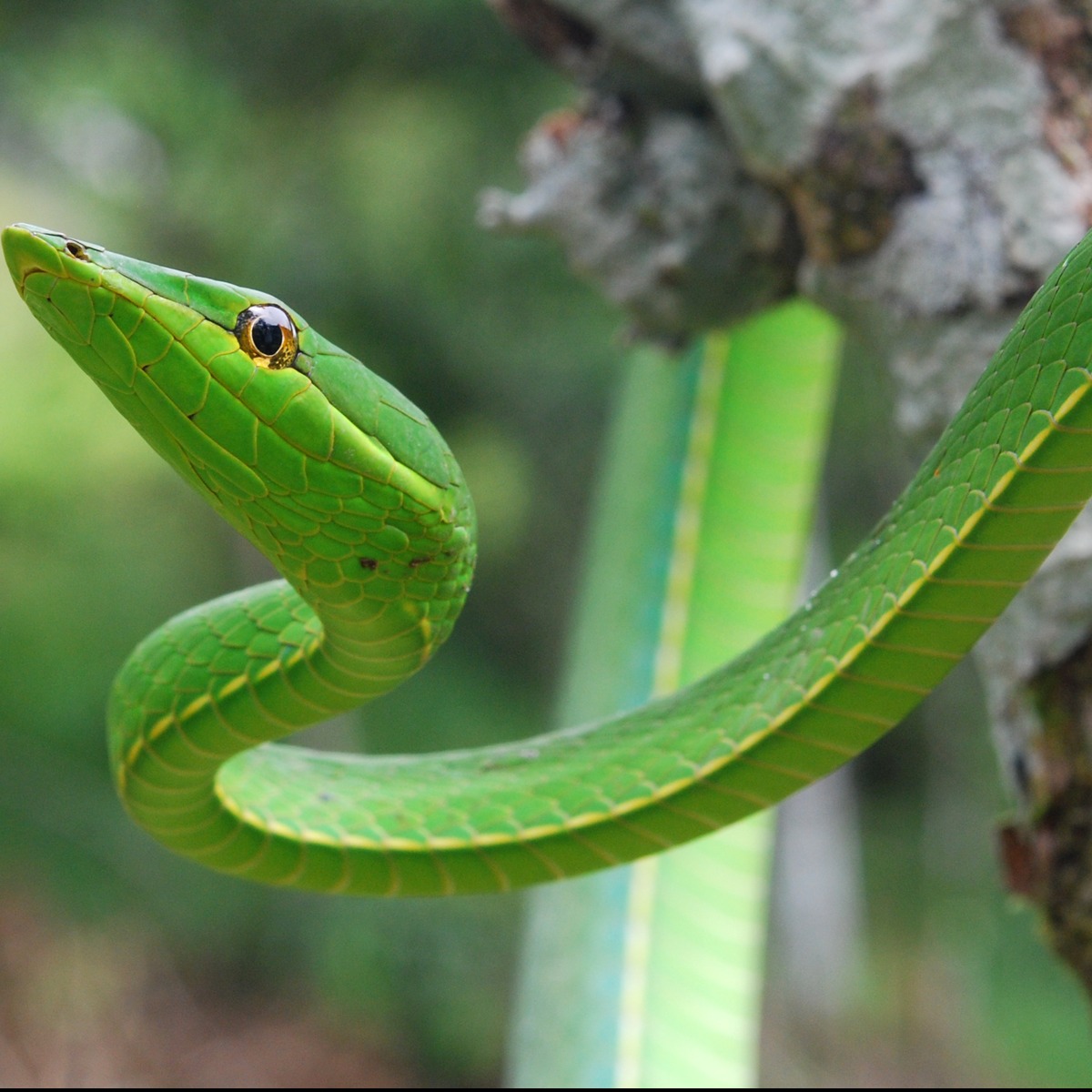
Oxybelis fulgidus
Green Vine Snake
(Daudin, 1803)
Added by
Anonymous Curator
Reviewed by
Under Review
Last modified by
Julia Trouin
TaxonomyBiological classification ranks placing this species within the tree of life, from Kingdom down to Genus.
Ecology & StatusHow this species lives: habitat preferences, diet, behavior, population status, and role in its ecosystem.
OriginWhether the species is native (evolved here), endemic (found only here), or introduced by human activity.
Native
Population TrendDirection of change in population size over time: increasing, stable, decreasing, or unknown.
Stable
Breeding SeasonTime of year when this species typically reproduces or flowers.
Wet Season
Trophic RolePosition in the food chain: producer, herbivore, carnivore, omnivore, decomposer, or parasite.
Carnivore
Recent SightingsWhether this species has been observed in the wild in Costa Rica within recent years.
Yes
Habitat SummaryOverview of the specific ecosystems and environments where this species is found in Costa Rica. Multi-lang
Inhabits mainly the middle and upper layers of humid tropical rainforests, gallery forests, and areas of dense vegetation near rivers. It is distributed from southern Mexico, throughout Central America, to northern South America (including the Amazon). It is a species highly dependent on arboreal architecture, preferring areas with an abundance of vines, epiphytes, and closed-canopy trees.BehaviourDaily activity patterns, movement, territory use, foraging style, and seasonal behavioral changes. Multi-lang
It is a very active diurnal reptile with highly specialized behavior. During daylight hours, it stays moving through the canopy looking for prey. Although it appears very slow, it is capable of making extremely fast attacks. At night, it coils on safe, dense branches, remaining virtually undetectable until dawn.Social ActivitySocial structure: whether the species is solitary, paired, or colonial; hierarchy and communication. Multi-lang
It is a solitary animal by nature. It does not show group behaviors or coordinated defense. Its interaction with other individuals is reduced to a minimum, outside of the encounters necessary for reproduction. Its survival strategy is based on individuality and mimicry.Feeding GuildWhat the species eats, how it forages or hunts, and its role as a consumer in the food web. Multi-lang
Carnivore specialized in small arboreal vertebrates. It mainly consumes lizards (especially of the Anolis genus), frogs, and, on occasion, bird nestlings that it finds in nests. Its feeding strategy consists of patiently stalking the prey before making a fast and precise movement.Trophic Chain DetailsSpecific interactions in local food webs: prey species, predators, competitors, and scavengers. Multi-lang
Functions as a key secondary consumer in the upper stratum. It specializes in the predation of lizards, tree frogs, and occasionally small birds or nestlings. Its role is crucial for controlling the populations of these small arboreal vertebrates. In turn, it can be prey for raptors, large arboreal snakes, and arboreal mammals.Reproductive BehaviourMating strategies, courtship displays, nesting or spawning behavior, and parental care. Multi-lang
Oviparous species. Reproduction occurs mainly during the rainy season. Females lay between 3 and 12 elongated eggs in protected cavities, tree hollows, or among the humus of epiphytes. The incubation period varies according to the ambient temperature, but the young are born as perfect replicas of the adults and are fully independent from the first moment.Physical Measures
Length (cm)
150.0 - 200.0 cm
Weight (Grams)
150 g - 350 g
Lifespan
Sexual MaturityAge at which the individual becomes capable of reproducing for the first time.
2 - 3 Years
Gestation / IncubationDuration from fertilization to birth (mammals) or to hatching (egg-laying species).
40 - 60