
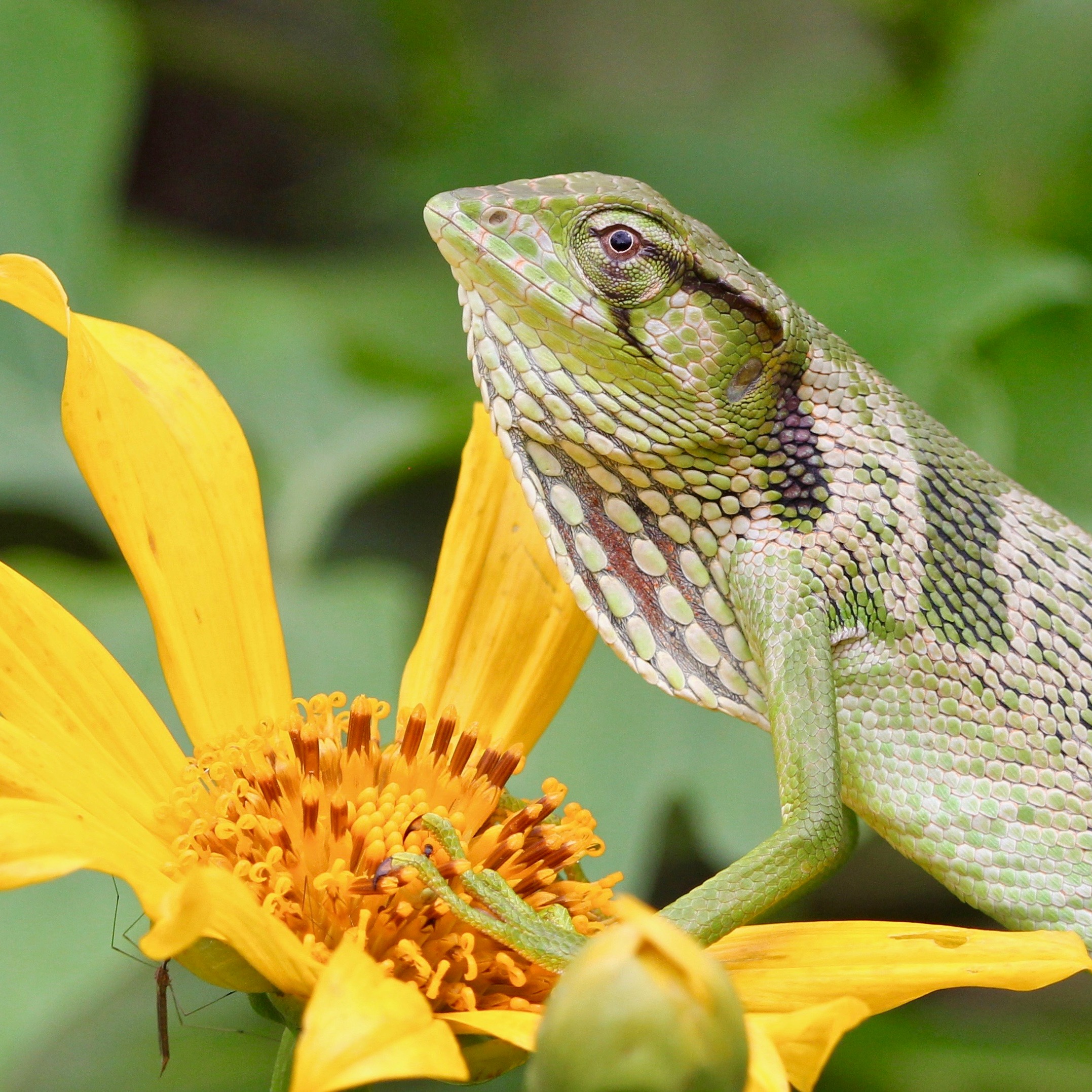
Polychrus gutturosus
Monkey Lizard
Berthold, 1846
Added by
Anonymous Curator
Reviewed by
Under Review
Last modified by
Julia Trouin
TaxonomyBiological classification ranks placing this species within the tree of life, from Kingdom down to Genus.
Ecology & StatusHow this species lives: habitat preferences, diet, behavior, population status, and role in its ecosystem.
OriginWhether the species is native (evolved here), endemic (found only here), or introduced by human activity.
Native
Population TrendDirection of change in population size over time: increasing, stable, decreasing, or unknown.
Stable
Breeding SeasonTime of year when this species typically reproduces or flowers.
Year Round
Trophic RolePosition in the food chain: producer, herbivore, carnivore, omnivore, decomposer, or parasite.
Omnivore
Recent SightingsWhether this species has been observed in the wild in Costa Rica within recent years.
Yes
Habitat SummaryOverview of the specific ecosystems and environments where this species is found in Costa Rica. Multi-lang
It inhabits predominantly the middle and high strata of humid jungles, tropical forests, and open wooded areas. It is strictly arboreal and rarely descends to the ground, unless absolutely necessary.BehaviourDaily activity patterns, movement, territory use, foraging style, and seasonal behavioral changes. Multi-lang
Strictly diurnal species. It spends hours motionless waiting for prey to pass nearby, at which point it can launch an ambush with surprising agility. It is a solitary animal that prefers the high canopy.Social ActivitySocial structure: whether the species is solitary, paired, or colonial; hierarchy and communication. Multi-lang
Totally solitary and territorial. Males actively defend small areas of the canopy against other males, displaying their brightly colored gular dewlap during conflicts.Feeding GuildWhat the species eats, how it forages or hunts, and its role as a consumer in the food web. Multi-lang
Ambush hunter. Uses its binocular vision to calculate distances precisely and then lunges quickly towards its prey. Its patience is its best hunting tool.Trophic Chain DetailsSpecific interactions in local food webs: prey species, predators, competitors, and scavengers. Multi-lang
Secondary consumer / Omnivore. Although its main diet consists of insects, caterpillars, and spiders, it occasionally consumes small fruits and tender shoots, which gives it a dietary advantage in the jungle environment.Reproductive BehaviourMating strategies, courtship displays, nesting or spawning behavior, and parental care. Multi-lang
Oviparous species. The female seeks tree hollows or cracks in the bark to lay her eggs. Incubation is long and depends on the environmental humidity of the forest.Physical Measures
Length (cm)
30.0 - 45.0 cm
Weight (Grams)
100 g - 250 g
Lifespan
Sexual MaturityAge at which the individual becomes capable of reproducing for the first time.
2 - 3 Years
Gestation / IncubationDuration from fertilization to birth (mammals) or to hatching (egg-laying species).
5 - 7