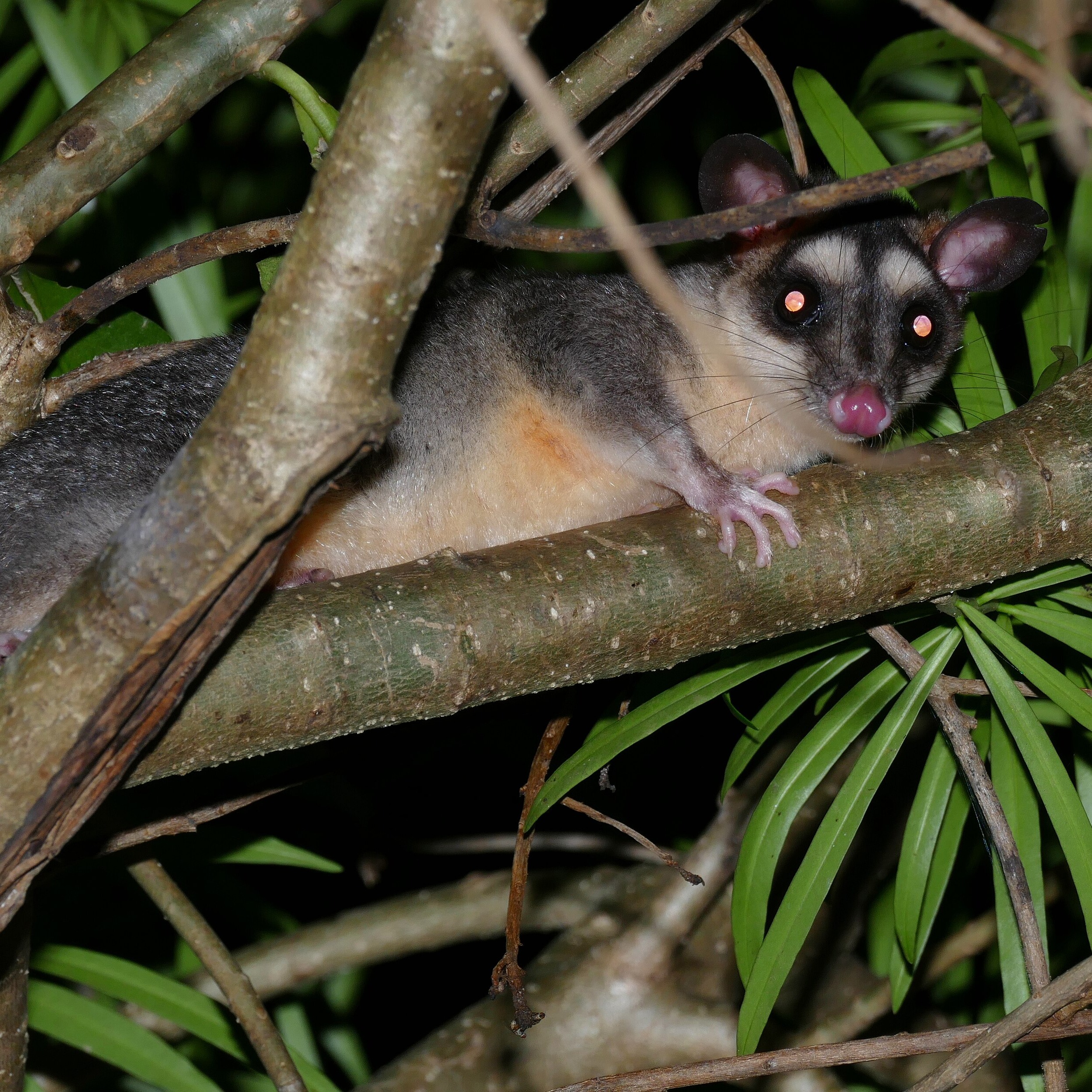
Philander opossum
Gray Four-eyed Opossum
(Linnaeus, 1758)
Added by
Anonymous Curator
Reviewed by
Under Review
Last modified by
Julia Trouin
TaxonomyBiological classification ranks placing this species within the tree of life, from Kingdom down to Genus.
Ecology & StatusHow this species lives: habitat preferences, diet, behavior, population status, and role in its ecosystem.
OriginWhether the species is native (evolved here), endemic (found only here), or introduced by human activity.
Native
Population TrendDirection of change in population size over time: increasing, stable, decreasing, or unknown.
Stable
Breeding SeasonTime of year when this species typically reproduces or flowers.
Year Round
Trophic RolePosition in the food chain: producer, herbivore, carnivore, omnivore, decomposer, or parasite.
Omnivore
Recent SightingsWhether this species has been observed in the wild in Costa Rica within recent years.
Yes
Habitat SummaryOverview of the specific ecosystems and environments where this species is found in Costa Rica. Multi-lang
It is a specialist of wet and riparian habitats. It prefers dense primary and secondary tropical forests, provided they are near rivers, streams, swamps, or ponds. It avoids dry savannas and wide-open spaces. Although it can tolerate some human alteration and is occasionally seen in crops or near rural areas, it strictly depends on water and surrounding forest cover. In Costa Rica, it is common in the lowlands and middle elevations of both slopes.BehaviourDaily activity patterns, movement, territory use, foraging style, and seasonal behavioral changes. Multi-lang
It is a solitary, extremely agile nocturnal forager. Although classified as an omnivore, its diet is much more carnivorous and insectivorous than that of other opossums. It patrols the edges of water bodies actively hunting frogs, toads, freshwater crabs, earthworms, large insects, and small rodents, occasionally supplementing with fruit and nectar. It is a territorial hunter, and males can engage in violent fights if their paths cross. It spends the day sleeping in its spherical nests in the trees.Social ActivitySocial structure: whether the species is solitary, paired, or colonial; hierarchy and communication. Multi-lang
Strictly solitary and highly territorial. Individuals actively avoid contact with each other and only meet for mating.Feeding GuildWhat the species eats, how it forages or hunts, and its role as a consumer in the food web. Multi-lang
Omnivore (with insectivorous/carnivorous tendency).Trophic Chain DetailsSpecific interactions in local food webs: prey species, predators, competitors, and scavengers. Multi-lang
Intermediate predator (Mesopredator) and Omnivore. Keeps soil amphibian and insect populations under control. It is common prey for owls, ocelots, jaguarundis, coyotes, and snakes like the fer-de-lance.Reproductive BehaviourMating strategies, courtship displays, nesting or spawning behavior, and parental care. Multi-lang
Like the common opossum, its reproduction is rapid. Gestation lasts about 13 to 14 days. The extremely underdeveloped young migrate to the female's well-developed marsupium. Usually, 4 to 7 young are born and remain in the pouch for about 10 weeks. Females can have two or more litters a year depending on food availability and the length of the rainy season.Physical Measures
Length (cm)
25.0 - 35.0 cm
Weight (Grams)
300 g - 1.00 kg
Lifespan
Sexual MaturityAge at which the individual becomes capable of reproducing for the first time.
6 - 8 Months
Gestation / IncubationDuration from fertilization to birth (mammals) or to hatching (egg-laying species).
13 - 14