
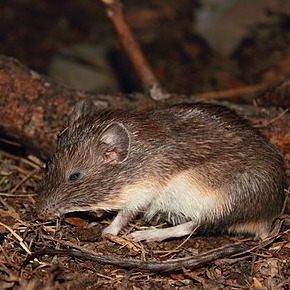
Heteromys desmarestianus
Desmarest's Spiny Pocket Mouse
Gray, 1868
Added by
Anonymous Curator
Reviewed by
Under Review
Last modified by
Julia Trouin
TaxonomyBiological classification ranks placing this species within the tree of life, from Kingdom down to Genus.
Ecology & StatusHow this species lives: habitat preferences, diet, behavior, population status, and role in its ecosystem.
OriginWhether the species is native (evolved here), endemic (found only here), or introduced by human activity.
Native
Population TrendDirection of change in population size over time: increasing, stable, decreasing, or unknown.
Stable
Breeding SeasonTime of year when this species typically reproduces or flowers.
Year Round
Trophic RolePosition in the food chain: producer, herbivore, carnivore, omnivore, decomposer, or parasite.
Herbivore
Recent SightingsWhether this species has been observed in the wild in Costa Rica within recent years.
Yes
Habitat SummaryOverview of the specific ecosystems and environments where this species is found in Costa Rica. Multi-lang
It is a dominant forest floor inhabitant in tropical ecosystems. It prefers primary wet forests, cloud forests, and mature secondary forests with an abundant canopy and dense understory. It rarely ventures into open areas or pastures. It requires soils with abundant wet leaf litter and fallen logs where it can build its underground burrow networks. In Costa Rica, it is ubiquitous in forest reserves from sea level up to 2,400 meters in altitude (such as La Selva Biological Station and Monteverde).BehaviourDaily activity patterns, movement, territory use, foraging style, and seasonal behavioral changes. Multi-lang
It is a strictly nocturnal, terrestrial, and solitary animal. It spends its nights patrolling the forest floor through established corridors under leaf litter and logs, moving at a fast pace or via small nervous hops. It dedicates most of its time to searching, transporting, and burying seeds, palm nuts (like Welfia or Socratea), and fallen fruits. It aggressively defends its seed caches from other rodents. During the day, it sleeps in burrows with multiple entrances that it digs in the soft earth.Social ActivitySocial structure: whether the species is solitary, paired, or colonial; hierarchy and communication. Multi-lang
Strictly solitary and highly territorial. Adults actively avoid each other and can engage in noisy fights if they find themselves competing for the same seed patch.Feeding GuildWhat the species eats, how it forages or hunts, and its role as a consumer in the food web. Multi-lang
Granivore / Frugivore (Occasionally insectivore).Trophic Chain DetailsSpecific interactions in local food webs: prey species, predators, competitors, and scavengers. Multi-lang
Primary consumer (Granivore/Frugivore) and important seed disperser. Due to its immense abundance in healthy jungles, it is the fundamental base prey for almost all terrestrial forest floor predators: venomous snakes (fer-de-lance, palm pitvipers), owls, small felines (margay, ocelot), and mesopredators like opossums, coatis, and weasels.Reproductive BehaviourMating strategies, courtship displays, nesting or spawning behavior, and parental care. Multi-lang
It can breed year-round, although reproductive peaks usually synchronize with seasons of highest fruit and seed production in the forest (generally at the beginning of the rainy season or end of the dry season). After a short gestation of about 28 days, the female gives birth to a small litter (2 to 5 pups) in a deep, dry nest within her burrow. They are born spineless, blind, and deaf, but develop rapidly to leave the nest within a few weeks.Physical Measures
Length (cm)
12.0 - 16.0 cm
Weight (Grams)
50 g - 85 g
Lifespan
Sexual MaturityAge at which the individual becomes capable of reproducing for the first time.
3 - 6 Months
Gestation / IncubationDuration from fertilization to birth (mammals) or to hatching (egg-laying species).
27 - 28