Costa Rica Species
Nymphaea ampla
PlantaeHighest rank in taxonomy. Groups all life into domains: Animalia, Plantae, Fungi, etc.IUCN LCInternational Union for Conservation of Nature — the world authority on species extinction risk, using standardized criteria. — Least Concern — widespread and abundant; not at immediate risk of extinction.In ProgressCurrent stage of this record in the editorial review workflow. Recent Sighting

Nymphaea ampla

White Water Lily / Dotora

(Salisb.) DC., 1821

Detailed Texts Multi-lang
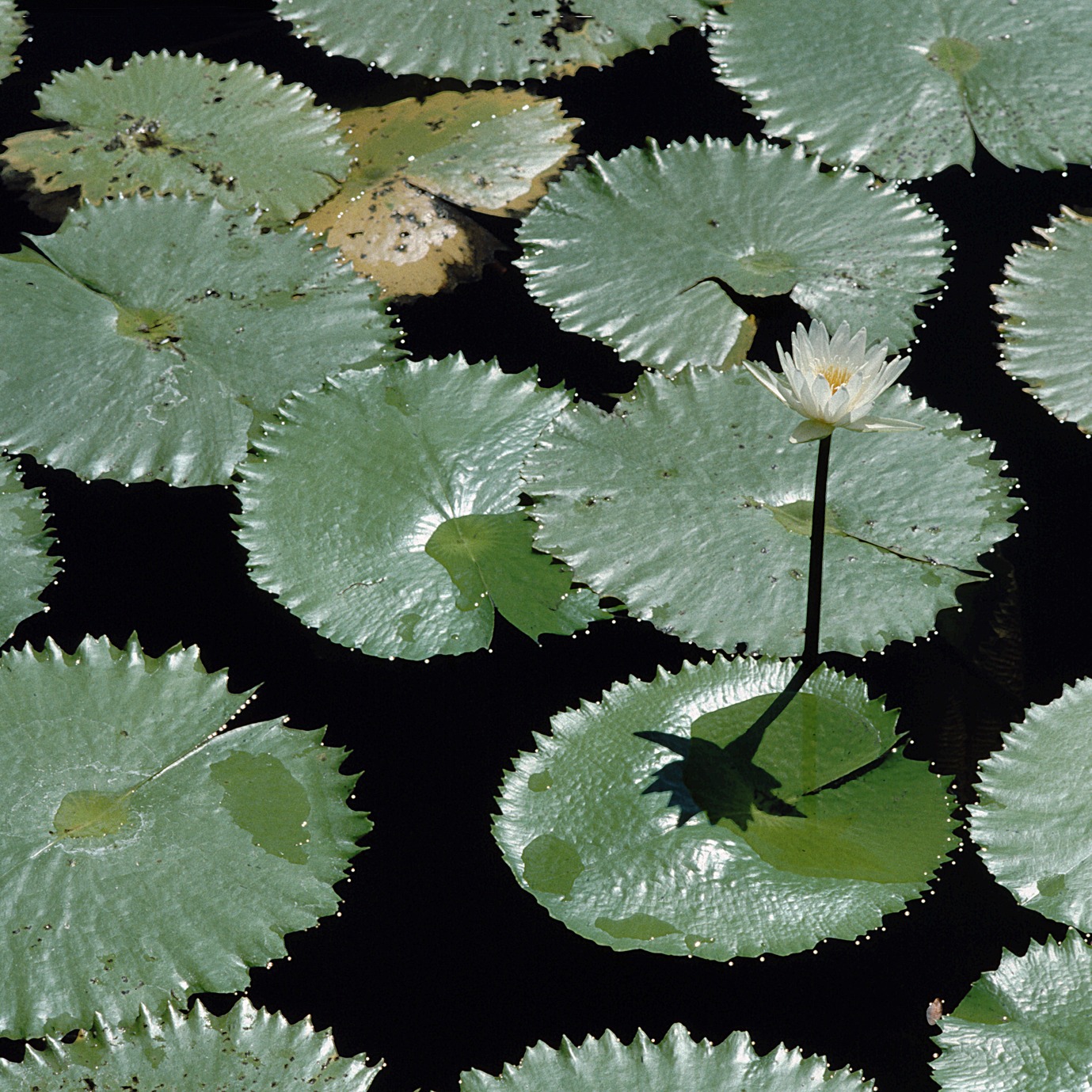
Nymphaea ampla is a rooted, perennial aquatic plant, famous for its mystical beauty and central role in the cosmogony of Mesoamerican civilizations. It possesses robust rhizomes submerged in the mud of freshwater bodies. Its leaves are large, orbicular, and floating, bright green on the upper side and often reddish or purple on the underside, with markedly serrated margins and a deep basal incision. The flower is spectacular: it emerges above the water surface held by a long peduncle, with immaculate white petals surrounding a center of intense yellow stamens. The flowers open during the day and exhale a sweet, heady fragrance that attracts beetles and bees. The fruit ripens underwater, releasing seeds that are dispersed by currents. It is an architectural species that transforms the surface of lagoons and swamps into vibrant ecosystems.

Added by

Anonymous Curator

Reviewed by

Under Review

Last modified by

Julia Trouin

TaxonomyBiological classification ranks placing this species within the tree of life, from Kingdom down to Genus.

PhylumRank below Kingdom. Groups organisms sharing a fundamental body plan (e.g., Chordata = vertebrates and some invertebrates).Tracheophyta
ClassRank below Phylum. Subdivides by structural traits (e.g., Mammalia, Aves, Reptilia, Insecta).Magnoliopsida
OrderRank below Class. Groups related families sharing common ancestry (e.g., Carnivora, Primates).Nymphaeales
FamilyRank below Order. Groups closely related genera (e.g., Felidae = cats, Canidae = dogs).Nymphaeaceae
GenusRank just above Species. The first word in the two-part binomial scientific name.Nymphaea
Taxonomic AuthorityThe scientist who first formally described and published this species, followed by the year of publication.(Salisb.) DC., 1821
Record Completeness
93%
Coming soon

Ecology & StatusHow this species lives: habitat preferences, diet, behavior, population status, and role in its ecosystem.

OriginWhether the species is native (evolved here), endemic (found only here), or introduced by human activity.

Native

Population TrendDirection of change in population size over time: increasing, stable, decreasing, or unknown.

Stable

Trophic RolePosition in the food chain: producer, herbivore, carnivore, omnivore, decomposer, or parasite.

--

Growth HabitPhysical form and structure of the plant: tree, shrub, herb, vine, epiphyte, aquatic, etc.

--

Leaf TypeLeaf characteristics: deciduous (seasonal shed), evergreen, simple, compound, needle-like, etc.

--

Flowering SeasonTime of year when this species typically reproduces or flowers.

Year Round

Recent SightingsWhether this species has been observed in the wild in Costa Rica within recent years.

Yes

Habitat SummaryOverview of the specific ecosystems and environments where this species is found in Costa Rica. Multi-lang

It inhabits slow-moving or stagnant freshwater bodies such as lagoons, swamps, canals, and river backwaters. It prefers shallow waters (up to 2 meters deep) with muddy bottoms rich in organic matter and full sun exposure. In Costa Rica, it is an iconic species of lowland wetlands, being especially abundant in Palo Verde National Park, Caño Negro, and coastal lagoons on both slopes.

Light & Water NeedsSunlight intensity and moisture levels this plant needs to grow and reproduce successfully. Multi-lang

Information not available in English. Help us expand this record!

BehaviourDaily activity patterns, movement, territory use, foraging style, and seasonal behavioral changes. Multi-lang

It is a structural species that acts as the foundation of aquatic micro-ecosystems. Its floating leaves provide shade that regulates water temperature and offers refuge for fish, amphibians, and invertebrates. Its flowers are pollinated by beetles from the Scarabaeidae family, which often spend the night inside the closed flower. The plant exhibits nyctinastic behavior, opening its flowers at dawn and closing them at dusk.

Toxicity / UsesToxic compounds present and their documented effects on humans or other organisms. Multi-lang

Information not available in English. Help us expand this record!

Physical Measures

Length (cm)

100.0 - 300.0 cm

Reproductive StructuresFlowers, fruits, and seeds — the reproductive organs and their seasonal appearance.

Flower Photos (Max 2)

No image

Fruit Photos (Max 2)

No image

Evolutionary AdaptationsInherited traits and behaviors that improve the species' survival and reproduction in its specific environment. Multi-lang

Aerenchyma and Buoyancy: Its petioles and peduncles have a specialized tissue called aerenchyma, filled with air channels. This adaptation not only allows leaves and flowers to float effortlessly but also facilitates oxygen transport from the surface to the rhizomes submerged in anoxic mud.
Hydrophobic Cuticular Layer: The upper surface of the leaves is covered by a dense waxy layer that repels water (lotus effect). This prevents the stomata, located only on the top side, from being blocked by water, allowing uninterrupted photosynthesis.

Main ThreatsDocumented pressures reducing the population: habitat loss, hunting, disease, climate change, and invasive species. Multi-lang

Agrochemical pollution: Inhabiting wetlands surrounded by agriculture, it is vulnerable to eutrophication and herbicides draining into water bodies, altering its reproductive cycle.

Interesting FactsSurprising or notable facts that highlight what makes this species unique or ecologically important. Multi-lang

The Sacred Flower of the Mayas: The ancient Mayas considered it a symbol of creation and rebirth. It was frequently depicted in art, and its flowers are believed to contain alkaloid compounds with psychoactive properties used in shamanic rituals.