
Costa Rica Species
Laternea pusilla
FungiHighest rank in taxonomy. Groups all life into domains: Animalia, Plantae, Fungi, etc.IUCN NEInternational Union for Conservation of Nature — the world authority on species extinction risk, using standardized criteria. — Not Evaluated — not yet assessed against the IUCN Red List criteria.In ProgressCurrent stage of this record in the editorial review workflow. Recent Sighting

Laternea pusilla

Red Star Stinkhorn

Berk. & M.A.Curtis, 1860

Detailed Texts Multi-lang
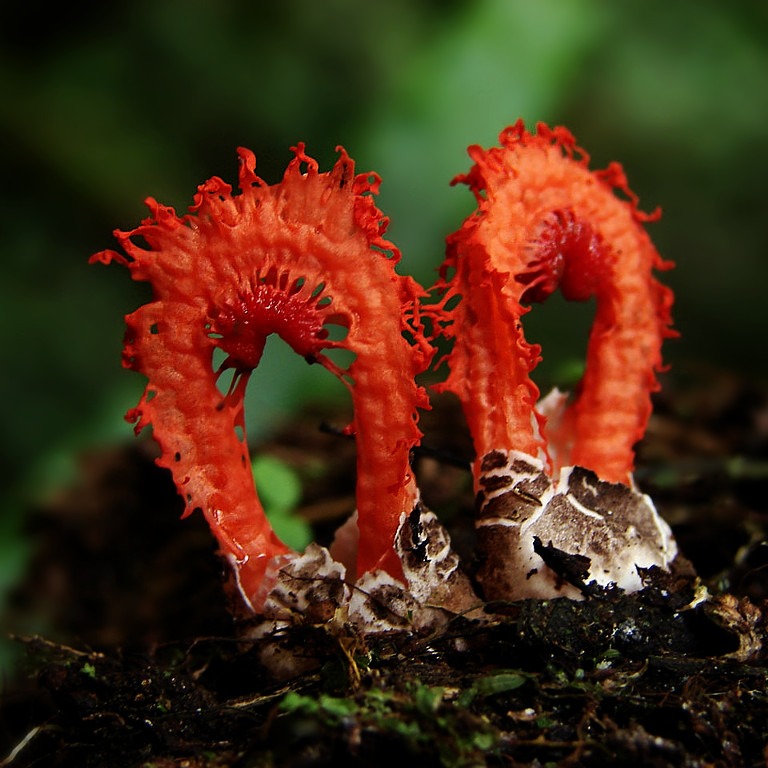
Laternea pusilla is a small, uniquely beautiful saprophytic fungus that emerges from the forest floor like a tiny radiated sculpture. It develops from a buried, whitish gelatinous 'egg'. Upon maturity, the fruiting body expands into a structure of 2 to 4 vertical arms of bright red or deep pink, which fuse at the apex forming an arch or open lantern. The defining feature of the genus is a specialized receptacle (glebifer) suspended just below the junction of the arms, where the slimy, olive-green, foul-smelling gleba accumulates. This odor of decaying organic matter is an evolutionary strategy to attract dispersing insects. It is a small but visually striking species, whose ephemeral structure disappears within hours after fulfilling its reproductive function.

Added by

Anonymous Curator

Reviewed by

Under Review

Last modified by

Julia Trouin

TaxonomyBiological classification ranks placing this species within the tree of life, from Kingdom down to Genus.

PhylumRank below Kingdom. Groups organisms sharing a fundamental body plan (e.g., Chordata = vertebrates and some invertebrates).Basidiomycota
ClassRank below Phylum. Subdivides by structural traits (e.g., Mammalia, Aves, Reptilia, Insecta).Agaricomycetes
OrderRank below Class. Groups related families sharing common ancestry (e.g., Carnivora, Primates).Phallales
FamilyRank below Order. Groups closely related genera (e.g., Felidae = cats, Canidae = dogs).Phallaceae
GenusRank just above Species. The first word in the two-part binomial scientific name.Laternea
Taxonomic AuthorityThe scientist who first formally described and published this species, followed by the year of publication.Berk. & M.A.Curtis, 1860
Record Completeness
93%
Coming soon

Ecology & StatusHow this species lives: habitat preferences, diet, behavior, population status, and role in its ecosystem.

OriginWhether the species is native (evolved here), endemic (found only here), or introduced by human activity.

Native

Population TrendDirection of change in population size over time: increasing, stable, decreasing, or unknown.

Stable

Trophic RolePosition in the food chain: producer, herbivore, carnivore, omnivore, decomposer, or parasite.

--

EdibilityWhether this mushroom is edible, toxic, hallucinogenic, or of unknown safety. Never eat based solely on this data.

--

Cap ShapeShape of the mushroom cap (pileus): convex, flat, umbonate, funnel-shaped, bell-shaped, etc.

--

Hymenium TypeThe spore-bearing surface of a fungus: gills, pores, teeth, ridges, smooth, or wrinkled.

--

Fruiting SeasonTime of year when this species typically reproduces or flowers.

Wet Season

Recent SightingsWhether this species has been observed in the wild in Costa Rica within recent years.

Yes

Habitat SummaryOverview of the specific ecosystems and environments where this species is found in Costa Rica. Multi-lang

It inhabits the floor of very wet tropical forests, cloud forests, and areas with abundant leaf litter and decaying wood accumulation. It prefers shaded microclimates with very high relative humidity. In Costa Rica, it is a native species found mainly in the lowlands and middle elevations of the Caribbean Slope and the South Pacific, appearing suddenly on the forest floor after periods of intense rain.

SubstrateThe organic material or host organism this fungus colonizes and decomposes. Multi-lang

Information not available in English. Help us expand this record!

BehaviourDaily activity patterns, movement, territory use, foraging style, and seasonal behavioral changes. Multi-lang

It acts as a primary leaf litter decomposer, recycling essential nutrients. Its reproductive strategy is purely entomophilous: it depends on flies that, attracted by the scent, walk on the suspended gleba, collect spores on their legs, and transport them to other moist forest patches. Its appearance is extremely ephemeral, lasting less than 24 hours in its expanded form.

Physical Measures

Length (cm)

3.0 - 6.0 cm

Hymenium StructuresMacro photographs of the spore-bearing surfaces used for mushroom identification.

No hymenium surface images available.

Evolutionary AdaptationsInherited traits and behaviors that improve the species' survival and reproduction in its specific environment. Multi-lang

Suspended Glebifer Receptacle: Unlike other stinkhorns where the gleba covers the arms, Laternea has an internal structure that holds the spore mass in the center of the 'lantern'. This adaptation protects the gleba from direct rain under the arch of the arms, keeping the attractive scent longer.
High Volatility Chemical Mimicry: It synthesizes volatile organic compounds that precisely mimic the chemical profile of carrion. Being a small fungus in a dense understory environment, this potent chemical signal is essential to compete with other odors and ensure the arrival of dipterans.

Main ThreatsDocumented pressures reducing the population: habitat loss, hunting, disease, climate change, and invasive species. Multi-lang

Microhabitat degradation: Leaf litter removal and soil desiccation due to canopy opening eliminate the conditions necessary for the mycelium to fruit. It is highly sensitive to changes in soil moisture.

Interesting FactsSurprising or notable facts that highlight what makes this species unique or ecologically important. Multi-lang

Lanterns in the Dark: Although they are not bioluminescent, the intense red color of Laternea pusilla stands out so much in the forest dimness that they look like small lit lanterns on the dark mulch.