
FungiIUCN NEIn Progress Recent Sighting
Laternea pusilla
Red Star Stinkhorn
Berk. & M.A.Curtis, 1860
Detailed Texts Multi-lang
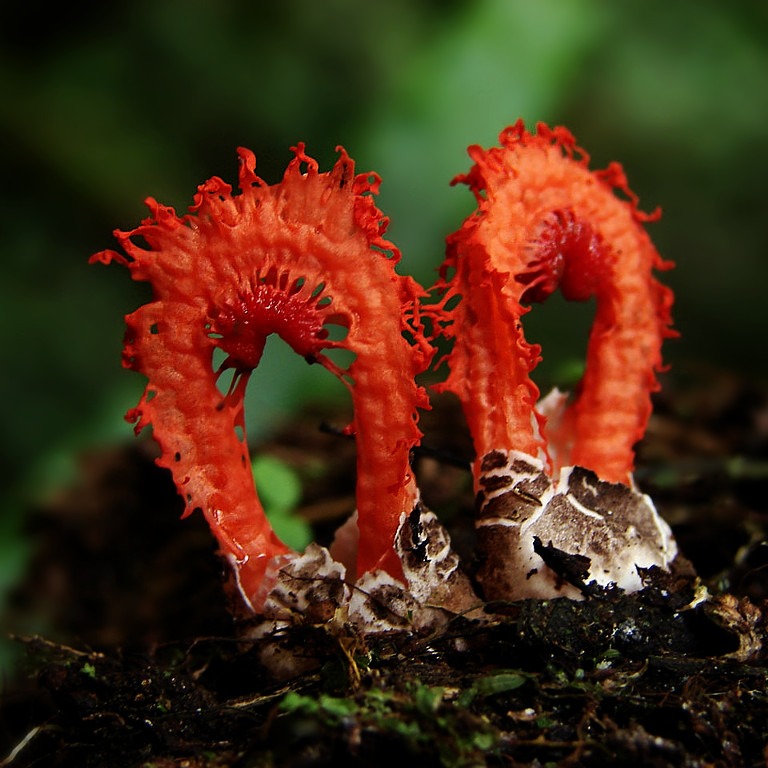
Laternea pusilla is a small, uniquely beautiful saprophytic fungus that emerges from the forest floor like a tiny radiated sculpture. It develops from a buried, whitish gelatinous 'egg'. Upon maturity, the fruiting body expands into a structure of 2 to 4 vertical arms of bright red or deep pink, which fuse at the apex forming an arch or open lantern. The defining feature of the genus is a specialized receptacle (glebifer) suspended just below the junction of the arms, where the slimy, olive-green, foul-smelling gleba accumulates. This odor of decaying organic matter is an evolutionary strategy to attract dispersing insects. It is a small but visually striking species, whose ephemeral structure disappears within hours after fulfilling its reproductive function.
Added by
Anonymous Curator
Reviewed by
Under Review
Last modified by
Julia Trouin
Taxonomy
PhylumBasidiomycota
ClassAgaricomycetes
OrderPhallales
FamilyPhallaceae
GenusLaternea
Taxonomic AuthorityBerk. & M.A.Curtis, 1860
Ecology & Status
Origin
Native
Population Trend
Stable
Edibility
--
Cap Shape
--
Hymenium Type
--
Fruiting Season
Wet Season
Recent Sightings
Yes
Habitat Summary Multi-lang
It inhabits the floor of very wet tropical forests, cloud forests, and areas with abundant leaf litter and decaying wood accumulation. It prefers shaded microclimates with very high relative humidity. In Costa Rica, it is a native species found mainly in the lowlands and middle elevations of the Caribbean Slope and the South Pacific, appearing suddenly on the forest floor after periods of intense rain.Substrate Multi-lang
Information not available in English. Help us expand this record!Behaviour Multi-lang
It acts as a primary leaf litter decomposer, recycling essential nutrients. Its reproductive strategy is purely entomophilous: it depends on flies that, attracted by the scent, walk on the suspended gleba, collect spores on their legs, and transport them to other moist forest patches. Its appearance is extremely ephemeral, lasting less than 24 hours in its expanded form.Physical Measures
Length (cm)
3.0 - 6.0 cm
Hymenium Structures
No hymenium surface images available.
Evolutionary Adaptations Multi-lang
Suspended Glebifer Receptacle: Unlike other stinkhorns where the gleba covers the arms, Laternea has an internal structure that holds the spore mass in the center of the 'lantern'. This adaptation protects the gleba from direct rain under the arch of the arms, keeping the attractive scent longer.
High Volatility Chemical Mimicry: It synthesizes volatile organic compounds that precisely mimic the chemical profile of carrion. Being a small fungus in a dense understory environment, this potent chemical signal is essential to compete with other odors and ensure the arrival of dipterans.
Main Threats Multi-lang
Microhabitat degradation: Leaf litter removal and soil desiccation due to canopy opening eliminate the conditions necessary for the mycelium to fruit. It is highly sensitive to changes in soil moisture.
Interesting Facts Multi-lang
Lanterns in the Dark: Although they are not bioluminescent, the intense red color of Laternea pusilla stands out so much in the forest dimness that they look like small lit lanterns on the dark mulch.