
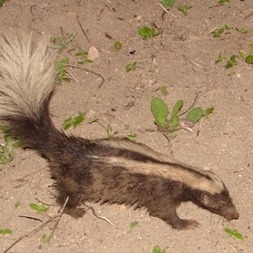
Conepatus semistriatus
Striped Hog-nosed Skunk
(Boddaert, 1785)
Added by
Anonymous Curator
Reviewed by
Under Review
Last modified by
Julia Trouin
TaxonomyBiological classification ranks placing this species within the tree of life, from Kingdom down to Genus.
Ecology & StatusHow this species lives: habitat preferences, diet, behavior, population status, and role in its ecosystem.
OriginWhether the species is native (evolved here), endemic (found only here), or introduced by human activity.
Native
Population TrendDirection of change in population size over time: increasing, stable, decreasing, or unknown.
Stable
Breeding SeasonTime of year when this species typically reproduces or flowers.
Dry Season
Trophic RolePosition in the food chain: producer, herbivore, carnivore, omnivore, decomposer, or parasite.
Insectivore
Recent SightingsWhether this species has been observed in the wild in Costa Rica within recent years.
Yes
Habitat SummaryOverview of the specific ecosystems and environments where this species is found in Costa Rica. Multi-lang
Unlike many forest mammals, the striped hog-nosed skunk avoids the dark, dense interior of primary rainforests. It prefers more open spaces: dry deciduous forests, savannas, scrublands, forest edges, and heavily human-altered areas such as cattle pastures and agricultural zones. In Costa Rica, it is very common in the Guanacaste province, the Central Valley, and the plains, where the soil allows for easy digging in search of insects.BehaviourDaily activity patterns, movement, territory use, foraging style, and seasonal behavioral changes. Multi-lang
It is a nocturnal forager, with a slow, waddling gait. It explores the terrain keeping its snout close to the ground, sniffing intensely in search of hidden food. It spends much of the night plowing and digging in the leaf litter and soft soil, leaving characteristic small conical holes in the earth in its wake. If frightened, its first warning is to stamp its front feet sharply on the ground. If the threat persists, it arches its back, puffs up its fur, raises its tail to expose the anal area, and finally sprays.Social ActivitySocial structure: whether the species is solitary, paired, or colonial; hierarchy and communication. Multi-lang
It is a strictly solitary animal. Adults generally avoid each other, and females only interact with males during the brief estrus period, later assuming solitary rearing of the kits.Feeding GuildWhat the species eats, how it forages or hunts, and its role as a consumer in the food web. Multi-lang
Insectivore / Omnivore.Trophic Chain DetailsSpecific interactions in local food webs: prey species, predators, competitors, and scavengers. Multi-lang
Omnivore / Insectivore (Mesopredator). Plays a crucial role as a natural biological controller of soil insect pests (May beetles, moth larvae, centipedes). It has very few natural predators; occasionally pumas or large birds of prey (like the Great Horned Owl, which lacks a developed sense of smell) manage to hunt it.Reproductive BehaviourMating strategies, courtship displays, nesting or spawning behavior, and parental care. Multi-lang
After mating, gestation lasts approximately 60 days (some sources suggest delayed implantation in colder areas, but less common in the tropics). The female prepares an underground burrow, often an abandoned armadillo hole that she expands herself, where she gives birth to 2 to 5 kits. They are born blind and hairless, but surprisingly, their skin already shows the black and white coloration pattern.Physical Measures
Length (cm)
33.0 - 50.0 cm
Weight (Grams)
1.40 kg - 3.50 kg
Lifespan
Sexual MaturityAge at which the individual becomes capable of reproducing for the first time.
10 - 12 Months
Gestation / IncubationDuration from fertilization to birth (mammals) or to hatching (egg-laying species).
58 - 62