
AnimaliaIUCN LCIn Progress Recent Sighting
Conepatus semistriatus
Striped Hog-nosed Skunk
(Boddaert, 1785)
Detailed Texts Multi-lang
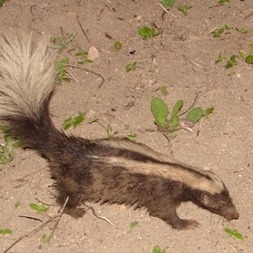
The striped hog-nosed skunk (Conepatus semistriatus) is a medium-sized mephitid with a robust, stocky body. Its most distinctive anatomical feature is its snout: bare, fleshy, and highly flexible, similar to a pig's, perfectly designed for rooting in the soil. Its fur is coarse and predominantly black or very dark brown, highlighted by two striking white stripes that start at the nape, run down the sides of the back, and fade towards the rump. Its tail is thick and bushy, often mixed with white hairs or with a completely white tip. It has highly muscular forelimbs with unusually long, strong claws specialized for digging like shovels. Naturally, it is world-renowned for its hyper-developed anal glands, capable of spraying a foul, sulfurous liquid as an extreme defense.
Added by
Anonymous Curator
Reviewed by
Under Review
Last modified by
Julia Trouin
Taxonomy
PhylumChordata
ClassMammalia
OrderCarnivora
FamilyMephitidae
GenusConepatus
Taxonomic Authority(Boddaert, 1785)
Ecology & Status
Origin
Native
Population Trend
Stable
Breeding Season
Dry Season
Trophic Role
Insectivore
Recent Sightings
Yes
Habitat Summary Multi-lang
Unlike many forest mammals, the striped hog-nosed skunk avoids the dark, dense interior of primary rainforests. It prefers more open spaces: dry deciduous forests, savannas, scrublands, forest edges, and heavily human-altered areas such as cattle pastures and agricultural zones. In Costa Rica, it is very common in the Guanacaste province, the Central Valley, and the plains, where the soil allows for easy digging in search of insects.Behaviour Multi-lang
It is a nocturnal forager, with a slow, waddling gait. It explores the terrain keeping its snout close to the ground, sniffing intensely in search of hidden food. It spends much of the night plowing and digging in the leaf litter and soft soil, leaving characteristic small conical holes in the earth in its wake. If frightened, its first warning is to stamp its front feet sharply on the ground. If the threat persists, it arches its back, puffs up its fur, raises its tail to expose the anal area, and finally sprays.Social Activity Multi-lang
It is a strictly solitary animal. Adults generally avoid each other, and females only interact with males during the brief estrus period, later assuming solitary rearing of the kits.Feeding Guild Multi-lang
Insectivore / Omnivore.Trophic Chain Details Multi-lang
Omnivore / Insectivore (Mesopredator). Plays a crucial role as a natural biological controller of soil insect pests (May beetles, moth larvae, centipedes). It has very few natural predators; occasionally pumas or large birds of prey (like the Great Horned Owl, which lacks a developed sense of smell) manage to hunt it.Reproductive Behaviour Multi-lang
After mating, gestation lasts approximately 60 days (some sources suggest delayed implantation in colder areas, but less common in the tropics). The female prepares an underground burrow, often an abandoned armadillo hole that she expands herself, where she gives birth to 2 to 5 kits. They are born blind and hairless, but surprisingly, their skin already shows the black and white coloration pattern.Physical Measures
Length (cm)
33.0 - 50.0 cm
Weight (Grams)
1.40 kg - 3.50 kg
Offspring per cycle2 - 5
Sexual DimorphismYes
Lifespan
Sexual Maturity
10 - 12 Months
Gestation / Incubation
58 - 62
Lifespan Estimated
Males3 - 6 Years
Females3 - 6 Years
Sexual Dimorphism
Males Multi-lang
Males tend to be between 10% and 15% larger and heavier than females.
Females Multi-lang
Slightly smaller than males, they raise the kits autonomously.
Evolutionary Adaptations Multi-lang
Excavator Morphology (Rooting): Its English name (hog-nosed) derives from its long, cartilaginous snout. Combined with a very muscular neck and enormous front claws (which can measure over 2.5 cm), this creature functions like a small biological tractor, plowing the earth and flipping heavy stones to unearth grubs.
Chemical Warfare (Thiol Spray): Its anal glands produce a highly volatile and sulfurous mixture of thiols (mercaptans). It can fire a fine, directed stream at a predator's eyes from over 3 meters away. The compound causes temporary blindness, mild asphyxiation, severe nausea, and an odor that permeates the victim for weeks.
Main Threats Multi-lang
Roadkill: This is likely the greatest threat to this species. Its gait is a slow waddle, and its primary defense strategy is to stop, raise its tail, and threaten to spray—a useless tactic against a moving vehicle.
Domestic Dogs and Persecution: It is often attacked by dogs in rural areas or killed by people due to the fear that it will kill poultry (which is rare) or simply out of disgust for its smell.
Interesting Facts Multi-lang
Venom Immunity: Like opossums, hog-nosed skunks have a very high natural tolerance to the venom of local snakes (such as rattlesnakes or fer-de-lances), allowing them to occasionally hunt and eat venomous reptiles.
Visual Warning (Aposematism): Its distinctive bright black and white color pattern is not designed for camouflage, but as a universal visual warning. In nature, the extreme contrast warns nocturnal predators: 'I am dangerous, stay away'.